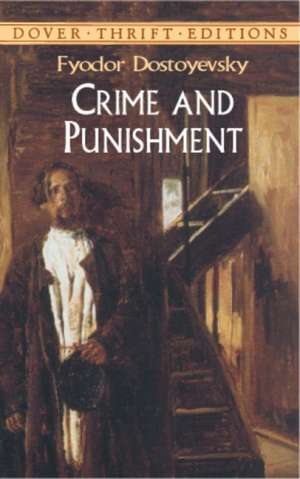
Crime and Punishment: Dover Thrift Editions
Autor Fyodor Dostoyevskyen Limba Engleză Paperback – 28 mar 2003
Simțim, încă de la primele pagini, o atmosferă de febrilitate claustrofobică, o tensiune care nu provine din exterior, ci din ungherele cele mai întunecate ale conștiinței umane. În Crime and Punishment, Fyodor Dostoevsky nu ne oferă doar un roman polițist, ci o radiografie a prăbușirii etice. Considerăm că forța acestei lucrări rezidă în tranziția de la raționamentul rece, calculat — prin care Rodion Raskolnikov își justifică crima — la delirul și obsesia care îl cuprind imediat după actul sângeros. Atmosfera te trimite cu gândul la Approaches to Teaching Dostoevsky's Crime and Punishment, deși aici accentul cade pe experiența brută, nemediată a „realismului fantastic”, unde granița dintre realitatea străzilor din Sankt Petersburg și halucinațiile protagonistului devine poroasă. Subliniem modul în care Fyodor Mikhailovich Dostoevsky explorează teme precum nihilismul și mântuirea, elemente pe care le vom regăsi, într-o formă mai amplă și metafizică, în The Brothers Karamazov. Dacă în The Gambler autorul analiza patima jocurilor de noroc prin prisma propriei experiențe, aici el disecă „pariul” periculos al unui individ cu propria moralitate. Stilul este dens, cu un ritm impus de febra protagonistului, oferind o perspectivă unică asupra modului în care o idee radicală poate devora un suflet în contextul unei societăți ruse aflate în plină turbulență spirituală.
Din seria Dover Thrift Editions
-
 Preț: 59.98 lei
 - 42%
 Preț: 34.60 lei
 - 20%
 Preț: 22.90 lei
 - 55%
 Preț: 20.90 lei
 -
 Preț: 122.73 lei
 -
 Preț: 26.93 lei
 - 39%
 Preț: 43.26 lei
 -
 Preț: 31.89 lei
 - 61%
 Preț: 18.06 lei
 - 42%
 Preț: 34.77 lei
 - 19%
 Preț: 28.75 lei
 - 20%
 Preț: 47.93 lei
 -
 Preț: 32.07 lei
 - 50%
 Preț: 17.46 lei
 -
 Preț: 47.74 lei
 -
 Preț: 24.96 lei
 -
 Preț: 82.98 lei
 - 57%
 Preț: 30.06 lei
 - 52%
 Preț: 20.24 lei
 - 18%
 Preț: 50.99 lei
 - 19%
 Preț: 36.96 lei
 - 20%
 Preț: 96.26 lei
 -
 Preț: 53.48 lei
 -
 Preț: 50.02 lei
 - 20%
 Preț: 22.68 lei
 -
 Preț: 36.25 lei
 - 20%
 Preț: 22.62 lei
 - 19%
 Preț: 23.37 lei
 -
 Preț: 40.66 lei
 - 54%
 Preț: 41.37 lei
 - 19%
 Preț: 20.14 lei
 -
 Preț: 72.29 lei
 - 19%
 Preț: 57.71 lei
 -
 Preț: 42.38 lei
 - 20%
 Preț: 22.36 lei
 - 16%
 Preț: 56.24 lei
 - 38%
 Preț: 66.97 lei
 -
 Preț: 39.90 lei
 - 46%
 Preț: 28.28 lei
 -
 Preț: 42.12 lei
 - 19%
 Preț: 34.37 lei
 - 25%
 Preț: 55.48 lei
 - 65%
 Preț: 18.38 lei
 - 19%
 Preț: 47.73 lei
 - 19%
 Preț: 71.42 lei
 -
 Preț: 71.58 lei
 - 19%
 Preț: 34.45 lei
 -
 Preț: 65.43 lei
 - 19%
 Preț: 68.89 lei
Preț: 56.06 lei
Carte disponibilă
Livrare economică 09-23 noiembrie
Livrare express 23-29 octombrie pentru 24.89 lei
Specificații
ISBN-10: 0486415872
Pagini: 448
Dimensiuni: 132 x 207 x 27 mm
Greutate: 0.32 kg
Editura: Dover Publications Inc.
Colecția Dover Thrift Editions
Seria Dover Thrift Editions
V-ar putea interesa
-
 In Search of Lost Time, Vol 3Marcel Proust-15%Preț: 69.74 lei82.32 lei
 -
 Doctor ZhivagoBoris Pasternak-35%Preț: 61.97 lei94.94 lei
 -
 The Count of Monte CristoAlexandre Dumas-17%Preț: 54.99 lei66.10 lei
 -
 The IdiotFyodor Dostoyevsky-21%Preț: 66.21 lei83.42 lei
 -
 Rashomon and Seventeen Other StoriesRyunosuke Akutagawa-25%Preț: 59.42 lei79.39 lei
 -
 -36%Preț: 60.14 lei93.85 lei
 -
 Naked LunchWilliam S. BurroughsPreț: 79.27 lei
 -
 The Diary of a Young GirlAnne Frank-23%Preț: 51.98 lei67.55 lei
 -
 The Life of a Stupid ManRyunosuke Akutagawa-39%Preț: 16.99 lei28.05 lei
 -
 Moby-DickHerman Melville-28%Preț: 64.52 lei89.36 lei
 -
 Love That Moves the Sun and Other StarsDante Alighieri-39%Preț: 17.49 lei28.48 lei
 -
 A Nervous BreakdownAnton Chekhov-37%Preț: 18.43 lei29.04 lei
 -
 The Body PoliticJean-Jacques Rousseau-37%Preț: 18.02 lei28.65 lei
 -
 Never Let Me GoKazuo IshiguroPreț: 72.69 lei
 -
 The StrangerAlbert CamusPreț: 94.97 lei
 -
 The Sailor Who Fell from Grace with the SeaYukio Mishima-19%Preț: 80.33 lei99.76 lei
 -
 Preț: 79.03 lei
 -
 The Setting SunOsamu DazaiPreț: 82.98 lei
 -
 Five Nights at Freddy's The Fourth Closet 3Scott CawthonPreț: 61.55 lei
 -
 -25%Preț: 59.65 lei79.85 lei
 -
 Daisy Jones & The SixTaylor Jenkins Reid-17%Preț: 60.56 lei73.16 lei
 -
 Karamazov BrothersFyodor DostoevskyPreț: 42.81 lei
 -
 Preț: 63.54 lei
 -
 Normal PeopleSally RooneyPreț: 99.27 lei
De ce să citești această carte
Recomandăm această ediție oricărui cititor care dorește să înțeleagă bazele psihologiei moderne în literatură. Crime and Punishment nu este doar o poveste despre o crimă, ci un studiu fascinant despre vinovăție și posibilitatea reabilitării. Veți câștiga o perspectivă profundă asupra dilemelor morale care rămân relevante și astăzi, totul sub semnătura unuia dintre cei mai mari gânditori ai literaturii universale.
Despre autor
Fyodor Mikhailovich Dostoevsky (1821–1881) a fost un romancier, eseist și filosof rus, recunoscut la nivel mondial drept unul dintre cei mai fini psihologi din istoria literaturii. Opera sa explorează condiția umană în contextul social și politic tensionat al Rusiei secolului al XIX-lea. Cu un palmares impresionant de 11 romane și numeroase nuvele, Dostoevsky a reușit să surprindă dualitatea sufletului uman, oscilând între credință și ateism, între rațiune și pasiune autodistructivă. Experiențele sale personale, de la condamnarea la moarte comutată în ultimul moment la lupta cu dependența, au infuzat scrierile sale cu o autenticitate și o profunzime rar egalate.
Textul de pe ultima copertă
One of the supreme masterpieces of world literature, "Crime and Punishment "catapulted Dostoyevsky to the forefront of Russian writers and into the ranks of the world's greatest novelists. Drawing upon experiences from his own prison days, the author recounts in feverish, compelling tones the story of Raskolnikov, an impoverished student tormented by his own nihilism, and the struggle between good and evil. Believing that he is above the law, and convinced that humanitarian ends justify vile means, he brutally murders an old woman a pawnbroker whom he regards as "stupid, ailing, greedy good for nothing." Overwhelmed afterwards by feelings of guilt and terror, Raskolnikov confesses to the crime and goes to prison. There he realizes that happiness and redemption can only be achieved through suffering. Infused with forceful religious, social, and philosophical elements, the novel was an immediate success. This extraordinary, unforgettable work is reprinted here in the authoritative Constance Garnett translation.
A selection of the Common Core State Standards Initiative."
Extras
On an exceptionally hot evening early in July a young man came out of the garret in which he lodged in S. Place and walked slowly, as though in hesitation, towards K. Bridge.
He had successfully avoided meeting his landlady on the staircase. His garret was under the roof of a high, five-storied house, and was more like a cupboard than a room. The landlady, who provided him with garret, dinners, and attendance, lived on the floor below, and every time he went out he was obliged to pass her kitchen, the door of which invariably stood open. And each time he passed, the young man had a sick, frightened feeling, which made him scowl and feel ashamed. He was hopelessly in debt to his landlady, and was afraid of meeting her.
This was not because he was cowardly and abject, quite the contrary; but for some time past, he had been in an over-strained, irritable condition, verging on hypochondria. He had become so completely absorbed in himself, and isolated from his fellows that he dreaded meeting, not only his landlady, but any one at all. He was crushed by poverty, but the anxieties of his position had of late ceased to weigh upon him. He had given up attending to matters of practical importance; he had lost all desire to do so. Nothing that any landlady could do had a real terror for him. But to be stopped on the stairs, to be forced to listen to her trivial, irrelevant gossip, to pestering demands for payment, threats and complaints, and to rack his brains for excuses, to prevaricate, to lie--no, rather than that, he would creep down the stairs like a cat and slip out unseen.
This evening, however, on coming out into the street, he became acutely aware of his fears.
"I want to attempt a thing like that and am frightened by these trifles," he thought, with an odd smile. "Hm . . . yes, all is in a man's hands and he lets it all slip from cowardice, that's an axiom. It would be interesting to know what it is men are most afraid of. Taking a new step, uttering a new word is what they fear most. . . . But I am talking too much. It's because I chatter that I do nothing. Or perhaps it is that I chatter because I do nothing. I've learned to chatter this last month, lying for days together in my den thinking . . . of Jack the Giant-killer. Why am I going there now? Am I capable of that? Is that serious? It is not serious at all. It's simply a fantasy to amuse myself; a plaything! Yes, maybe it is a plaything."
The heat in the street was terrible: and the airlessness, the bustle and the plaster, scaffolding, bricks, and dust all about him, and that special Petersburg stench, so familiar to all who are unable to get out of town in summer--all worked painfully upon the young man's already overwrought nerves. The insufferable stench from the pot-houses, which are particularly numerous in that part of the town, and the drunken men whom he met continually, although it was a working day, completed the revolting misery of the picture. An expression of the profoundest disgust gleamed for a moment in the young man's refined face. He was, by the way, exceptionally handsome, above the average in height, slim, well-built, with beautiful dark eyes and dark brown hair. Soon he sank into deep thought, or more accurately speaking into a complete blankness of mind; he walked along not observing what was about him and not caring to observe it. From time to time, he would mutter something, from the habit of talking to himself, to which he had just confessed. At these moments he would become conscious that his ideas were sometimes in a tangle and that he was very weak; for two days he had scarcely tasted food.
He was so badly dressed that even a man accustomed to shabbiness would have been ashamed to be seen in the street in such rags. In that quarter of the town, however, scarcely any short-coming in dress would have created surprise. Owing to the proximity of the Hay Market, the number of establishments of bad character, the preponderance of the trading and working class population crowded in these streets and alleys in the heart of Petersburg, types so various were to be seen in the streets that no figure, however queer, would have caused surprise. But there was such accumulated bitterness and contempt in the young man's heart that, in spite of all the fastidiousness of youth, he minded his rags least of all in the street. It was a different matter when he met with acquaintances or with former fellow students, whom, indeed, he disliked meeting at any time. And yet when a drunken man who, for some unknown reason, was being taken somewhere in a huge waggon dragged by a heavy dray horse, suddenly shouted at him as he drove past: "Hey there, German hatter!" bawling at the top of his voice and pointing at him--the young man stopped suddenly and clutched tremulously at his hat. It was a tall round hat from Zimmerman's, but completely worn out, rusty with age, all torn and bespattered, brimless and bent on one side in a most unseemly fashion. Not shame, however, but quite another feeling akin to terror had overtaken him.
"I knew it," he muttered in confusion, "I thought so! That's the worst of all! Why, a stupid thing like this, the most trivial detail might spoil the whole plan. Yes, my hat is too noticeable. . . . It looks absurd and that makes it noticeable. . . . With my rags I ought to wear a cap, any sort of old pancake, but not this grotesque thing. Nobody wears such a hat, it would be noticed a mile off, it would be remembered. . . . What matters is that people would remember it, and that would give them a clue. For this business one should be as little conspicuous as possible. . . . Trifles, trifles are what matter! Why, it's just such trifles that always ruin everything. . . ."
He had not far to go; he knew indeed how many steps it was from the gate of his lodging house: exactly seven hundred and thirty. He had counted them once when he had been lost in dreams. At the time he had put no faith in those dreams and was only tantalising himself by their hideous but daring recklessness. Now, a month later, he had begun to look upon them differently, and, in spite of the monologues in which he jeered at his own impotence and indecision, he had involuntarily come to regard this "hideous" dream as an exploit to be attempted, although he still did not realise this himself. He was positively going now for a "rehearsal" of his project, and at every step his excitement grew more and more violent.
With a sinking heart and a nervous tremor, he went up to a huge house which on one side looked on to the canal, and on the other into the street. This house was let out in tiny tenements and was inhabited by working people of all kinds--tailors, locksmiths, cooks, Germans of sorts, girls picking up a living as best they could, petty clerks, etc. There was a continual coming and going through the two gates and in the two court-yards of the house. Three or four door-keepers were employed on the building. The young man was very glad to meet none of them, and at once slipped unnoticed through the door on the right, and up the staircase. It was a back staircase, dark and narrow, but he was familiar with it already, and knew his way, and he liked all these surroundings: in such darkness even the most inquisitive eyes were not to be dreaded.
"If I am so scared now, what would it be if it somehow came to pass that I were really going to do it?" he could not help asking himself as he reached the fourth storey. There his progress was barred by some porters who were engaged in moving furniture out of a flat. He knew that the flat had been occupied by a German clerk in the civil service, and his family. This German was moving out then, and so the fourth floor on this staircase would be untenanted except by the old woman. "That's a good thing anyway," he thought to himself, as he rang the bell of the old woman's flat. The bell gave a faint tinkle as though it were made of tin and not of copper. The little flats in such houses always have bells that ring like that. He had forgotten the note of that bell, and now its peculiar tinkle seemed to remind him of something and to bring it clearly before him. . . . He started, his nerves were terribly overstrained by now. In a little while, the door was opened a tiny crack: the old woman eyed her visitor with evident distrust through the crack, and nothing could be seen but her little eyes, glittering in the darkness. But, seeing a number of people on the landing, she grew bolder, and opened the door wide. The young man stepped into the dark entry, which was partitioned off from the tiny kitchen. The old woman stood facing him in silence and looking inquiringly at him. She was a diminutive, withered-up old woman of sixty, with sharp malignant eyes and a sharp little nose. Her colourless, somewhat grizzled hair was thickly smeared with oil, and she wore no kerchief over it. Round her thin long neck, which looked like a hen's leg, was knotted some sort of flannel rag, and, in spite of the heat, there hung flapping on her shoulders, a mangy fur cape, yellow with age. The old woman coughed and groaned at every instant. The young man must have looked at her with a rather peculiar expression, for a gleam of mistrust came into her eyes again.
"Raskolnikov, a student, I came here a month ago," the young man made haste to mutter, with a half-bow, remembering that he ought to be more polite.
"I remember, my good sir, I remember quite well your coming here," the old woman said distinctly, still keeping her inquiring eyes on his face.
"And here . . . I am again on the same errand," Raskolnikov continued, a little disconcerted and surprised at the old woman's mistrust. "Perhaps she is always like that though, only I did not notice it the other time," he thought with an uneasy feeling.
The old woman paused, as though hesitating; then stepped on one side, and pointing to the door of the room, she said, letting her visitor pass in front of her:
"Step in, my good sir."
The little room into which the young man walked, with yellow paper on the walls, geraniums and muslin curtains in the windows, was brightly lighted up at that moment by the setting sun.
"So the sun will shine like this then too!" flashed as it were by chance through Raskolnikov's mind, and with a rapid glance he scanned everything in the room, trying as far as possible to notice and remember its arrangement. But there was nothing special in the room. The furniture, all very old and of yellow wood, consisted of a sofa with a huge bent wooden back, an oval table in front of the sofa, a dressing-table with a looking-glass fixed on it between the windows, chairs along the walls and two or three halfpenny prints in yellow frames, representing German damsels with birds in their hands--that was all. In the corner a light was burning before a small ikon. Everything was very clean; the floor and the furniture were brightly polished; everything shone.
"Lizaveta's work," thought the young man. There was not a speck of dust to be seen in the whole flat.
"It's in the houses of spiteful old widows that one finds such cleanliness," Raskolnikov thought again, and he stole a curious glance at the cotton curtain over the door leading into another tiny room, in which stood the old woman's bed and chest of drawers and into which he had never looked before. These two rooms made up the whole flat.
"What do you want?" the old woman said severely, coming into the room and, as before, standing in front of him so as to look him straight in the face.
"I've brought something to pawn here," and he drew out of his pocket an old-fashioned flat silver watch, on the back of which was engraved a globe; the chain was of steel.
"But the time is up for your last pledge. The month was up the day before yesterday."
"I will bring you the interest for another month; wait a little."
"But that's for me to do as I please, my good sir, to wait or to sell your pledge at once."
"How much will you give me for the watch, Alyona Ivanovna?"
"You come with such trifles, my good sir, it's scarcely worth anything. I gave you two roubles last time for your ring and one could buy it quite new at a jeweller's for a rouble and a half."
"Give me four roubles for it, I shall redeem it, it was my father's. I shall be getting some money soon."
"A rouble and a half, and interest in advance, if you like!"
"A rouble and a half!" cried the young man.
"Please yourself"--and the old woman handed him back the watch. The young man took it, and was so angry that he was on the point of going away; but checked himself at once, remembering that there was nowhere else he could go, and that he had had another object also in coming.
"Hand it over," he said roughly.
The old woman fumbled in her pocket for her keys, and disappeared behind the curtain into the other room. The young man, left standing alone in the middle of the room, listened inquisitively, thinking. He could hear her unlocking the chest of drawers.
"It must be the top drawer," he reflected. "So she carries the keys in a pocket on the right. All in one bunch on a steel ring. . . . And there's one key there, three times as big as all the others, with deep notches; that can't be the key of the chest of drawers . . . then there must be some other chest or strong-box . . . that's worth knowing. Strong-boxes always have keys like that . . . but how degrading it all is."
The old woman came back.
"Here, sir: as we say ten copecks the rouble a month, so I must take fifteen copecks from a rouble and a half for the month in advance. But for the two roubles I lent you before, you owe me now twenty copecks on the same reckoning in advance. That makes thirty-five copecks altogether. So I must give you a rouble and fifteen copecks for the watch. Here it is."
Recenzii
“This fresh, new translation…provides a more exact, idiomatic, and contemporary rendition of the novel that brings Fyodor Dostoevsky’s tale achingly alive…It succeeds beautifully.” –San Francisco Chronicle
“Reaches as close to Dostoevsky’s Russian as is possible in English…The original’s force and frightening immediacy is captured…The Pevear and Volokhonsky translation will become the standard English version.”–Chicago Tribune
Notă biografică
His prison experiences coupled with his conversion to a profoundly religious philosophy formed the basis for his great novels. But it was his fortuitous marriage to Anna Snitkina, following a period of utter destitution brought about by his compulsive gambling, that gave Dostoevsky the emotional stability to complete Crime and Punishment (1866), The Idiot (1868-69), The Possessed (1871-72), and The Brothers Karamazov (1879-80). When Dostoevsky died in 1881, he left a legacy of masterworks that influenced the great thinkers and writers of the Western world and immortalized him as a giant among writers of world literature.