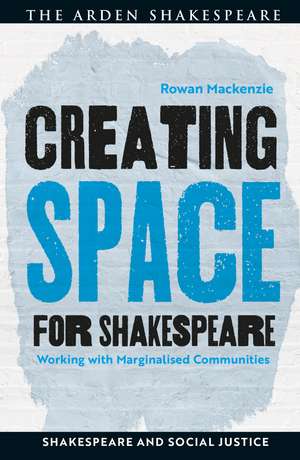
Creating Space for Shakespeare: Working with Marginalized Communities: Shakespeare and Social Justice
Autor Rowan Mackenzie Dr David Ruiter, Matthieu Chapmanen Limba Engleză Hardback – 9 mar 2023
It draws on a diverse range of projects from across the globe, many of which the author has facilitated or been directly involved with, including those with incarcerated people, people with mental health issues, learning disabilities and who have experienced homelessness. As this book evidences, Shakespeare can be used to alter the spatial constraints of people who feel imprisoned, whether literally or metaphorically, enabling them to speak and to be heard in ways which may previously have been elusive or unattainable.
The book examines the use of trauma-informed principles to explore the ways in which consistency, longevity, trust and collaboration enable the development of resilience, positive autonomy and communication skills. It explores this phenomenon of creating space for people to find their own way of expressing themselves in a way that mainstream society can understand, whilst also challenging society to 'see better' and to hear better. This is not a process of social homogenisation but of encouraging positive interactions and removing the stigma of marginalization.

Preț: 550.13 lei
Preț vechi: 830.38 lei
-34%
Puncte Express: 825
Carte tipărită la comandă
Livrare economică 07-21 decembrie
Livrare prin curier în România Termenul estimat este afișat lângă disponibilitate.
Transport gratuit pentru acest produs Plată online sau ramburs, în funcție de opțiunile comenzii.
Retur gratuit în 14 zile Comandă securizată și suport în română.
Specificații
ISBN-13: 9781350272651
ISBN-10: 1350272655
Pagini: 280
Ilustrații: 25 bw illus
Dimensiuni: 138 x 216 x 22 mm
Greutate: 0.46 kg
Editura: Bloomsbury Publishing
Colecția The Arden Shakespeare
Seria Shakespeare and Social Justice
Locul publicării:London, United Kingdom
ISBN-10: 1350272655
Pagini: 280
Ilustrații: 25 bw illus
Dimensiuni: 138 x 216 x 22 mm
Greutate: 0.46 kg
Editura: Bloomsbury Publishing
Colecția The Arden Shakespeare
Seria Shakespeare and Social Justice
Locul publicării:London, United Kingdom
V-ar putea interesa
-
 -29%Preț: 534.58 lei755.60 lei
 -
 Preț: 386.30 leiRecomandat
 -
 Preț: 351.89 lei
 -
 Preț: 321.78 lei
 -
 -13%Preț: 164.28 lei189.16 lei
 -
 Applied Theatre Voice: Performance and Social JusticeDr Sarah Weston-33%Preț: 549.46 lei816.02 lei
 -
 -33%Preț: 528.37 lei791.70 lei
 -
 Prison Theatre and the Global Crisis of IncarcerationProf Ashley E. Lucas-20%Preț: 182.58 lei227.28 lei
 -
 -21%Preț: 247.73 lei312.90 lei
 -
 Preț: 248.31 lei
 -
 Socially Engaged Creative PracticeJess Moriarty-23%Preț: 949.23 lei1232.77 lei
 -
 The PerformerRichard SennettPreț: 92.52 lei
 -
 The Creative Dementia Practice Handbook: Arts for Health and WellbeingMaria Pasiecznik Parsons-23%Preț: 142.16 lei184.33 lei
 -
 -28%Preț: 237.22 lei328.29 lei
 -
 -19%Preț: 603.42 lei744.97 lei
 -
 -18%Preț: 309.95 lei380.00 lei
 -
 Residencies ReflectedIrmeli Kokko-16%Preț: 139.38 lei166.07 lei
Cuprins
List of Illustrations
Introduction
Social justice and Social Injustices
Creative Spaces
Performance Spaces
Reflective Spaces
Mediated Spaces
Chapter 1 - The Need to Break Down Silos
Learning Disabilities
Mental Health Issues
Criminal Justice System
Homelessness
Chapter 2 - Creative Spaces
Short-term Projects
Medium-term Projects
Long-term Projects
Conclusions
Chapter 3 - Performative Spaces
Demarcated Spaces
Appropriated Spaces
Conclusions
Chapter 4 - Reflective Spaces
Individual Reflections
Reflections on Group Dynamics
Conclusions
Chapter 5 - Mediated Spaces
Journalism
Documentaries
Low Budget Media
Written Media
Conclusions
Conclusion
References
Index
Introduction
Social justice and Social Injustices
Creative Spaces
Performance Spaces
Reflective Spaces
Mediated Spaces
Chapter 1 - The Need to Break Down Silos
Learning Disabilities
Mental Health Issues
Criminal Justice System
Homelessness
Chapter 2 - Creative Spaces
Short-term Projects
Medium-term Projects
Long-term Projects
Conclusions
Chapter 3 - Performative Spaces
Demarcated Spaces
Appropriated Spaces
Conclusions
Chapter 4 - Reflective Spaces
Individual Reflections
Reflections on Group Dynamics
Conclusions
Chapter 5 - Mediated Spaces
Journalism
Documentaries
Low Budget Media
Written Media
Conclusions
Conclusion
References
Index
Recenzii
Creating Space for Shakespeare offers a vivid, clear-sighted, praxis-oriented account of what has been termed 'applied Shakespeare' - projects which harness the Shakespeare canon and its cultural capital to a range of benign social purposes. While some Shakespearean scholars limit themselves to trying to speak with the dead, Mackenzie shows how the plays can enable us to speak with hitherto excluded categories of the living.
What place can Shakespeare have for the most vulnerable sections of our society? If your answer is that he stands only for an imposed high culture, Rowan Mackenzie's remarkable and deeply moving account of the part his plays can occupy in a wide range of kinds of marginalized communities will make you think again. This compassionate survey of her own work and that of many others redefines what Shakespeare means in 21st century Britain.
Rowan Mackenzie has written a remarkable book, made even more so by her thorough academic research combined with an accessible approach. We are taken on a creative journey through several prison institutions, each unique in their own way, as are the inhabitants, individuals who embark on their own creative journey. Too often attitudes prevail that such populations do not deserve Shakespeare, let alone drama. However the drama holds the very key to change, and Shakespeare a very specific form of drama to facilitate this change. The hard hitting challenges and the profound insights are all the result of applied Shakespeare. Rowan writes with understanding and compassion and her love of her work is constantly demonstrated. We are there in the workshop or performance, witnessing these remarkable events! This book should be read by dramatherapists and all arts and creative arts therapists, educators and clinicians who work in associated forensic fields. Ideally it should be recommended as a model for both practice and research, in prevention as well as rehabilitation. It is a gem of a book!
What place can Shakespeare have for the most vulnerable sections of our society? If your answer is that he stands only for an imposed high culture, Rowan Mackenzie's remarkable and deeply moving account of the part his plays can occupy in a wide range of kinds of marginalized communities will make you think again. This compassionate survey of her own work and that of many others redefines what Shakespeare means in 21st century Britain.
Rowan Mackenzie has written a remarkable book, made even more so by her thorough academic research combined with an accessible approach. We are taken on a creative journey through several prison institutions, each unique in their own way, as are the inhabitants, individuals who embark on their own creative journey. Too often attitudes prevail that such populations do not deserve Shakespeare, let alone drama. However the drama holds the very key to change, and Shakespeare a very specific form of drama to facilitate this change. The hard hitting challenges and the profound insights are all the result of applied Shakespeare. Rowan writes with understanding and compassion and her love of her work is constantly demonstrated. We are there in the workshop or performance, witnessing these remarkable events! This book should be read by dramatherapists and all arts and creative arts therapists, educators and clinicians who work in associated forensic fields. Ideally it should be recommended as a model for both practice and research, in prevention as well as rehabilitation. It is a gem of a book!