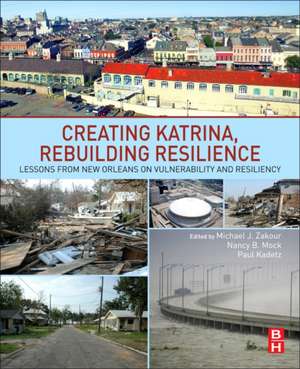
Creating Katrina, Rebuilding Resilience: Lessons from New Orleans on Vulnerability and Resiliency
Editat de Michael J. Zakour, Nancy Mock, Paul Kadetzen Limba Engleză Paperback – 15 noi 2017
Notăm cu interes apariția volumului Creating Katrina, Rebuilding Resilience, o lucrare care se poziționează ferm în centrul curriculei de management al dezastrelor și planificare urbană. În cadrul programelor de studii superioare, această carte servește drept studiu de caz fundamental pentru înțelegerea modului în care vulnerabilitățile structurale preexistente dictează capacitatea de redresare a unei comunități. Spre deosebire de analizele care se concentrează strict pe răspunsul de urgență, editorii Michael J. Zakour, Nancy Mock și Paul Kadetz direcționează atenția către procesul de reconstrucție pe termen lung, oferind o perspectivă rară și necesară asupra etapelor post-dezastru.
Structura volumului este organizată riguros în trei părți: cadrul teoretic, analiza vulnerabilității și mecanismele de reziliență. Apreciem în mod deosebit introducerea teoriei „Vulnerability-plus”, care unifică conceptele de reziliență și vulnerabilitate într-un sistem coerent. Această abordare continuă munca anterioară a lui Michael J. Zakour din Community Disaster Vulnerability, unde autorul explora impactul dezastrelor asupra populațiilor marginalizate, însă volumul de față extinde analiza prin integrarea unor discipline diverse, de la antropologie la științe politice.
Considerăm această lucrare o alternativă robustă la Fostering Community Resilience pentru cursurile de securitate națională și politici publice, cu avantajul unei perspective locale autentice. Dacă titluri precum Katrina's Imprint analizează impactul cultural și politic general, Creating Katrina, Rebuilding Resilience oferă un instrumentar tehnic și sociologic mult mai aplicat, beneficiind de expertiza unor autori care au trăit nemijlocit experiența reconstrucției în New Orleans. Este o resursă academică ce reușește să echilibreze rigoarea cercetării cu datele empirice colectate de la fața locului.
Preț: 398.57 lei
Preț vechi: 530.91 lei
-25%
Carte tipărită la comandă
Livrare economică 01-15 iunie
Specificații
ISBN-10: 0128095571
Pagini: 420
Dimensiuni: 191 x 235 x 28 mm
Greutate: 0.89 kg
Editura: ELSEVIER SCIENCE
V-ar putea interesa
-
 WreckersSimon ParkPreț: 183.14 lei
 -
 Compounding Disasters in Gulf Coast Communities 2020-2021Impacts Committee on Compounding Disasters in Gulf Coast CommunitiesPreț: 239.05 lei
 -
 SanctuaryEmily Rapp BlackPreț: 146.30 lei
 -
 Disasters – A Sociological ApproachK TierneyPreț: 184.23 lei
 -
 Resilience: Why Things Bounce BackAndrew Zolli-8%Preț: 70.73 lei76.85 lei
 -
 Disaster Response and RecoveryDavid A. McEntire-19%Preț: 553.88 lei683.80 lei
 -
 -28%Preț: 99.18 lei137.04 lei
 -
 Rebuilding New OrleansSarah FoutsPreț: 142.31 lei
 -
 The "Katrina Effect": On the Nature of CatastropheWilliam M. Taylor-17%Preț: 191.48 lei229.47 lei
 -
 Disaster NationalismVivian Y. ChoiPreț: 233.37 lei
 -
 Preț: 185.48 lei
 -
 DisastersKathleen TierneyPreț: 163.11 lei
 -
 Preț: 259.53 lei
 -
 LifehouseAdam GreenfieldPreț: 87.86 lei
 -
 Invisible ReconstructionLucia Patrizio GunningPreț: 236.42 lei
 -
 Creating a StormIsabelle SeddonPreț: 167.41 lei
 -
 Public Catastrophes, Private LossesSarah TobiasPreț: 180.67 lei
 -
 -20%Preț: 55.42 lei68.98 leiRecomandat
 -
 After the Storm: The Cultural Politics of Hurricane KatrinaSimon Dickel PhD-24%Preț: 250.29 lei327.52 lei
 -
 Preț: 284.58 lei
Public țintă
researchers, graduate students, disaster services professionals, and emergency management professionalsDe ce să citești această carte
Recomandăm această carte cercetătorilor și profesioniștilor din managementul situațiilor de urgență care caută o analiză profundă, dincolo de intervenția imediată. Cititorul câștigă o înțelegere clară a modului în care inegalitățile sociale și erorile de inginerie se transformă în catastrofe. Este o resursă esențială pentru a învăța din lecțiile orașului New Orleans, oferind modele teoretice testate pentru construirea unor comunități mai rezistente în fața viitoarelor dezastre naturale.
Descriere scurtă
The disaster knowledge of diverse disciplines and professions is brought together in this book, with authors from social work, public health, community organizing, sociology, political science, public administration, psychology, anthropology, geography and the study of religion. The editors offer both expert and an insider perspectives on Katrina because they have lived in New Orleans and experienced Katrina and the recovery. An improved understanding of the recovery and reconstruction phases of disaster is also presented, and these disaster stages have been the least examined in the disaster and emergency management literature.
- Integrates multiple disciplines to study the long-term recovery of the worst non-terrorist disaster in U.S. history
- Provides a local perspective, with at least one co-contributor for each chapter living in New Orleans
- Examines vulnerability and resilience theory and application
Cuprins
1. Editors’ introduction: The voices of the barefoot Scholars
2. Settlement shifts in the wake of catastrophe
3. Vulnerability-plus theory: The integration of community disaster vulnerability and resiliency theories
4. A systems approach to vulnerability and resilience in post-Katrina New Orleans
5. “Built-in structural violence and vulnerability: A common threat to resilient disaster recovery
PART II. DISASTER VULNERABILITY
6. Setting the Stage for the Katrina Catastrophe: Environmental Degradation, Engineering Miscalculation, Ignoring Science, and Human Mismanagement
7. Three centuries in the making: Hurricane Katrina from an historical perspective
8. The resilience in the shadows of catastrophe: Addressing the existence and implications of vulnerability in New Orleans and Southeastern Louisiana
9. Problematizing vulnerability: Unpacking gender, intersectionality, and the normative disaster paradigm
PART III. DISASTER RESILIENCE
10. Culture and resilience: How music has fostered resilience in post-Katrina New Orleans
11. Resilience among vulnerable populations: The neglected role of culture
12. Faith-based organizations in Katrina: The United Methodist Church
13. Collective efficacy, social capital and resilience: An inquiry into the relationship between social infrastructure and resilience after Hurricane Katrina
14. Dynamics of early recovery in two historically low-income New Orleans’ neighborhoods: Treme´ and Central City
PART IV. CONCLUSION AND LESSONS LEARNED
15. The Katrina catastrophe and science: Does experiencing a catastrophe at “ground zero have impacts on the professional performance/identity of social scientist survivors?
16. How barefoot scholars were deployed: The good, the bad, the ugly
17. Lessons learned from New Orleans on vulnerability, resilience, and their integration