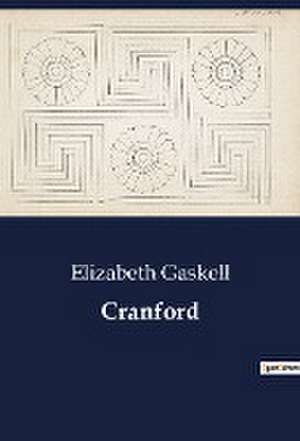
Cranford
Autor Elizabeth Gaskellen Limba Engleză Paperback – 27 iun 2023
(Available at Amazon's CreateSpace) Classic Books for Your Inspiration and Entertainment Visit Us at: goo.gl/0oisZU
Preț: 310.68 lei
Carte disponibilă
Livrare economică 30 octombrie-05 noiembrie
Livrare express 20-24 octombrie pentru 35.38 lei
Specificații
Pagini: 670
Dimensiuni: 148 x 210 x 36 mm
Greutate: 0.85 kg
Ediția:2. Tirage
Editura: Culturea
V-ar putea interesa
-
 The Thief of AlwaysClive BarkerPreț: 98.37 lei
 -
 The Cranford ChroniclesElizabeth Gaskell-17%Preț: 60.47 lei72.67 lei
 -
 Wives and DaughtersElizabeth Gaskell-16%Preț: 62.00 lei73.58 lei
 -
 Miss MarjoribanksMargaret Oliphant-29%Preț: 66.88 lei93.80 lei
 -
 Sense and SensibilityJane Austen-25%Preț: 104.81 lei139.37 lei
 -
 Jane Eyre: Clothbound Classics Series. Special EditionCharlotte Bronte-27%Preț: 108.46 lei148.52 lei
 -
 -25%Preț: 103.53 lei138.61 lei
 -
 The Adventures of Robin HoodRichard Lancelyn Green-19%Preț: 88.49 lei108.58 lei
 -
 The Jungle BooksRudyard Kipling-17%Preț: 103.93 lei124.95 lei
 -
 Old Possum's Book of Practical CatsT S EliotPreț: 82.58 lei
 -
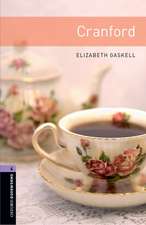 Oxford Bookworms Library: Level 4: CranfordElizabeth GaskellPreț: 86.08 lei
 -
 Jane EyreCharlotte Brontë-14%Preț: 51.69 lei60.45 lei
 -
 The Adventures of Tom SawyerMark TwainPreț: 42.74 lei
 -
 Peter Pan in Kensington Gardens / Peter and WendyJ. M. Barrie-17%Preț: 42.34 lei51.16 lei
 -
 The Secret GardenFrances Hodgson Burnett-18%Preț: 48.05 lei58.29 lei
 -
 White is for WitchingHelen Oyeyemi-34%Preț: 51.77 lei78.73 lei
 -
 -25%Preț: 43.77 lei58.32 lei
 -
 Fashion in the Time of Jane AustenSarah Jane Downing-38%Preț: 47.03 lei76.40 lei
 -
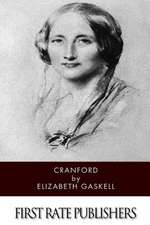 CranfordElizabeth Cleghorn GaskellPreț: 43.05 lei
 -
 Les MiserablesVictor HugoPreț: 199.42 lei
Notă biografică
Elizabeth Gaskell (1810 - 65) was born in London, but grew up in the north of England in the village of Knutsford. In 1832 she married the Rev. William Gaskell and had four daughters, and one son who died in infancy. Her first novel, Mary Barton, was published in 1848 and won the attention of Charles Dickens and most of her later work was publish in his journals. She was also a lifelong friend of Charlotte Bronte, whose biography she wrote, as well as her many novels and short stories.
Patricia Ingham is Senior Research Fellow and Reader at St Anne's College, Oxford. She has written on the Victorian novel and on Hardy in particular. she is the General Editor of all Hardy's fiction in the Penguin Classics and has edited Gaskell's North and South for the series.
Descriere
'A man ... is so in the way in the house!'A vivid and affectionate portrait of a provincial town in early Victorian England, Elizabeth Gaskell's Cranford describes a community dominated by its independent and refined women. Undaunted by poverty, but dismayed by changes brought by the railway and by new commercial practices, the ladies of Cranford respond to disruption with both suspicion and courage. Miss Matty and her sister Deborah uphold standards and survive personal tragedy and everyday dramas; innovation may bring loss, but it also brings growth, and welcome freedoms. Cranford suggests that representatives of different and apparently hostile social worlds, their minds opened by sympathy and suffering, can learn from each other. Its social comedy develops into a study of generous reconciliation, of a kind that will value the past as it actively shapes the future.This edition includes two related short pieces by Gaskell, 'The Last Generation in England' and 'The Cage at Cranford', as well as a selection from the diverse literary and social contexts in which the Cranford tales take their place. ABOUT THE SERIES: For over 100 years Oxford World's Classics has made available the widest range of literature from around the globe. Each affordable volume reflects Oxford's commitment to scholarship, providing the most accurate text plus a wealth of other valuable features, including expert introductions by leading authorities, helpful notes to clarify the text, up-to-date bibliographies for further study, and much more.
Recenzii
This Broadview Edition provides an assortment of historical materials to put the novel in context, including Gaskell’s letters from the period of the novel’s writing, excerpts from texts read by the characters, illustrations from the novel and from contemporary periodicals, and other Victorian writings on industrialization, etiquette, and domestic life.
“Elizabeth Langland’s edition of Cranford is likely to introduce a new generation of readers to the pleasures of Gaskell’s most delightful but least immediately appreciated novel. By including in her appendices of historical materials choice selections from conduct books and writings on political and domestic economy, as well as in her informed, accessible introduction, Langland demonstrates that, appearances aside, the world of Cranford is firmly located in its Victorian context and addresses, however obliquely, some of the most intractable problems of its age—and of ours.” — Eileen Gillooly, Columbia University
Cuprins
Introduction
Elizabeth Gaskell: A Brief Chronology
A Note on the Text
Cranford
Appendix A: Pre- and Post-Cranford Texts
- Elizabeth Gaskell, “The Last Generation in England” (1849)
- Elizabeth Gaskell, “The Cage at Cranford” (1863)
- Letters of Charles Dickens (1850–53)
- Letters of Mrs. Gaskell (1851–65)
- Letters of Charlotte Brontë (1852–53)
- From [Henry Forgehill Chorley], The Athenaeum (25 June 1853)
- The Examiner (23 July 1853)
- Harper’s New Monthly Magazine (September 1853)
- “A Few Words on Social Philosophy,” Blackwood’s Edinburgh Magazine (April 1858)
- “Mrs. Gaskell,” The Nation (7 December 1865)
- From Adam Smith, The Theory of Moral Sentiments (1759)
- From Maria Edgeworth, The Parent’s Assistant or Stories for Children (1796?)
- From Elizabeth Gaskell, Mary Barton (1848)
- From Charles Day, Hints on Etiquette and the Usages of Society with a Glance at Bad Habits (1836)
- From Anon., Etiquette for the Ladies (1837)
- From Sarah Stickney Ellis, The Women of England (1839)
- From Eliza Acton, Modern Cookery in All its Branches (1845)
- From Isabella Beeton, Beeton’s Book of Household Management (1861)
- From J.S. Mill, Principles of Political Economy (1848)
- From Charles Lamb, Essays of Elia (1823)
- From George Eliot, Scenes of Clerical Life (1857)