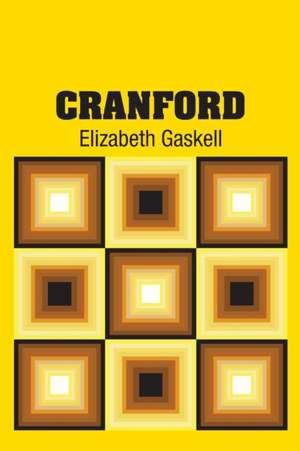
Cranford
Autor Elizabeth Cleghorn Gaskellen Limba Engleză Paperback – 30 oct 2018
Preț: 74.74 lei
Puncte Express: 112
Carte indisponibilă temporar
Doresc să fiu notificat când acest titlu va fi disponibil:
Se trimite...
Specificații
ISBN-13: 9781731701640
ISBN-10: 1731701640
Pagini: 230
Dimensiuni: 152 x 229 x 14 mm
Greutate: 0.38 kg
Editura: Simon & Brown
ISBN-10: 1731701640
Pagini: 230
Dimensiuni: 152 x 229 x 14 mm
Greutate: 0.38 kg
Editura: Simon & Brown
V-ar putea interesa
-
 The Forgotten SeamstressLiz TrenowPreț: 71.91 lei
 -
 I Heart ChristmasLindsey KelkPreț: 64.60 lei
 -
 What a Girl WantsLindsey KelkPreț: 92.52 lei
 -
 Northanger AbbeyVal McDermidPreț: 78.35 lei
 -
 CLASSICS NORTH AND SOUTHElizabeth GaskellPreț: 28.01 lei
 -
 Mary BartonElizabeth Gaskell-24%Preț: 55.41 lei73.08 lei
 -
 North and SouthElizabeth Gaskell-15%Preț: 50.63 lei59.70 lei
 -
 The Cranford ChroniclesElizabeth Gaskell-17%Preț: 60.47 lei72.67 lei
 -
 Wives and DaughtersElizabeth Gaskell-16%Preț: 62.00 lei73.58 lei
 -
 Oxford Bookworms Library: Level 4: CranfordElizabeth GaskellPreț: 86.08 lei
 -
 Elizabeth GaskellJenny UglowPreț: 125.26 lei
 -
 The Moorland CottageElizabeth Cleghorn GaskellPreț: 40.29 lei
 -
 Wives and DaughtersElizabeth Cleghorn GaskellPreț: 88.76 lei
 -
 Mary BartonElizabeth Cleghorn GaskellPreț: 58.31 lei
 -
 CranfordElizabeth GaskellPreț: 43.46 lei
 -
 CranfordElizabeth Gaskell-17%Preț: 137.09 lei164.84 lei
 -
 The Country of the Pointed FirsSarah Orne JewettPreț: 36.09 lei
 -
 Wives and DaughtersElizabeth GaskellPreț: 39.16 lei
 -
 Cranford & Selected Short StoriesElizabeth GaskellPreț: 28.01 lei
 -
 Mary BartonElizabeth GaskellPreț: 28.01 lei
 -
 Gaskell, E: CranfordElizabeth GaskellPreț: 50.43 lei
 -
 -12%Preț: 60.62 lei68.78 lei
 -
 North and SouthElizabeth Gaskell-5%Preț: 56.84 lei59.70 lei
 -
 North and SouthElizabeth GaskellPreț: 37.90 lei
 -
 MiddlemarchGeorge EliotPreț: 28.01 lei
Cuprins
1. Our society; 2. The captain; 3. A love affair of long ago; 4. A visit to an old bachelor; 5. Old letters; 6. Poor Peter; 7. Visiting; 8. 'Your Ladyship'; 9. Signor Brunoni; 10. The panic; 11. Samuel Brown; 12. Engaged to be married; 13. Stopped payment; 14. Friends in need; 15. A happy return; 16. 'Peace to Cranford'.
Descriere
Descriere de la o altă ediție sau format:
Published in novel form in 1853, Elizabeth Gaskell's best-known work is a warm caricature of life in a peculiar town.
Published in novel form in 1853, Elizabeth Gaskell's best-known work is a warm caricature of life in a peculiar town.
Notă biografică
Elizabeth Cleghorn Gaskell, also known as Mrs Gaskell, was an English author, biographer, and short story writer. Her stories provide a vivid image of many levels of Victorian society, including the very impoverished. Her debut work, Mary Barton, was published in 1848. The first biography of Charlotte Bronte was The Life of Charlotte Bronte by Elizabeth Gaskell, published in 1857. In her biography, she wrote solely about the moral and sophisticated portions of Bronte's life; the rest she left out, concluding that some, more lurid aspects were better kept buried. Gaskell's best-known novels include Cranford (1851-1853), North and South (1854-1855), and Wives and Daughters (1864-1866), all of which were adapted for television by the BBC. Gaskell was born Elizabeth Cleghorn Stevenson on September 29, 1810, in Lindsey Row, Chelsea, London (now 93 Cheyne Walk). Her father, William Stevenson, a Unitarian from Berwick-upon-Tweed, was preacher at Failsworth, Lancashire, but resigned on ethical reasons. He traveled to London in 1806 with the aim of heading to India after being appointed private secretary to the Earl of Lauderdale, who would later become Governor General of India.