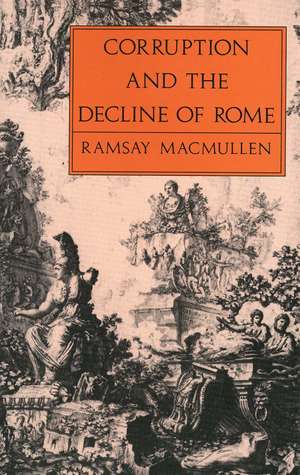
Corruption and the Decline of Rome
Autor Ramsay MacMullenen Limba Engleză Paperback – 25 iul 1990
“It is a seductive thesis, told with brio and all the guarantees of scholarship.”—The Economist
Prominent historian Ramsay MacMullen here offers a new perspective on the decline and fall of Rome. MacMullen argues that a key factor in Rome’s fall was the steady loss of focus and control over government as its aims were thwarted for private gain by high-ranking bureaucrats and military leaders. Written in an informal and lively style, his book—the culmination of years of research and thoughtful analysis—provides a fascinating, fresh line of investigation and shows convincingly that the decline of Rome was a gradual, insidious process rather than a climactic event.
Preț: 388.02 lei
Nou
Puncte Express: 582
Preț estimativ în valută:
68.65€ • 79.98$ • 59.95£
68.65€ • 79.98$ • 59.95£
Carte tipărită la comandă
Livrare economică 19 ianuarie-02 februarie 26
Preluare comenzi: 021 569.72.76
Specificații
ISBN-13: 9780300047998
ISBN-10: 0300047991
Pagini: 331
Ilustrații: 17 b-w illus.
Dimensiuni: 156 x 235 x 21 mm
Greutate: 0.51 kg
Ediția:Revised.
Editura: Yale University Press
Colecția Yale University Press
ISBN-10: 0300047991
Pagini: 331
Ilustrații: 17 b-w illus.
Dimensiuni: 156 x 235 x 21 mm
Greutate: 0.51 kg
Ediția:Revised.
Editura: Yale University Press
Colecția Yale University Press
V-ar putea interesa
-
 The Oxford History of ByzantiumCyril Mango-18%Preț: 139.29 lei169.63 lei
 -
 -23%Preț: 933.02 lei1217.90 lei
 -
 Roman Social Relations, 50 B.C. to A.D. 284Ramsay MacMullenPreț: 231.59 lei
 -
 Civilization Before Greece and RomeH. W. F. SaggsPreț: 338.54 lei
 -
 Carausius and Allectus: The British UsurpersP. J. CaseyPreț: 479.60 lei
 -
 -23%Preț: 415.72 lei539.89 lei
 -
 Christianity and Paganism in the Fourth to Eighth CenturiesRamsay MacMullenPreț: 287.69 lei
 -
 Romanization in the Time of AugustusRamsay MacMullenPreț: 255.99 lei
 -
 A Visitor's Guide to the Ancient OlympicsNeil FaulknerPreț: 142.76 lei
 -
 Preț: 273.83 lei
 -
 Travel and Geography in the Roman EmpireColin Adams-15%Preț: 411.58 lei484.20 lei
 -
 Preț: 358.12 lei
 -
 Urbanism and Settlement in the Roman Province of Moesia SuperiorDragana Mladenovic-8%Preț: 601.80 lei654.12 lei
 -
 The CeltsAlice Roberts-28%Preț: 64.01 lei88.92 lei
 -
 -15%Preț: 569.41 lei669.90 lei
Recenzii
“It is a seductive thesis, told with brio and all the guarantees of scholarship.”—The Economist
“Ramsay MacMullen is arguably the finest Roman historian America has produced. . . . His arguments demonstrate good sense, buttressed by data not speculation.”—Erich Segal, The Independent
“MacMullen is very widely read; over 700 books and articles are cited. He has a good eye for an interesting topic on a grand scale, and he is not afraid to chance his arm on modern parallels.”—Keith Hopkins, Times Literary Supplement
“[Macmullen is]one of the most outstanding historians of the ancient world.”—Anthony A. Barrett, The Historian
“MacMullen’s book steps far outside the narrow investigation that its title might seem to promise, and therein lie its strength and abiding value. . . . The central theme of the book is how power was exercised in the Roman Empire, and on this the author has a great deal to say that is illuminating. . . . Not the least of the book’s merits is its long introductory chapter. . . . MacMullen writes throughout in an engaging, rather conversational style.”—T. D. Barnes, Classical Views
“MacMullen extends his gaze to the whole sweep of the Roman Empire. Characteristically, the product is rich and diverse. MacMullen seems to have read everything: his reader is treated to a wonderful array of anecdotes, recondite pieces of information, amusing snippets. . . . It is vintage MacMullen, down to the engaging and colourful style.”—C. E. V. Nixon, Ancient History
“This book is powerful, original and highly stimulating, presenting a savory slice of Roman reality that is much worth reading.”—Michael P. Speidel, American Historical Review
“MacMullen continues easily to digest massive amounts of primary and secondary material, to find the perfectly illustrative instance, to write unusually readable prose, and to instruct us from the perspective of ‘historical sociology.’ . . . The book is an admirable contribution to a classic scholarly genre—with the inevitable warnings about contemporary American parallels.”—Robert J. Penella, Religious Studies Review
“A splendid example of how successfully the methods of historical sociology can elucidate the traditional narrative material of ancient history. . . . MacMullen’s range and depth of learning are abundantly apparent in this study in the archaeological, epigraphic, and narrative detail which supports his arguments. . . . MacMullen raises and confronts the theoretical issues that lie at the heart of understanding a cultural transformation which had ramifications that extended beyond attitudes and mores to the political shape and endurance of the whole Roman Empire.”—Callie Williamson, Journal of Interdisciplinary History
“All students of history must welcome this wide-ranging book from so eminent an authority. . . . This [is] an accessible and stimulating book for the general reader as well as for the specialist. . . . MacMullen has done an important service in highlighting the importance of corruption in the later Roman Empire.”—Jill Harries, International History Review
“An important book which will initiate a long debate. . . . A vivid and frightening picture of how a great state and civilization, the construction of centuries of painfully acquired political culture, can be cripplingly undermined.”—Stephen Williams, History Today
“MacMullen considers the economics, and especially the sociology, of Rome’s decline as he observes ‘the will of a great empire dissolving in the uncontrolled impulses of private enterprise.’”—Frances Taliaferro, Newsday
Recipient of a Lifetime Award for Scholarly Distinction from the American Historical Association
“A fine study in political sociology. It poses the deep problem of when patron-client political systems can be militarily effective.”—Arthur Stinchcombe, Northwestern University
“Ramsay MacMullen is arguably the finest Roman historian America has produced. . . . His arguments demonstrate good sense, buttressed by data not speculation.”—Erich Segal, The Independent
“MacMullen is very widely read; over 700 books and articles are cited. He has a good eye for an interesting topic on a grand scale, and he is not afraid to chance his arm on modern parallels.”—Keith Hopkins, Times Literary Supplement
“[Macmullen is]one of the most outstanding historians of the ancient world.”—Anthony A. Barrett, The Historian
“MacMullen’s book steps far outside the narrow investigation that its title might seem to promise, and therein lie its strength and abiding value. . . . The central theme of the book is how power was exercised in the Roman Empire, and on this the author has a great deal to say that is illuminating. . . . Not the least of the book’s merits is its long introductory chapter. . . . MacMullen writes throughout in an engaging, rather conversational style.”—T. D. Barnes, Classical Views
“MacMullen extends his gaze to the whole sweep of the Roman Empire. Characteristically, the product is rich and diverse. MacMullen seems to have read everything: his reader is treated to a wonderful array of anecdotes, recondite pieces of information, amusing snippets. . . . It is vintage MacMullen, down to the engaging and colourful style.”—C. E. V. Nixon, Ancient History
“This book is powerful, original and highly stimulating, presenting a savory slice of Roman reality that is much worth reading.”—Michael P. Speidel, American Historical Review
“MacMullen continues easily to digest massive amounts of primary and secondary material, to find the perfectly illustrative instance, to write unusually readable prose, and to instruct us from the perspective of ‘historical sociology.’ . . . The book is an admirable contribution to a classic scholarly genre—with the inevitable warnings about contemporary American parallels.”—Robert J. Penella, Religious Studies Review
“A splendid example of how successfully the methods of historical sociology can elucidate the traditional narrative material of ancient history. . . . MacMullen’s range and depth of learning are abundantly apparent in this study in the archaeological, epigraphic, and narrative detail which supports his arguments. . . . MacMullen raises and confronts the theoretical issues that lie at the heart of understanding a cultural transformation which had ramifications that extended beyond attitudes and mores to the political shape and endurance of the whole Roman Empire.”—Callie Williamson, Journal of Interdisciplinary History
“All students of history must welcome this wide-ranging book from so eminent an authority. . . . This [is] an accessible and stimulating book for the general reader as well as for the specialist. . . . MacMullen has done an important service in highlighting the importance of corruption in the later Roman Empire.”—Jill Harries, International History Review
“An important book which will initiate a long debate. . . . A vivid and frightening picture of how a great state and civilization, the construction of centuries of painfully acquired political culture, can be cripplingly undermined.”—Stephen Williams, History Today
“MacMullen considers the economics, and especially the sociology, of Rome’s decline as he observes ‘the will of a great empire dissolving in the uncontrolled impulses of private enterprise.’”—Frances Taliaferro, Newsday
Recipient of a Lifetime Award for Scholarly Distinction from the American Historical Association
“A fine study in political sociology. It poses the deep problem of when patron-client political systems can be militarily effective.”—Arthur Stinchcombe, Northwestern University
Notă biografică
Ramsay MacMullen (1928–2022), a widely regarded historian of Rome and early Christianity, was Dunham Professor Emeritus of History and Classics at Yale University. His many books include Roman Social Relations, 50 B.C. to A.D. 284; Christianity and Paganism in the Fourth to Eighth Centuries; Christianizing the Roman Empire; Romanization in the Time of Augustus; and Voting About God in Early Church Councils.