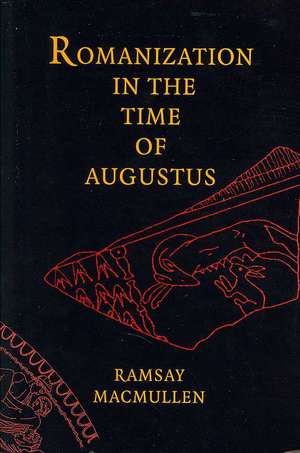
Romanization in the Time of Augustus
Autor Ramsay MacMullenen Limba Engleză Paperback – 25 mar 2008
During the lifetime of Augustus (from 63 BCE to AD 14), Roman civilization spread at a remarkable rate throughout the ancient world, influencing such areas as art and architecture, religion, law, local speech, city design, clothing, and leisure and family activities. In this book, Ramsay MacMullen investigates why the adoption of Roman ways was so prevalent during this period.
Drawing largely on archaeological sources, MacMullen discovers that during this period more than half a million Roman veterans were resettled in colonies overseas, and an additional hundred or more urban centers in the provinces took on normal Italian-Roman town constitutions. Great sums of expendable wealth came into the hands of ambitious Roman and local notables, some of which was spent in establishing and advertising Roman ways. MacMullen argues that acculturation of the ancient world was due not to cultural imperialism on the part of the conquerors but to eagerness of imitation among the conquered, and that the Romans were able to respond with surprisingly effective techniques of mass production and standardization.
Preț: 255.99 lei
Nou
Puncte Express: 384
Preț estimativ în valută:
45.29€ • 52.85$ • 39.60£
45.29€ • 52.85$ • 39.60£
Carte tipărită la comandă
Livrare economică 16-30 ianuarie 26
Preluare comenzi: 021 569.72.76
Specificații
ISBN-13: 9780300137538
ISBN-10: 0300137532
Pagini: 240
Ilustrații: 20 b-w illus.
Dimensiuni: 156 x 235 x 15 mm
Greutate: 0.37 kg
Editura: Yale University Press
Colecția Yale University Press
ISBN-10: 0300137532
Pagini: 240
Ilustrații: 20 b-w illus.
Dimensiuni: 156 x 235 x 15 mm
Greutate: 0.37 kg
Editura: Yale University Press
Colecția Yale University Press
V-ar putea interesa
-
 Vidas FracturadasAaron ClarkePreț: 74.86 lei
 -
 Preț: 152.44 lei
 -
 Oh, We Are Not Gonna Go ThereAlexanderPreț: 216.54 lei
 -
 Christianity and Paganism in the Fourth to Eighth CenturiesRamsay MacMullenPreț: 287.69 lei
 -
 Gustav Mahler: A Life in CrisisStuart FederPreț: 367.48 lei
 -
 Surviving Choppy SeasVan Gent, WillaPreț: 47.57 lei
 -
 Uber Stories, from a DriverGare, PhilPreț: 82.11 lei
 -
 The Incompatibility TheoryAlevizopoulos, MeletisPreț: 91.35 lei
 -
 And I QuoteLeonard JonesPreț: 60.89 lei
 -
 Staging MusicalsMatthew White-23%Preț: 178.09 lei232.09 lei
Recenzii
“Whereas Romanization is sometimes touched on in other late republican and Augustan studies, MacMullen gives the subject the full treatment that it deserves. Romanization in the Time of Augustus will be of value to all who have a personal or professional interest in Roman civilization.”—Randolph H. Lytton, History
“Fans of Ramsay MacMullen’s prolific output will find in this latest volume all the ingredients of his previous successes. . . . The writing is elegant and lucid. . . . This small book with its large theme is important enough to merit both attention and critical evaluation; and whether it inspires imitation or provokes a creative resistance, the scholarly community is lucky to have it.”—Greg Woolf, Journal of Roman Archaeology
“This is a little gem of a book; its scholarship is what we have come to expect from its author, comprehensive and provocative. It is certain to become the starting point for students of the complex historical phenomenon of Romanization.”—Journal of Interdisciplinary History
“In his latest book, Ramsay MacMullen continues his enviable tradition of identifying a subject with wide implications and dealing with it concisely. The book is a timely contribution to our revitalized assessment of a pivotal period.”—Karl Galinsky, American Historical Review
“MacMullen’s study succeeds admirably. He has taken a huge body of complex material and produced attractive answers to important questions. His documentation is transparent and exemplary, allowing readers to follow him and check his conclusions at every turn. . . . Readers interested in the origins of their cultural patrimony will be well served by this book.”—Geoffrey Bakewell, Theological Studies
“This is a challenging and stimulating work that should be read widely, if only to counter the current tendency to denigrate the many outstanding achievements of imperial Rome.”—Anthony A. Barrett, The Historian
Recipient of Lifetime Award for Scholarly Distinction from the American Historical Association, 2001
“The book is a ‘must-buy.’ The work is original and important, the scholarship comprehensive, and the style clear and readable.”—Colin Wells, Trinity University
“[A] significant contribution to the understanding of what is meant by the term ‘Romanization.’”—R. I. Curtis, University of Georgia
“Fans of Ramsay MacMullen’s prolific output will find in this latest volume all the ingredients of his previous successes. . . . The writing is elegant and lucid. . . . This small book with its large theme is important enough to merit both attention and critical evaluation; and whether it inspires imitation or provokes a creative resistance, the scholarly community is lucky to have it.”—Greg Woolf, Journal of Roman Archaeology
“This is a little gem of a book; its scholarship is what we have come to expect from its author, comprehensive and provocative. It is certain to become the starting point for students of the complex historical phenomenon of Romanization.”—Journal of Interdisciplinary History
“In his latest book, Ramsay MacMullen continues his enviable tradition of identifying a subject with wide implications and dealing with it concisely. The book is a timely contribution to our revitalized assessment of a pivotal period.”—Karl Galinsky, American Historical Review
“MacMullen’s study succeeds admirably. He has taken a huge body of complex material and produced attractive answers to important questions. His documentation is transparent and exemplary, allowing readers to follow him and check his conclusions at every turn. . . . Readers interested in the origins of their cultural patrimony will be well served by this book.”—Geoffrey Bakewell, Theological Studies
“This is a challenging and stimulating work that should be read widely, if only to counter the current tendency to denigrate the many outstanding achievements of imperial Rome.”—Anthony A. Barrett, The Historian
Recipient of Lifetime Award for Scholarly Distinction from the American Historical Association, 2001
“The book is a ‘must-buy.’ The work is original and important, the scholarship comprehensive, and the style clear and readable.”—Colin Wells, Trinity University
“[A] significant contribution to the understanding of what is meant by the term ‘Romanization.’”—R. I. Curtis, University of Georgia
Notă biografică
Ramsay MacMullen (1928–2022), a widely regarded historian of Rome and early Christianity, was Dunham Professor Emeritus of History and Classics at Yale University. His many books include Corruption and the Decline of Rome; Roman Social Relations, 50 B.C. to A.D. 284; Christianity and Paganism in the Fourth to Eighth Centuries; Christianizing the Roman Empire; and Voting About God in Early Church Councils.