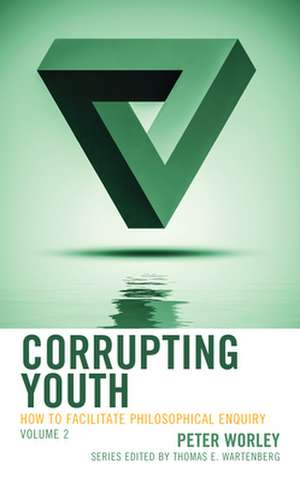
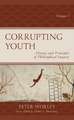
Corrupting Youth: How to Facilitate Philosophical Enquiry, Volume 2: Big Ideas for Young Thinkers
Autor If Machine Peter Worleyen Limba Engleză Paperback – 15 feb 2021


Preț: 216.28 lei
Puncte Express: 324
Carte tipărită la comandă
Livrare economică 22 octombrie-05 noiembrie
Livrare prin curier în România Termenul estimat este afișat lângă disponibilitate.
Transport gratuit de la 400.00 lei Plată online sau ramburs, în funcție de opțiunile comenzii.
Retur gratuit în 14 zile Comandă securizată și suport în română.
Specificații
ISBN-13: 9781475848175
ISBN-10: 147584817X
Pagini: 164
Ilustrații: 11 b/w illustrations; 6 tables; 16 textboxes
Dimensiuni: 148 x 228 x 12 mm
Greutate: 0.26 kg
Editura: Bloomsbury Publishing
Colecția Rowman & Littlefield
Seria Big Ideas for Young Thinkers
Locul publicării:New York, United States
ISBN-10: 147584817X
Pagini: 164
Ilustrații: 11 b/w illustrations; 6 tables; 16 textboxes
Dimensiuni: 148 x 228 x 12 mm
Greutate: 0.26 kg
Editura: Bloomsbury Publishing
Colecția Rowman & Littlefield
Seria Big Ideas for Young Thinkers
Locul publicării:New York, United States
Cuprins
Preface
Facilitating PhiE
PreparationPart One: Basic facilitation, getting PhiE going
Philosophical process and contentThe essential core of PhiEBasic mechanism of PhiEThe PhiE step-by-stepThink, Speak, ListenThink: the stimulusThink and Speak: questions in PhiE
Other key question-types in PhiESpeak: reasons
Listen: ListeningOther key dispositions in PhiE
Part Two: Expert facilitation, managing dialectic
If-ing, anchoring and opening-up
Further Facilitation Considerations
The Response Detector and The Third Way
Right-to-reply
Inclusionary moves
The Emergent Question Approach
Silent Dialogue
The Imaginary Disagreer: 'silent dialogue' in the classroom
The Hokey Kokey method
Arguments and hidden premises
The Mapper and PIES(S) Questions
Part Three: Advanced Facilitation, taking things further
The Sibelius Model
Writing in PhiE
Self-facilitation
Metacognition and Extended Thinking in PhiE
Thinking Tools and Thinking Wall
Metacognition in Plato and PhiE
Do you know that you know?
Meno-cognition: learning attention to ourselves
Session-plans
Session-plan 1: Epistemology through images
Magritte's Pipe
Session-plan 2: Ethics through a question
Ethical Protesting
Session-plan 3: Aesthetics through performance
The Concert
Session-plan 4: Metaphysics through texts
Stepping into rivers with Heraclitus, Cratylus and Plato
Appendix A-D: Tables of moves
Appendix E: Pieces of music for The Concert session plan
Bibliography
About the Author
Facilitating PhiE
PreparationPart One: Basic facilitation, getting PhiE going
Philosophical process and contentThe essential core of PhiEBasic mechanism of PhiEThe PhiE step-by-stepThink, Speak, ListenThink: the stimulusThink and Speak: questions in PhiE
Other key question-types in PhiESpeak: reasons
Listen: ListeningOther key dispositions in PhiE
Part Two: Expert facilitation, managing dialectic
If-ing, anchoring and opening-up
Further Facilitation Considerations
The Response Detector and The Third Way
Right-to-reply
Inclusionary moves
The Emergent Question Approach
Silent Dialogue
The Imaginary Disagreer: 'silent dialogue' in the classroom
The Hokey Kokey method
Arguments and hidden premises
The Mapper and PIES(S) Questions
Part Three: Advanced Facilitation, taking things further
The Sibelius Model
Writing in PhiE
Self-facilitation
Metacognition and Extended Thinking in PhiE
Thinking Tools and Thinking Wall
Metacognition in Plato and PhiE
Do you know that you know?
Meno-cognition: learning attention to ourselves
Session-plans
Session-plan 1: Epistemology through images
Magritte's Pipe
Session-plan 2: Ethics through a question
Ethical Protesting
Session-plan 3: Aesthetics through performance
The Concert
Session-plan 4: Metaphysics through texts
Stepping into rivers with Heraclitus, Cratylus and Plato
Appendix A-D: Tables of moves
Appendix E: Pieces of music for The Concert session plan
Bibliography
About the Author
Recenzii
Peter Worley's works form an introduction of sorts to philosophical dialogue on both the theoretical and practical levels. While lucid and coherent, they are above all illuminating and enlightening, educating the reader in the questions that engage the practitioners of PwC/P4C and the dialogue created by questions and ponderings that opens up a whole world of imagination-answers in turn raising new queries. As per his wont, Worley's writing is imbued with an inner fire that easily translates into action-an enthusiasm that verges on educational, pedagogical, and philosophical exaltation. On coming to the end of the reading experience, we are left with the conviction that there must be more-a higher level, material we have yet to be exposed to-and it is worth our while to wait and hope to reach even greater heights of our common humanity.
Corrupting Youth is yet another great contribution to the literature on philosophy in schools from Peter Worley. Worley traces the ancient sources of his dialectical approach to philosophical enquiry, brings out its continuing value, and explains the principles and practices involved. Here is an expert facilitator who shows how you can become one too.
All facilitators of philosophical enquiry, and indeed all educators, should pounce on this book. In this volume Worley provides a wealth of eminently practical and imaginative resources, honed through his many years of experience, which will enrich and enliven the classroom and beyond for pupils, participants and facilitators alike. The aim of both well-integrated volumes is to foster the open, questioning mindsets - constructively critical, collaborative and imaginative - which are so urgently needed to tackle the complex challenges of the 21st century.'
I believe that Worley's book will serve as a reference point for future debates. I highly recommend a close study of this book to anyone interested in learning the subtle dynamics of dialogic inquiry and facilitation. Worley's book, especially Volume II, is one of the most sophisticated and insightful handbooks available for facilitating philosophical inquiry in schools.
Corrupting Youth is yet another great contribution to the literature on philosophy in schools from Peter Worley. Worley traces the ancient sources of his dialectical approach to philosophical enquiry, brings out its continuing value, and explains the principles and practices involved. Here is an expert facilitator who shows how you can become one too.
All facilitators of philosophical enquiry, and indeed all educators, should pounce on this book. In this volume Worley provides a wealth of eminently practical and imaginative resources, honed through his many years of experience, which will enrich and enliven the classroom and beyond for pupils, participants and facilitators alike. The aim of both well-integrated volumes is to foster the open, questioning mindsets - constructively critical, collaborative and imaginative - which are so urgently needed to tackle the complex challenges of the 21st century.'
I believe that Worley's book will serve as a reference point for future debates. I highly recommend a close study of this book to anyone interested in learning the subtle dynamics of dialogic inquiry and facilitation. Worley's book, especially Volume II, is one of the most sophisticated and insightful handbooks available for facilitating philosophical inquiry in schools.
Notă biografică
Peter Worley is a British philosopher, educator and author specialising in philosophy for children and philosophical enquiry in education. He is the founder and former Chief Executive Officer of The Philosophy Foundation, a UK charity promoting philosophy in schools and communities.
He is widely regarded as a leading figure in the international Philosophy for Children (P4C) movement and served as President of SOPHIA, the European Foundation for the Advancement of Philosophy with Children, from 2014 to 2019. He is a Visiting Research Associate at King's College London and a Fellow of the Royal Society of Arts. He is the author of numerous books on philosophy and education, including The If Machine and The If Odyssey. Lesson plans from these books were used and credited in the BBC drama Waiting for the Out, while several lesson plans from The If Machine formed the basis of the BAFTA-nominated BBC Learning series What Makes Me Me. The If Machine was also featured in the documentary Young Plato.