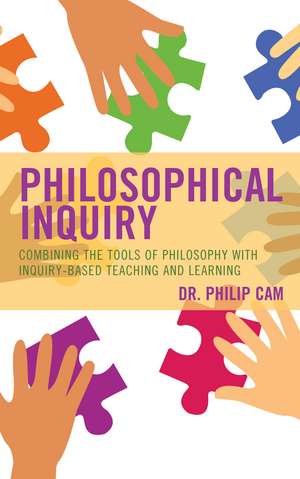
Philosophical Inquiry: Combining the Tools of Philosophy with Inquiry-based Teaching and Learning: Big Ideas for Young Thinkers
Autor Philip Camen Limba Engleză Paperback – 20 ian 2020
Drawing on educational and psychological theory, Philosophical Inquiry emphasizes the use of collaborative learning, through class discussion, working with a partner, and small group work. This approach teaches students to think in socially responsible ways. It means that students become not only thinking individuals but also good team-players, with benefits that extend beyond the classroom and the school to community life and the world of work.


Preț: 218.51 lei
Preț vechi: 292.62 lei
-25%
Puncte Express: 328
Carte tipărită la comandă
Livrare economică 08-22 decembrie
Livrare express 31 octombrie-06 noiembrie pentru 97.03 lei
Livrare prin curier în România Termenul estimat este afișat lângă disponibilitate.
Transport gratuit de la 400.00 lei Plată online sau ramburs, în funcție de opțiunile comenzii.
Retur gratuit în 14 zile Comandă securizată și suport în română.
Specificații
ISBN-13: 9781475846294
ISBN-10: 1475846290
Pagini: 200
Ilustrații: 30 b/w illustrations;17 tables
Dimensiuni: 146 x 226 x 12 mm
Greutate: 0.26 kg
Editura: Bloomsbury Publishing
Colecția Rowman & Littlefield
Seria Big Ideas for Young Thinkers
Locul publicării:New York, United States
ISBN-10: 1475846290
Pagini: 200
Ilustrații: 30 b/w illustrations;17 tables
Dimensiuni: 146 x 226 x 12 mm
Greutate: 0.26 kg
Editura: Bloomsbury Publishing
Colecția Rowman & Littlefield
Seria Big Ideas for Young Thinkers
Locul publicării:New York, United States
Cuprins
Preface
Acknowledgments
Introduction
Chapter 1: Getting Started
Arranging the Classroom and Setting the Rules
Structuring a Lesson
A Toolkit for Thinking
Learning Outcomes
Chapter 2: Questioning
Question Starters
Thinking about Response Demands
The Question Quadrant
Factual, Evaluative and Conceptual Questions
Setting an Agenda
Unpacking Problems and Questions
The Teacher as Procedural Questioner
The Characteristics of Philosophical Questions
Constructing Discussion Plans
Exercises and Activities
Chapter 3: Conceptual Exploration
Categorical Operations
Comparative Operations
Complex Concepts
Clarification
Exercises and Activities
Chapter 4: Reasoning
The Language of Reasoning
Justification and Inference
Conditional Reasoning
Deductive Reasoning
Inductive Reasoning
Necessary and Sufficient Conditions
Contradiction and Logical Impossibility
Analyzing and Evaluating Reasoning
Mapping Arguments in Discussion
Exercises and Activities
Bibliography
Acknowledgments
Introduction
Chapter 1: Getting Started
Arranging the Classroom and Setting the Rules
Structuring a Lesson
A Toolkit for Thinking
Learning Outcomes
Chapter 2: Questioning
Question Starters
Thinking about Response Demands
The Question Quadrant
Factual, Evaluative and Conceptual Questions
Setting an Agenda
Unpacking Problems and Questions
The Teacher as Procedural Questioner
The Characteristics of Philosophical Questions
Constructing Discussion Plans
Exercises and Activities
Chapter 3: Conceptual Exploration
Categorical Operations
Comparative Operations
Complex Concepts
Clarification
Exercises and Activities
Chapter 4: Reasoning
The Language of Reasoning
Justification and Inference
Conditional Reasoning
Deductive Reasoning
Inductive Reasoning
Necessary and Sufficient Conditions
Contradiction and Logical Impossibility
Analyzing and Evaluating Reasoning
Mapping Arguments in Discussion
Exercises and Activities
Bibliography
Recenzii
Philip Cam is internationally known for his very thoughtful and practical approach to critical inquiry. His latest book does not disappoint - it is beautifully written. Focusing on the three main skills - questioning, explaining and reasoning - he outlines ways in which teachers can develop them, with a lucidity and power that is undeniable. In the activities at the end of each chapter he gives very clear examples which should enable even the barely interested teacher to successfully operationalize the methods. This book is highly recommended for all those interested in moving pedagogy and the curriculum into the 21st century.
Philip Cam has been at the forefront of work in the theory and practice of philosophy in schools for more than three decades. His compelling account of the skills children need to think well and the inquiry-based pedagogy needed to cultivate them finds its most definitive expression to date in this elegant, accessible book. An outstanding introduction to philosophical inquiry in the classroom.
An important contribution to the theory and practice of philosophy in schools and to education more generally. This is one of the best books in the field and will surely become a go-to resource for teachers.
Philosophical inquiry: Combining the Tools of Philosophy with Inquiry-based Teaching and Learning is a gem. It is a delightfully original and incisive contribution to the literature on dialogical pedagogy that seamlessly synthesizes simplicity and sophistication. Replete with lucid explanations about the moves in thinking and practical advice on how to identify and enact them, this book is an invaluable resource for teachers committed to cultivating children's natural curiosity. The organization, scope, and sequence of the book-which includes chapters on questions, conceptual exploration and reasoning with illustrative snippets of dialogue and a wide variety of age-appropriate exercises and activities-reflects the depth of Cam's expertise in Philosophy for/with Children. Cam not only demonstrates philosophy's inherent connection to the subjects already studied in school, he also attests to its combined cognitive and social value. Written in accessible language with examples drawn from Cam's extensive experience in schools, Philosophical Inquiry invites classroom teachers to widen their repertoire by incorporating philosophy's general-purpose tools for intellectual work into their teaching practice. Cam trusts the pedagogical appeal of philosophy as much as he trusts practitioners of inquiry-based teaching and learning. Read this book and you will discover that they are made for one another.
Phil Cam invites educators to see each school subject and academic discipline as a realm of inquiry to which we invite our students to bring their own questions, and where we think together with them in ways that are likely to result in deeper understanding, keener appreciation and fresh insights, not only about the subject, but also about ourselves and one another. Cam makes the compelling case historically, theoretically, and most of all practically, that the tools of philosophy are just those needed to conduct genuine inquiry across school subjects. The treasure trove of practical suggestions and organized activities he offers on questioning, concept development, and reasoning is more than a welcome resource for the classroom: it is a framework for inquiring into one's own pedagogy.
Philip Cam has been at the forefront of work in the theory and practice of philosophy in schools for more than three decades. His compelling account of the skills children need to think well and the inquiry-based pedagogy needed to cultivate them finds its most definitive expression to date in this elegant, accessible book. An outstanding introduction to philosophical inquiry in the classroom.
An important contribution to the theory and practice of philosophy in schools and to education more generally. This is one of the best books in the field and will surely become a go-to resource for teachers.
Philosophical inquiry: Combining the Tools of Philosophy with Inquiry-based Teaching and Learning is a gem. It is a delightfully original and incisive contribution to the literature on dialogical pedagogy that seamlessly synthesizes simplicity and sophistication. Replete with lucid explanations about the moves in thinking and practical advice on how to identify and enact them, this book is an invaluable resource for teachers committed to cultivating children's natural curiosity. The organization, scope, and sequence of the book-which includes chapters on questions, conceptual exploration and reasoning with illustrative snippets of dialogue and a wide variety of age-appropriate exercises and activities-reflects the depth of Cam's expertise in Philosophy for/with Children. Cam not only demonstrates philosophy's inherent connection to the subjects already studied in school, he also attests to its combined cognitive and social value. Written in accessible language with examples drawn from Cam's extensive experience in schools, Philosophical Inquiry invites classroom teachers to widen their repertoire by incorporating philosophy's general-purpose tools for intellectual work into their teaching practice. Cam trusts the pedagogical appeal of philosophy as much as he trusts practitioners of inquiry-based teaching and learning. Read this book and you will discover that they are made for one another.
Phil Cam invites educators to see each school subject and academic discipline as a realm of inquiry to which we invite our students to bring their own questions, and where we think together with them in ways that are likely to result in deeper understanding, keener appreciation and fresh insights, not only about the subject, but also about ourselves and one another. Cam makes the compelling case historically, theoretically, and most of all practically, that the tools of philosophy are just those needed to conduct genuine inquiry across school subjects. The treasure trove of practical suggestions and organized activities he offers on questioning, concept development, and reasoning is more than a welcome resource for the classroom: it is a framework for inquiring into one's own pedagogy.