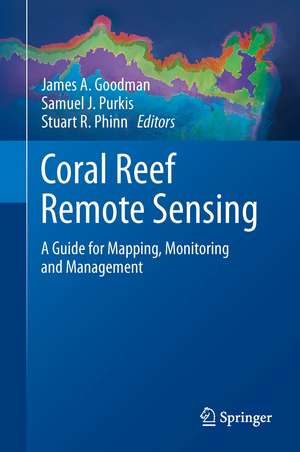
Coral Reef Remote Sensing: A Guide for Mapping, Monitoring and Management
Editat de James A. Goodman, Samuel J. Purkis, Stuart R. Phinnen Limba Engleză Hardback – 8 iul 2013
Descoperim în Coral Reef Remote Sensing un instrument de lucru fundamental pentru cercetarea marină contemporană, axat pe capitolul critic al monitorizării recifelor de corali aflate în declin. Considerăm că structura propusă de editorii James A. Goodman, Samuel J. Purkis și Stuart R. Phinn este una dintre cele mai riguroase din literatura de specialitate, deoarece nu se limitează la o prezentare teoretică, ci organizează materia în funcție de tehnologia de achiziție a datelor. De la senzorii multispectrali și hiperspectrali, până la utilizarea sistemelor LiDAR și a vehiculelor subacvatice autonome (AUV), volumul oferă o perspectivă tehnică asupra modului în care putem obține evaluări cantitative repetabile pentru ecosisteme vaste.
Apreciem în mod deosebit modul în care autorii integrează datele colectate de pe platforme eterogene — sateliți, avioane sau nave — transformând informația brută în soluții de management. Comparabil cu Remote Sensing and Modeling de Charles W. Finkl în rigurozitate, acest volum se diferențiază prin focalizarea strictă pe mediul coralier, oferind protocoale specifice pentru coloana de apă și habitatele bentonice, actualizat pentru noile cerințe de rezoluție temporală și spațială necesare în secolul XXI. Stilul editorial este unul tehnic, orientat spre precizie, fiind bogat ilustrat cu studii de caz care demonstrează aplicabilitatea practică a fiecărui tip de senzor. Este o resursă care depășește simpla cartografiere, adresând întrebări științifice complexe despre procesele biofizice ale recifelor la scară globală.
Preț: 882.26 lei
Preț vechi: 1160.87 lei
-24%
Carte tipărită la comandă
Livrare economică 09-15 septembrie
Specificații
ISBN-10: 9048192919
Pagini: 300
Ilustrații: XXV, 436 p. 146 illus., 110 illus. in color.
Dimensiuni: 155 x 235 x 27 mm
Greutate: 0.95 kg
Ediția:2013
Editura: SPRINGER NETHERLANDS
Colecția Springer
Locul publicării:Dordrecht, Netherlands
V-ar putea interesa
-
 Coral Reefs: A Very Short IntroductionCharles Sheppard-22%Preț: 54.69 lei69.77 lei
 -
 Encyclopedia of Remote SensingEni G Njoku-18%Preț: 1906.38 lei2324.85 lei
 -
 Preț: 168.26 lei
 -
 Reefs of TimeLisa S. GardinerPreț: 168.34 lei
 -
 Preț: 339.64 lei
 -
 Remote Sensing and Image InterpretationThomas Lillesand-18%Preț: 1345.99 lei1641.45 lei
 -
 GIS For DummiesJami DennisPreț: 165.83 lei
 -
 Remote Sensing and Global Environmental ChangeSam J. Purkis-19%Preț: 446.06 lei550.69 lei
 -
 Introduction to Remote Sensing, Sixth EditionJames B. Campbell-15%Preț: 671.95 lei790.53 lei
 -
 Space Technology Contribution in Engineering ServicesRustam B Rustamov-30%Preț: 1566.22 lei2224.16 lei
 -
 Curing CoralSummer CollinsPreț: 103.56 lei
 -
 Preț: 235.76 lei
 -
 Advances in Remote Sensing and Geo Informatics ApplicationsHesham M. El-Askary-18%Preț: 928.77 lei1132.64 lei
 -
 -18%Preț: 864.31 lei1054.04 lei
 -
 -20%Preț: 1414.10 lei1767.62 lei
 -
 Seafloor Mapping along Continental ShelvesCharles W. Finkl-18%Preț: 790.89 lei964.50 lei
 -
 Preț: 428.67 lei
 -
 Advances in Geoscience and Remote Sensing TechnologyJosaphat Tetuko Sri Sumantyo-18%Preț: 1346.27 lei1641.80 lei
Public țintă
ResearchDe ce să citești această carte
Această lucrare este esențială pentru cercetătorii și managerii de mediu care au nevoie de o bază tehnică solidă în utilizarea sistemelor informatice geografice aplicate mediului marin. Cititorul câștigă acces la metodologii avansate de monitorizare (LiDAR, acustică, radar) și, mai important, învață cum să aleagă senzorul optim pentru obiective specifice de conservare, asigurând o acuratețe sporită în evaluarea stării ecosistemelor coraliere.
Descriere scurtă
Remote sensing is now a fundamental tool for the mapping, monitoring and management of coral reef ecosystems. Remote sensing offers repeatable, quantitative assessments of habitat and environmental characteristics over spatially extensive areas. As the multi-disciplinary field of coral reef remote sensing continues to mature, results demonstrate that the techniques and capabilities continue to improve. New developments allow reef assessments and mapping to be performed with higher accuracy, across greater spatial areas, and with greater temporal frequency. The increased level of information that remote sensing now makes available also allows more complex scientific questions to be addressed.
As defined for this book, remote sensing includes the vast array of geospatial data collected from land, water, ship, airborne and satellite platforms. The book is organized by technology, including: visible and infrared sensing using photographic, multispectral and hyperspectral instruments; active sensing using light detection and ranging (LiDAR); acoustic sensing using ship, autonomous underwater vehicle (AUV) and in-water platforms; and thermal and radar instruments.
Emphasis and Audience
This book serves multiple roles. It offers an overview of the current state-of-the-art technologies for reef mapping, provides detailed technical information for coral reef remote sensing specialists,imparts insight on the scientific questions that can be tackled using this technology, and also includes a foundation for those new to reef remote sensing. The individual sections of the book include introductory overviews of four main types of remotely sensed data used to study coral reefs, followed by specific examples demonstrating practical applications of the different technologies being discussed. Guidelines for selecting the most appropriate sensor for particular applications are provided, including an overview of how to utilize remote sensing data as an effective tool in science and management. The text is richly illustrated with examples of each sensing technology applied to a range of scientific, monitoring and management questions in reefs around the world. As such, the book is broadly accessible to a general audience, as well as students, managers, remote sensing specialists and anyone else working with coral reef ecosystems.
Recenzii
"This remarkable book, Coral Reef Remote Sensing: A Guide for Mapping, Monitoring and Management, for the first time documents the full range of remote sensing systems, methodologies and measurement capabilities essential to understanding more fully the status and changes over time of coral reefs globally. Such information is essential and provides the foundation for policy development and for implementing management strategies to protect these critically endangered ecosystems. ... Included here is an overview of technologies for reef mapping, technical information useful for scientists and other research and policy development experts, ideas for application of remote sensing to resolve questions, and thoughts about future remote sensing technologies and their applications.
I wholeheartedly recommend this book to scientists, students, managers, remote sensing specialists and anyone who would like to be inspired by the ingenious new ways that have been developed and are being applied to solve one of the world’s greatest challenges: how to take care of the ocean that takes care of us."
Sylvia A. Earle
National Geographic Explorer in Residence
Founder, Mission Blue