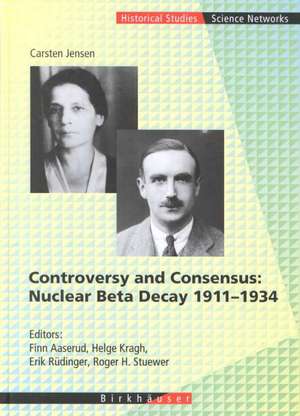
Controversy and Consensus: Nuclear Beta Decay 1911-1934: Science Networks. Historical Studies, cartea 24
Autor Carsten Jensen Editat de Finn Aaserud, Helge Kragh, Erik Rüdinger, Roger H. Stueweren Limba Engleză Hardback – dec 1999
Din seria Science Networks. Historical Studies
- 24%
 Preț: 1640.86 lei
 - 18%
 Preț: 758.81 lei
 - 15%
 Preț: 627.31 lei
 - 18%
 Preț: 767.34 lei
 -
 Preț: 370.62 lei
 -
 Preț: 471.42 lei
 - 15%
 Preț: 460.87 lei
 -
 Preț: 373.93 lei
 - 15%
 Preț: 671.24 lei
 - 15%
 Preț: 635.19 lei
 - 15%
 Preț: 511.16 lei
 - 15%
 Preț: 477.18 lei
 - 24%
 Preț: 998.73 lei
 -
 Preț: 381.19 lei
 - 18%
 Preț: 868.12 lei
 -
 Preț: 367.81 lei
 - 15%
 Preț: 622.73 lei
 - 15%
 Preț: 675.70 lei
 - 15%
 Preț: 645.93 lei
 - 15%
 Preț: 627.94 lei
 - 15%
 Preț: 625.09 lei
 - 18%
 Preț: 881.33 lei
 - 15%
 Preț: 616.67 lei
 - 15%
 Preț: 618.09 lei
 - 18%
 Preț: 1079.74 lei
 - 18%
 Preț: 1200.58 lei
 - 20%
 Preț: 646.84 lei
 - 15%
 Preț: 624.01 lei
 - 20%
 Preț: 614.29 lei
 - 15%
 Preț: 668.92 lei
 -
 Preț: 384.05 lei
 -
 Preț: 393.08 lei
 - 15%
 Preț: 615.40 lei
 - 15%
 Preț: 627.39 lei
 - 15%
 Preț: 625.32 lei
 -
 Preț: 375.87 lei
Preț: 376.70 lei
Puncte Express: 565
Carte tipărită la comandă
Livrare economică 09-23 iunie
Specificații
ISBN-13: 9783764353131
ISBN-10: 3764353139
Pagini: 244
Ilustrații: XVII, 217 p.
Dimensiuni: 160 x 241 x 45 mm
Greutate: 0.54 kg
Ediția:2000
Editura: birkhäuser
Colecția Science Networks. Historical Studies
Seria Science Networks. Historical Studies
Locul publicării:Basel, Switzerland
ISBN-10: 3764353139
Pagini: 244
Ilustrații: XVII, 217 p.
Dimensiuni: 160 x 241 x 45 mm
Greutate: 0.54 kg
Ediția:2000
Editura: birkhäuser
Colecția Science Networks. Historical Studies
Seria Science Networks. Historical Studies
Locul publicării:Basel, Switzerland
V-ar putea interesa
-
 Isaac NewtonJames GleickPreț: 88.61 lei
 -
 We, The DrownedCarsten Jensen-28%Preț: 65.76 lei91.97 lei
 -
 Science: A HistoryJohn GribbinPreț: 131.30 lei
 -
 Molecules: A Very Short IntroductionPhilip Ball-21%Preț: 53.51 lei67.81 lei
 -
 Electrodynamics from Ampère to EinsteinOlivier Darrigol-36%Preț: 601.42 lei945.38 lei
 -
 -12%Preț: 308.46 lei350.08 lei
 -
 -17%Preț: 475.42 lei576.12 lei
 -
 The Right and the Welfare StateCarsten Jensen-34%Preț: 627.27 lei949.57 lei
 -
 -30%Preț: 469.59 lei675.05 lei
 -
 Preț: 258.31 lei
 -
 -27%Preț: 64.78 lei89.24 lei
 -
 Preț: 79.71 lei
 -
 The Tesla PapersNikola TeslaPreț: 117.49 lei
 -
 Sigmund Freud: Examining the Essence of his ContributionRichard Stevens-26%Preț: 182.54 lei248.24 lei
 -
 Erik H. Erikson: Explorer of Identity and the Life CycleRichard StevensPreț: 181.10 lei
 -
 Preț: 109.02 lei
 -
 I Have Seen The World BeginCarsten JensenPreț: 110.78 lei
Public țintă
ResearchCuprins
1 Prelude: Beta-Spectrum Research in the Pre-Nuclear Years, 1900–1911.- 1.1 Discovery and identification of the beta particle.- 1.2 The first experiments on the velocity distribution of beta particles.- 1.3 Absorption measurements question the inhomogeneity of the beta particles.- 1.4 The Hahn-Meitner vs. Wilson controversy.- 1.5 From unity to complexity: magnetic-deflection experiments, 1910–1911.- 2 The Origin of Beta Rays, and the Growing Complexity of Their Spectrum: The Rutherford Era, 1911–1919.- 2.1 Introduction.- 2.2 Rutherford’s 1912 theory, and reactions to it.- 2.3 The beta particle as a nuclear constituent.- 2.4 An extreme complexity of beta line-spectra is brought to light: deflection experiments in the years 1911–1913.- 2.5 Continuity as well as lines: The composite beta spectrum.- 2.6 Rutherford’s 1914 theory.- 2.7 The Bohr-Sommerfeld quantum conditions and the beta line-spectrum.- 2.8 Rutherford and the gamma rays.- 3 The Rise of a Controversy: Ellis, Meitner and Smekal Advance Different Beta-Spectrum Theories, 1920–1922.- 3.1 Introduction.- 3.2 Internal conversion, nuclear levels, and Ellis’s interpretation of the beta line-spectrum.- 3.3 Analogy between alpha and beta emission, and Meitner’s interpretation of the beta line-spectrum.- 3.4 Ellis’s response to Meitner’s hypothesis, and his interpretation of the continuous beta spectrum.- 3.5 Meitner replies to Ellis, and reveals her view on the continuous beta spectrum.- 3.6 The atom as a unity: Smekal joins the discussion, and is met with a sharp reaction.- 3.7 Two repetitions of the Chadwick experiment lead to contradictory conclusions.- 4 Secondary Effects and Order of Emission: Two Main Questions in the Controversy, 1923–1925.- 4.1 Introduction.- 4.2 Meitner investigates thebeta spectrum of UX1 and takes it as further support for her view.- 4.3 Radiationless transitions: Rosseland suggests an explanation of the emission of primary, and some secondary, beta particles.- 4.4 The nuclear field and the Compton effect: Two possible reasons for the continuous beta spectrum.- 4.5 Ellis and Skinner reinvestigate the beta line-spectra of RaB and C, and serious problems arise.- 4.6 Beta first, gamma second, or is it the other way around?.- 5 The End of the Beginning: The Controversy Enters the Decisive Phase, 1925–1929.- 5.1 Introduction.- 5.2 Ellis adjusts his view on the emission process, but maintains his interpretation of the continuous spectrum.- 5.3 The number of emitted beta particles.- 5.4 Ellis and Wooster’s tour de force: A determination of the heating effect of RaE.- 5.5 Continental reactions to Ellis and Wooster’s experiment.- 5.6 Some concluding remarks about the controversy.- 6 From Anomaly to Explanation: The Continuous Beta Spectrum, 1929–1934.- 6.1 Introduction.- 6.2 Non-conservation of energy or a new particle? The first phase of the Bohr-Pauli dispute, 1929–1932.- 6.3 Other attempts at explaining the anomalous continuity.- 6.4 The question of upper limits in beta spectra, and the thorium C branching problem.- 6.5 The impact of the miraculous year: The second phase of the Bohr-Pauli dispute, 1932–1933.- 6.6 The two theories of beta decay.- 7 Towards a Theory of Internal Conversion: The Beta Line-Spectrum, 1927–1934.- 7.1 Introduction.- 7.2 Experimental evidence brings about a new view on the origin of gamma rays.- 7.3 The radiation hypothesis proves insufficient to explain internal conversion of gamma rays.- 7.4 A theory of internal conversion is developed.- Summary and Conclusion.- Name Index.
Recenzii
"Jensen’s book helps lay the foundations of a new and comprehensive history of nuclear science." (Centaurus)