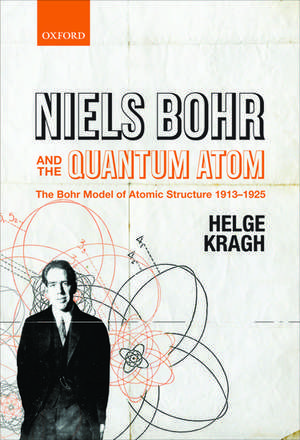
Niels Bohr and the Quantum Atom: The Bohr Model of Atomic Structure 1913-1925
Autor Helge Kraghen Limba Engleză Hardback – 3 mai 2012
Imaginați-vă un fizician care, în 1913, îndrăznește să contrazică legile stabilite ale electromagnetismului pentru a salva arhitectura atomului. Paradoxul central al vieții lui Niels Bohr, explorat cu minuțiozitate în Niels Bohr and the Quantum Atom, rezidă în capacitatea sa de a construi o structură revoluționară pe fundații pe care el însuși le știa a fi precare. Considerăm că forța acestui volum semnat de Helge Kragh nu stă doar în rigoarea istorică, ci în modul cinematic în care reconstituie „instinctul unic” al lui Bohr — acea intuiție aproape mistică ce i-a permis să vizualizeze ordinea acolo unde contemporanii săi vedeau doar haos matematic.
Subliniem faptul că autorul nu se limitează la o prezentare tehnică a modelului atomic, ci plasează teoria într-un context mult mai vast, incluzând rezistența savanților conservatori și ambiția lui Bohr de a explica nu doar atomul, ci și formarea moleculelor. Narativul amintește de From Data to Quanta prin intensitatea cu care reconstituie o epocă în care fizica se afla într-o stare de flux permanent. Spre deosebire de alte biografii, Helge Kragh reușește să transforme evoluția unei idei într-un studiu de caz despre dinamica schimbării de paradigmă.
În contextul operei sale, această carte reprezintă o rafinare a temelor explorate în volume precum Simply Dirac sau The Oxford Handbook of the History of Modern Cosmology. Dacă în lucrările anterioare Kragh analiza limbajul științei sau cosmologia la scară largă, aici el coboară în laboratorul mental al lui Bohr. Merită menționat că textul beneficiază de 47 de ilustrații care ajută la vizualizarea unor concepte care, în perioada 1913-1925, păreau de neînțeles pentru mintea umană obișnuită.
Preț: 475.42 lei
Preț vechi: 576.12 lei
-17%
Carte tipărită la comandă
Livrare economică 12-23 iunie
Specificații
ISBN-10: 0199654980
Pagini: 416
Ilustrații: 45 b/w line illustrations, 2 b/w halftones
Dimensiuni: 177 x 248 x 29 mm
Greutate: 0.86 kg
Editura: Oxford University Press
Colecția OUP Oxford
Locul publicării:Oxford, United Kingdom
V-ar putea interesa
-
 RadioactiveLauren RednissPreț: 108.35 lei
 -
 Matron in ChargeEvelyn PrentisPreț: 108.56 lei
 -
 Early Responses to the Periodic SystemMasanori KajiPreț: 331.11 lei
 -
 William Osler: A Life in MedicineMichael Bliss-13%Preț: 252.10 lei288.29 lei
 -
 Harvey Cushing: A Life in SurgeryMichael Bliss-12%Preț: 254.06 lei289.12 lei
 -
 J. D. Bernal: The Sage of ScienceAndrew Brown-19%Preț: 85.50 lei105.07 lei
 -
 -21%Preț: 93.17 lei118.37 lei
 -
 Jonas Salk: A LifeCharlotte DeCroes Jacobs-15%Preț: 242.79 lei286.01 lei
 -
 GalileoJohn L. Heilbron-16%Preț: 105.14 lei125.60 lei
 -
 -27%Preț: 419.57 lei571.78 lei
 -
 James Joseph Sylvester: Life and Work in LettersKaren Hunger Parshall-23%Preț: 469.00 lei606.58 lei
 -
 -28%Preț: 784.43 lei1087.17 lei
 -
 I Died for Beauty: Dorothy Wrinch and the Cultures of ScienceMarjorie Senechal-14%Preț: 366.16 lei427.61 lei
 -
 Ivan Pavlov: A Russian Life in ScienceDaniel P. Todes-22%Preț: 269.37 lei347.02 lei
 -
 Dirac: A Scientific BiographyHelge Kragh-11%Preț: 599.02 lei673.06 lei
 -
 Preț: 385.48 lei
 -
 Preț: 101.98 lei
 -
 Brain on FireSusannah CahalanPreț: 97.36 lei
 -
 An Atomic Love StoryShirley StreshinskyPreț: 209.53 lei
 -
 Simply DiracHelge KraghPreț: 53.25 lei
 -
 Varying GravityHelge KraghPreț: 373.47 lei
De ce să citești această carte
Pentru cititorul pasionat de istoria ideilor și de fizică cuantică, această carte oferă o perspectivă rară asupra modului în care o teorie controversată devine fundamentul științei moderne. Veți câștiga o înțelegere profundă a „vechii teorii cuantice” și a contextului uman și academic în care Niels Bohr și-a apărat viziunea. Este o resursă esențială pentru a vedea cum geniul individual navighează printre critici pentru a schimba cursul istoriei.
Despre autor
Helge S. Kragh este un distins profesor de istoria științei la Universitatea din Aarhus, Danemarca, cu o carieră academică impresionantă ce include stagii la Universitatea Cornell și Universitatea din Oslo. Specializarea sa transdisciplinară în fizică și istorie îi permite să abordeze subiecte complexe precum mecanica cuantică și cosmologia cu o claritate rară. În lucrările sale, Kragh explorează nu doar faptele științifice, ci și evoluția limbajului și a conceptelor care definesc înțelegerea noastră asupra universului, fiind considerat unul dintre cei mai importanți biografi ai ideilor științifice contemporane.
Descriere
Recenzii
In this new book, Helge Kragh fills in the details of Bohr's early career and how it affected science, not to mention Bohr himself. As befits a science historian, Kragh commendably links Bohr's enduring contributions to the painstaking efforts of the many researchers who found the various tiny pieces of the atomic jigsaw and helped fit them together.
Kragh's writing is vivid and clear, and he makes effective use of quotations from correspondences and recollections to convey a feeling of the multiform responses of contemporaries to the events described.
Drawing on an enormous amount of mathematically challenging primary and secondary source material, Helge Kragh provides a panoramic overview of the genesis, development, and demise of the so-called old quantum theory that, for over a decade, guided physicists in their attempts to unravel the mysteries of atomic spectra and atomic structure.