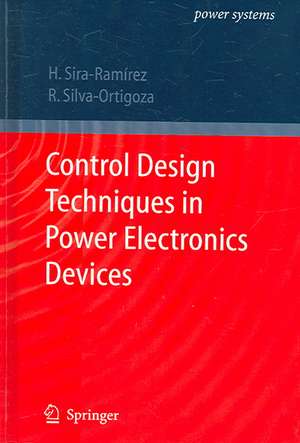
Control Design Techniques in Power Electronics Devices: Power Systems
Autor Hebertt J. Sira-Ramirez, Ramón Silva-Ortigozaen Limba Engleză Hardback – 7 iul 2006
Among the control theories which feature in the book are: sliding mode control, feedback control by means of approximate linearization and nonlinear control design methods.
This monograph will be of interest to researchers, tutors and students in power systems and their related control problems.
Din seria Power Systems
- 18%
 Preț: 934.14 lei
- 18%
 Preț: 930.31 lei
- 15%
 Preț: 610.62 lei
- 18%
 Preț: 758.01 lei
- 18%
 Preț: 923.89 lei
- 18%
 Preț: 812.11 lei
- 20%
 Preț: 1141.02 lei
- 18%
 Preț: 1058.74 lei
- 18%
 Preț: 925.33 lei
- 18%
 Preț: 986.78 lei
- 18%
 Preț: 817.35 lei
- 18%
 Preț: 1610.27 lei
- 18%
 Preț: 944.71 lei
- 18%
 Preț: 918.77 lei
- 15%
 Preț: 666.74 lei
- 15%
 Preț: 661.42 lei
- 15%
 Preț: 669.62 lei
- 18%
 Preț: 1547.12 lei
- 18%
 Preț: 957.93 lei
- 18%
 Preț: 917.09 lei
- 18%
 Preț: 1291.81 lei
- 18%
 Preț: 1066.29 lei
- 15%
 Preț: 661.18 lei
- 20%
 Preț: 650.34 lei
- 18%
 Preț: 1912.23 lei
- 15%
 Preț: 613.60 lei
- 15%
 Preț: 617.27 lei
- 15%
 Preț: 660.97 lei
- 15%
 Preț: 666.74 lei
-
 Preț: 403.77 lei
- 18%
 Preț: 755.13 lei
- 18%
 Preț: 925.04 lei
- 15%
 Preț: 671.56 lei
- 18%
 Preț: 974.36 lei
- 18%
 Preț: 925.62 lei
- 20%
 Preț: 1217.76 lei
- 18%
 Preț: 917.15 lei
- 18%
 Preț: 754.77 lei
- 18%
 Preț: 954.50 lei
- 18%
 Preț: 956.50 lei
- 18%
 Preț: 1150.61 lei
Preț: 1268.60 lei
Preț vechi: 1547.06 lei
-18%
Puncte Express: 1903
Carte tipărită la comandă
Livrare economică 05-19 decembrie
Livrare prin curier în România Termenul estimat este afișat lângă disponibilitate.
Transport gratuit pentru acest produs Plată online sau ramburs, în funcție de opțiunile comenzii.
Retur gratuit în 14 zile Comandă securizată și suport în română.
Specificații
ISBN-13: 9781846284588
ISBN-10: 1846284589
Pagini: 444
Ilustrații: XVII, 423 p.
Dimensiuni: 160 x 241 x 29 mm
Greutate: 0.78 kg
Ediția:2006
Editura: Springer
Colecția Power Systems
Seria Power Systems
Locul publicării:London, United Kingdom
ISBN-10: 1846284589
Pagini: 444
Ilustrații: XVII, 423 p.
Dimensiuni: 160 x 241 x 29 mm
Greutate: 0.78 kg
Ediția:2006
Editura: Springer
Colecția Power Systems
Seria Power Systems
Locul publicării:London, United Kingdom
V-ar putea interesa
-
 Engineering Systems Integration: Theory, Metrics, and MethodsGary O. Langford-20%Preț: 1359.34 lei1699.18 lei
-
 Mastering Split-Range ControlGeorge Buckbee P. E.Preț: 87.75 lei
-
 Motoring Without GasolineJohn TalbotPreț: 201.13 lei
-
 Preț: 89.22 lei
-
 Preț: 97.66 lei
-
 Preț: 101.64 lei
-
 Preț: 89.22 lei
-
 Preț: 75.04 lei
-
 Preț: 59.87 lei
-
 Automation ManifestoAbbate, DanPreț: 75.48 lei
-
 Technologie ALS Mittel Zum ErfolgRoman RammlerPreț: 131.04 lei
-
 Recent Advances in Learning and ControlVincent D. Blondel-15%Preț: 629.88 lei741.04 lei
-
 -15%Preț: 642.16 lei755.48 lei
-
 Anti-personnel Landmine Detection for Humanitarian DeminingKatsuhisa Furuta-15%Preț: 664.55 lei781.82 lei
-
 Rescue RoboticsSatoshi Tadokoro-15%Preț: 661.83 lei778.62 lei
-
 Fault-Tolerant Flight Control and Guidance SystemsGuillaume J J Ducard-18%Preț: 985.35 lei1201.64 lei
-
 Design Rules for Actuators in Active Mechanical SystemsOriol Gomis-Bellmunt-18%Preț: 976.47 lei1190.82 lei
-
 -15%Preț: 631.57 lei743.02 lei
-
 Active Control of Flexible StructuresAlberto Cavallo-15%Preț: 663.58 lei780.69 lei
-
 Passivity-based Control of Euler-Lagrange SystemsRomeo Ortega-18%Preț: 1451.74 lei1770.41 lei
-
 Nonlinear and Hybrid Systems in Automotive ControlRolf Johansson-18%Preț: 988.68 lei1205.70 lei
-
 Dynamic Modelling of Gas TurbinesGennady G Kulikov-18%Preț: 988.99 lei1206.08 lei
-
 Energy-Based Control of Electromechanical SystemsVictor Manuel Hernández-Guzmán-18%Preț: 1172.50 lei1429.88 lei
-
 Automatic Control with ExperimentsVictor Manuel Hernández-Guzmán-25%Preț: 735.42 lei986.63 lei
-
 Time-Delay SystemsSun Yi-15%Preț: 557.53 lei655.92 lei
Public țintă
ResearchCuprins
Modelling.- Modelling of DC-to-DC Power Converters.- Controller Design Methods.- Sliding Mode Control.- Approximate Linearization in the Control of Power Electronics Devices.- Nonlinear Methods in the Control of Power Electronics Devices.- Applications.- DC-to-AC Power Conversion.- AC Rectifiers.
Notă biografică
Romeo Ortega obtained the Docteur D`Etat from the Polytechnical Institute of Grenoble, France in 1984 . He then joined the National University of Mexico, where he worked until 1989. He was a Visiting Professor at the University of Illinois, USA, in 1987-88 and at McGill University, Canada, in 1991-1992, and a Fellow of the Japan Society for Promotion of Science in 1990-1991. Currently he is in the Laboratoire des Signaux et Systèmes of Supélec in Gif-sur-Yvette, France, where he holds a position of Directeur de Recherche from the CNRS. His research interests are in the fields of nonlinear and adaptive control with special emphasis on applications. He is a co-author of the Springer-Verlag book Nonlinear Adaptive Control Design and Applications, and has published more than 100 scientific papers in international journals. Dr Ortega has been the chairman of the IEEE Working Group on Adaptive Control and Systems Identification, of the IFAC Technical Committee on Adaptive Control and Tuning and of the Automatica Paper Prize Award Committee. He has served as Associate Editor for various scientific journals. Dr Ortega is a member of the IFAC Technical Board and a Fellow of the IEEE.
Antonio Loría has been a research fellow at the University of Twente, NTNU Norway and UCSB, California. Currently, he has a tenure position as Associate Researcher with the National Centre for Scientific Research (CNRS), France. He is author of more than seventy scientific journal and conference papers as well as four book chapters in control theory; of these publications, more than 20 are on robot control. He is co-author of Control of Robot Manipulators in Joint Space by R. Kelly, V. Santibáñez and A. Loría, (1-85233-994-2).
Hebertt Sira-Ramirez has published his work in 4 books, 20 book chapters, many of them in Springer-Verlag volumes, 114 journal publications in credited, refereed, journals and over 192 specialized internationalconferences. He obtained his MSEE and his PhD, both from the Massachusetts Institute of Technology (Cambridge, USA) in 1972 and 1977, respectively. He worked as a professor, and researcher, for 28 years at the Universidad de Los Andes in Merida, Venezuela, and has worked for the last 7 years in a Scientific Research Institute in Mexico City (Cinvestav-IPN). He is a member of the IFAC Technical Committee on Non-Linear Control Systems.
Textul de pe ultima copertă
Control Design Techniques in Power Electronics Devices deals specifically with control theories relevant to the design of control units for switched power electronics devices, for the most part represented by DC–DC converters and supplies, by rectifiers of different kinds and by inverters with varying topologies. The theoretical methods for designing controllers in linear and nonlinear systems are accompanied by multiple case studies and examples showing their application in the emerging field of power electronics. The book is introduced through the very important topic of modeling switched power electronics as controlled dynamical systems. Detailed circuit layouts, schematics and actual closed-loop control responses from a representative group of the plants under discussion and generated by applying the theory are included.
The control theories which feature in the book are: sliding mode control and feedback control by means of approximate linearization (linear state feedback, static and dynamic proportional-integral-differential (PID control), output feedback trough observer design, Lyapunov-based control and passivity-based control). Nonlinear control design methods represented include: exact feedback linearization, input-output linearization, differential flatness, generalized PID control and, again, passivity-based control.
This monograph will be of interest to researchers in power systems and their related control problems. It will also assist tutors and students in these fields with its dydactic style and its rich source of worked-out application examples from a broad spectrum of control theories.
Caracteristici
The reader will see how power electronics systems can benefit from the judicious application of advanced control theory Shows how to design controllers for power systems, taking into account the real limitations and requirements of those systems Large number of real applications will help tutors teaching automatic control and power systems courses in finding practical examples for their students Includes supplementary material: sn.pub/extras