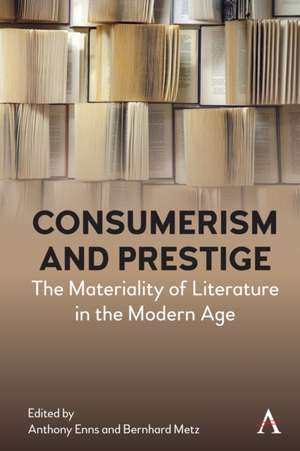
Consumerism and Prestige: Anthem Studies in Book History, Publishing and Print Culture
Editat de Anthony Enns, Bernhard Metzen Limba Engleză Hardback – 5 iul 2022
The individual chapters cover a wide range of historical periods, genres, and national literatures, and they are divided into four sections that focus on different ways in which the materiality of literature is related to cultural prestige. The first section, "Material Forms and Literary Publishing," focuses on how writers and publishers used the material properties of books to enhance their symbolic value and to challenge the idea of literature as a mass-produced commodity. These material strategies thus served to reinforce traditional distinctions of taste, which were closely aligned with the power of the literary elite, as the consumers of deluxe editions often sought to acquire respect and admiration within their social spheres. The second section, "Material Distinctions in Popular Fiction," examines how the publishers of popular texts also used the material properties of books to enhance their symbolic and economic value, as works that were perceived as less prestigious were often more marketable, yet they could appeal to different groups of readers in different ways based on an alternative set of cultural distinctions. Instead of using books to signify their socioeconomic status, for example, fans of popular genre fiction more often fetishize special editions as a way of gaining prestige within their own reading communities. The third section, "Cultural Prestige and Graphic Narratives," focuses on how the material properties of visual texts were also used to signify the differences between "low" and "high" art. The graphic novel format, for example, often served to enhance the status of previously lowbrow content by presenting it as a durable work that was worthy of being sold in bookstores and preserved in archives. The fourth and final section, "Electronic Publishing and Reading Practices," also focuses on how new forms of electronic display are currently transforming the status of literary texts. While some contributors argue that e-books are potentially more prestigious than printed books, as they are less dependent on the economic imperatives of the publishing industry, others argue that printed books continue to serve a crucial non-literary function as markers of socioeconomic status. As with the other sections, therefore, the contributors in this section agree that distinctions of taste are still largely dependent on the materiality of literature, as the material properties of literary texts continue to reflect and influence their cultural prestige.

Preț: 719.08 lei
Preț vechi: 933.87 lei
-23%
Puncte Express: 1079
Carte tipărită la comandă
Livrare economică 07-21 decembrie
Livrare prin curier în România Termenul estimat este afișat lângă disponibilitate.
Transport gratuit pentru acest produs Plată online sau ramburs, în funcție de opțiunile comenzii.
Retur gratuit în 14 zile Comandă securizată și suport în română.
Specificații
ISBN-13: 9781839982767
ISBN-10: 1839982764
Pagini: 258
Dimensiuni: 157 x 235 x 20 mm
Greutate: 0.57 kg
Editura: Anthem Press
Colecția Anthem Studies in Book History, Publishing and Print Culture
Seria Anthem Studies in Book History, Publishing and Print Culture
ISBN-10: 1839982764
Pagini: 258
Dimensiuni: 157 x 235 x 20 mm
Greutate: 0.57 kg
Editura: Anthem Press
Colecția Anthem Studies in Book History, Publishing and Print Culture
Seria Anthem Studies in Book History, Publishing and Print Culture
V-ar putea interesa
-
 'Troilus and Criseyde'Jenni NuttallPreț: 216.68 lei
 -
 Parmenides’ Vision: A Study of Parmenides’ PoemStuart B. Martin-32%Preț: 527.90 lei770.93 lei
 -
 An Introduction to Piers PlowmanMichael A Calabrese-15%Preț: 498.35 lei586.29 lei
 -
 Claudian and the Roman Epic TraditionCatherine Ware-14%Preț: 736.39 lei856.27 lei
 -
 Rethinking Roman AllianceBill Gladhill-11%Preț: 503.96 lei566.26 lei
 -
 -32%Preț: 633.85 lei929.79 lei
 -
 Linguistic Interaction in Roman ComedyPeter Barrios-Lech-36%Preț: 620.20 lei973.21 lei
 -
 Writing the Bible: Scribes, Scribalism and ScriptThomas Römer-15%Preț: 435.68 lei512.55 lei
 -
 Post-Structuralist ClassicsAndrew Benjamin-18%Preț: 1115.65 lei1360.55 lei
 -
 The Cold Counsel: The Women in Old Norse Literature and MythSarah M. Anderson-15%Preț: 428.25 lei503.82 lei
 -
 Poems Of Wine & RevelryJim ColvillePreț: 471.97 lei
 -
 A Literary History of the Fourteenth CenturyNatalino Sapegno-23%Preț: 658.43 lei855.11 lei
 -
 Alexander the Great in the Middle AgesMarkus Stock-19%Preț: 520.82 lei642.99 lei
 -
 The Task of the ClericSimone Pinet-19%Preț: 481.77 lei594.78 lei
 -
 -25%Preț: 278.87 lei370.01 lei
 -
 Miracles of the Virgin in Middle English: A Broadview Anthology of British Literature editionAdrienne Williams Boyarin-16%Preț: 151.03 lei179.92 lei
 -
 -23%Preț: 1253.59 lei1628.04 lei
 -
 A Little Primer of Tu FuDavid HawkesPreț: 101.54 lei
Notă biografică
Anthony Enns is an associate professor in the Department of English at Dalhousie University.
Bernhard Metz is an associate director of the SNF-funded project "Online-Edition der Rezensionen und Briefe Albrecht von Hallers" at the University of Bern.
Bernhard Metz is an associate director of the SNF-funded project "Online-Edition der Rezensionen und Briefe Albrecht von Hallers" at the University of Bern.
Cuprins
Acknowledgments; Contributors; Introduction: Consumerism and Prestige; Section One. MATERIAL FORMS AND LITERARYPUBLISHING, Chapter 1. Devotion and Consumption: Ludwig Tieck, Literary Pocketbooks, and the Novella Craze, Christoph Rauen; Chapter 2. Packaging Process: Peter Handke's Writing for Sale; 3 Jacob Haubenreich, Chapter 3. Contrasts in the Brazilian Book Market in the Early Twenty-First Century , Laura Rivas Gagliardi; Section Two. MATERIAL DISTINCTIONS INPOPULAR FICTION; Chapter 4. Only the "Outward Appearance" of a Harem? , eading Memoirs of an Arabian Princess as a Material Text, Kate Roy; Chapter 5 Hidden Codes of Love: The Materiality of the Category Romance Novel, An Goris; Chapter 6. Stephen King's The Girl Who Loved Tom Gordon: A Rhetorical Reading of the Schneekluth Edition Dust Jackets, Thorsten Bothe; Section Three. CULTURAL PRESTIGE ANDGRAPHIC NARRATIVES; Chapter 7. The Printing of Phantasms: The Illustrations of Nineteenth-Century Serialized Novels and their Appropriation in Max Ernst's Collage Novel Une semaine de bonté, Philipp Venghaus; Chapter 8. From Penny Dreadful to Graphic Novel: Alan Moore and Kevin O'Neill's Genealogy of Comics in The League of Extraordinary Gentlemen, Jeff Thoss; Chapter 9. Comic Books versus Graphic Novels: Commodity Forms and Cultural Prestige, Anthony Enns; Section Four. ELECTRONIC PUBLISHING ANDREADING PRACTICES; Chapter 10. The Book and the E-Book: Footnotes, Margins, and Typography in The Brief Wondrous Life of Oscar Wao, Bernhard Metz; Chapter 11. E-Book Collections as an Opportunity to Recover Unpublished or Forgotten Texts, Laura Hatry; Chapter 12. How Much Does the Symbolic Capital of Books Cost? Operationalizing the Prestige of Books in the Digital Age, Pasqualina Sorrentino and Massimo Salgaro; Index
Descriere
Descriere de la o altă ediție sau format:
This anthology explores the relationships and interdependencies between literary production and distinctions of taste by examining how the material aspects of literary texts, such as the cover, binding, typography, and paper stock, reflect or even determine their cultural status.
This anthology explores the relationships and interdependencies between literary production and distinctions of taste by examining how the material aspects of literary texts, such as the cover, binding, typography, and paper stock, reflect or even determine their cultural status.