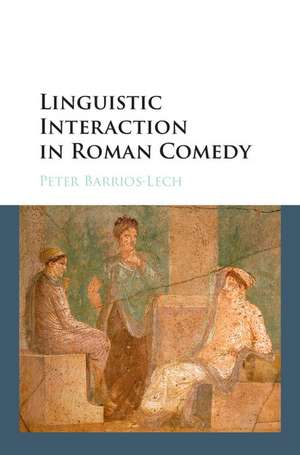
Linguistic Interaction in Roman Comedy
Autor Peter Barrios-Lechen Limba Engleză Hardback – 26 mai 2016
Preț: 620.20 lei
Preț vechi: 973.21 lei
-36%
Puncte Express: 930
Carte indisponibilă temporar
Livrare prin curier în România Termenul estimat este afișat lângă disponibilitate.
Transport gratuit pentru acest produs Plată online sau ramburs, în funcție de opțiunile comenzii.
Retur gratuit în 14 zile Comandă securizată și suport în română.
Specificații
ISBN-13: 9781107129825
ISBN-10: 1107129826
Pagini: 410
Ilustrații: 10 b/w illus. 32 tables
Dimensiuni: 158 x 238 x 26 mm
Greutate: 0.69 kg
Editura: Cambridge University Press
Locul publicării:New York, United States
ISBN-10: 1107129826
Pagini: 410
Ilustrații: 10 b/w illus. 32 tables
Dimensiuni: 158 x 238 x 26 mm
Greutate: 0.69 kg
Editura: Cambridge University Press
Locul publicării:New York, United States
V-ar putea interesa
-
 -15%Preț: 108.98 lei127.89 lei
 -
 Oxford Guides to Chaucer: Troilus and CriseydeBarry Windeatt-28%Preț: 416.04 lei577.70 lei
 -
 HoraceEduard Fraenkel-32%Preț: 612.34 lei904.22 lei
 -
 Virgil: Aeneid 10Virgil-28%Preț: 515.68 lei717.54 lei
 -
 Book VIIThucydides-23%Preț: 112.42 lei145.42 lei
 -
 Aristophanes and the Definition of ComedyM. S. Silk-28%Preț: 427.58 lei595.34 lei
 -
 Medieval Narrative: An IntroductionTony Davenport-19%Preț: 337.26 lei417.45 lei
 -
 A Commentary on Propertius, Book 3S. J. Heyworth-16%Preț: 216.83 lei258.25 lei
 -
 The Fourth Book of the Chronicle of FredegarJ. M. Wallace-Hadrill-29%Preț: 403.35 lei570.44 lei
 -
 Preț: 376.71 lei
 -
 Preț: 253.98 lei
 -
 The Cambridge Companion to Ancient RhetoricErik GundersonPreț: 286.64 lei
 -
 The Cambridge Companion to the Arthurian LegendElizabeth ArchibaldPreț: 223.84 lei
 -
 The Cambridge Companion to the Greek and Roman NovelTim WhitmarshPreț: 326.02 lei
 -
 The Book of MemoryMary CarruthersPreț: 271.45 lei
 -
 The Hammer of WitchesChristopher S. MackayPreț: 303.34 lei
Cuprins
1. Introduction; Part I. The Latin Directive: Introduction to Part I; 2. The moods of command – imperatives and subjunctives; 3. Prohibitions in Early Latin; 4. Indirect requests – questions and statements; 5. The 'can you' request and others; Conclusion to Part I; Part II. Interactional Particles in Roman Comedy: 6. How to soften a command; 7. How to strengthen a command; 8. How to soften a statement in Latin; Part III. Structuring Conversation: 9. Interruptions and attention-getters; 10. Openings and closings in Roman comedy; Conclusion to Parts I-III: summary of findings; Part IV. Interpreting Interactions in Roman Comedy: 11. Discourse in Roman comedy; 12. Role shifts, speech shifts; Appendix 1. Speech and character types in Roman comedy; Appendix 2. About the directive database; Appendix 3. Politeness phenomena in Roman comedy.
Recenzii
'This excellent work offers new insights into the ways Plautus and Terence use language. … In short, this book makes a valuable contribution in a number of different areas and will be welcomed by a wide range of scholars.' Eleanor Dickey, Bryn Mawr Classical Review
Descriere
A comprehensive account of features of Latin that emerge from dialogue, drawing on the data from Roman comedy and drama.