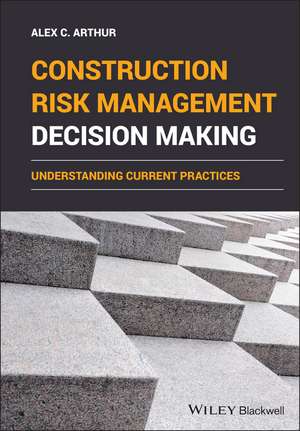
Construction Risk Management Decision Making
Autor Alex C Arthuren Limba Engleză Hardback – 22 noi 2021
Multe organizații din industria construcțiilor cad în capcana mitului conform căruia riscul poate fi gestionat exclusiv prin modele matematice rigide și date cantitative. În realitate, succesul sau eșecul unui proiect depinde de factorul uman și de deciziile intuitive luate sub presiune. În Construction Risk Management Decision Making, Alex C Arthur demontează ideea că algoritmii pot înlocui judecata profesională, propunând în schimb o ancorare solidă în științele comportamentale și gândirea sistemică. Apreciem modul în care autorul structurează materialul, începând cu fundamentarea teoretică a percepției riscului și continuând cu o analiză detaliată a sistemului de livrare în construcții. Găsim în prima parte a cărții o explorare fascinantă a modului în care trăsăturile de personalitate și diferențele culturale între stakeholderi influențează categorisirea riscurilor. Cititorul care a aplicat ideile din Managing Risk in Construction Projects 3e de N. Smith va găsi aici elementul care completează tabloul: trecerea de la procesele formale de identificare a riscului la înțelegerea proceselor cognitive care stau la baza deciziilor. Cartea este organizată progresiv, pornind de la conceptele de sisteme deschise și închise în Capitolul 2, până la diferențierea specializărilor în echipele de proiect. Această abordare sistemică ne permite să vedem proiectul nu ca pe o listă de sarcini, ci ca pe un organism viu unde interacțiunile umane generează riscuri intangibile. Spre deosebire de alte manuale tehnice, lucrarea publicată de Wiley integrează studii de caz care reflectă realitatea șantierului, oferind un ghid practic pentru prioritizarea riscurilor prin sisteme decizionale calitative.
Preț: 600.39 lei
Preț vechi: 652.59 lei
-8%
Carte tipărită la comandă
Livrare economică 26 noiembrie-10 decembrie
Specificații
ISBN-10: 1119693004
Pagini: 432
Dimensiuni: 170 x 244 x 24 mm
Greutate: 0.89 kg
Editura: Wiley
Locul publicării:Chichester, United Kingdom
V-ar putea interesa
-
 Thinking, Fast and SlowDaniel Kahneman-27%Preț: 90.73 lei123.57 leiRecomandat
 -
 On the EdgeNate SilverPreț: 107.37 lei
 -
 Risk: A Very Short IntroductionBaruch Fischhoff-19%Preț: 57.46 lei71.30 lei
 -
 RiskStanley McChrystal-31%Preț: 63.77 lei91.93 lei
 -
 You Already KnowLaura HuangPreț: 122.17 lei
 -
 Against the GodsPeter L. BernsteinPreț: 131.51 lei
 -
 People and Organizational Management in ConstructionShamil NaoumPreț: 414.25 lei
 -
 Think ClearlyKiko LlanerasPreț: 122.43 lei
 -
 Tune InNuala Walsh-11%Preț: 101.92 lei114.97 lei
 -
 Preț: 302.54 lei
 -
 -19%Preț: 451.56 lei557.48 lei
 -
 How to Measure Anything in Project ManagementDouglas W. HubbardPreț: 357.24 lei
 -
 Preț: 438.65 lei
 -
 Preț: 129.64 lei
 -
 Project Decisions, 2nd EditionLev VirinePreț: 193.10 lei
 -
 Project Risk Management: A Practical Implementation ApproachMichael A. BissonettePreț: 311.71 lei
 -
 Preț: 380.39 lei
 -
 Judgement at Work: Making Better ChoicesAndrew Likierman-19%Preț: 68.78 lei84.96 lei
 -
 Preț: 345.54 lei
 -
 Running the RiskDavid Burrett ReidPreț: 140.40 lei
De ce să citești această carte
Această carte este esențială pentru managerii de proiect și inginerii care doresc să înțeleagă de ce sistemele tradiționale de management al riscului eșuează adesea în practică. Veți învăța să identificați tiparele comportamentale care influențează deciziile critice și să aplicați gândirea sistemică pentru a naviga prin incertitudinea specifică industriei construcțiilor. Este un instrument care transformă experiența intuitivă într-o metodologie de lucru structurată.
Despre autor
Alex C Arthur este un reputat manager de proiect și consultant senior, cu o vastă experiență practică în industria construcțiilor. Expertiza sa se concentrează pe intersecția dintre managementul riscului și comportamentul organizațional, aducând o perspectivă academică riguroasă asupra proceselor decizionale din teren. Prin activitatea sa de consultant, a asistat numeroase organizații în implementarea sistemelor calitative de gestionare a proiectelor complexe, fiind totodată un colaborator activ în dezvoltarea programelor de formare pentru specialiști în inginerie și topografie.
Descriere
CONSTRUCTION RISK MANAGEMENT DECISION MAKING
Explores the relevance of systems thinking and behavioral science in construction risk management
Effective risk management is a vital component of all successful construction projects. Although quantitative tools for evaluating data and minimizing risk are readily available, construction managers commonly adopt a more innate, experience-based approach. In Construction Risk Management Decision Making, project manager and senior consultant Alex C. Arthur provides step-by-step advice on assessing and prioritizing risk using qualitative decision-making systems in the construction industry.
Incorporating key theories and concepts from systems thinking and behavioral science, this highly practical guide focuses on the behavior patterns of real people in the industry, rather than complex quantitative techniques and data. Concise, easy-to-understand chapters highlight the current practices of construction risk management while helping readers view risk and decision making from a broader perspective. Throughout the book, the author presents invaluable insights into the ways construction professionals think and behave in the real world.
- Addresses the actual risk management practices of construction professionals
- Applies human behavioral theories to the study of construction risk management decision making
- Illustrates the highly intuitive approaches prevalent in various construction projects
- Features real-life case studies and practical examples throughout
Construction Risk Management Decision Making is an excellent textbook for advanced students in project management, engineering, construction, and surveying courses, and a must-have guide for practitioners of construction management, surveying, and architecture.