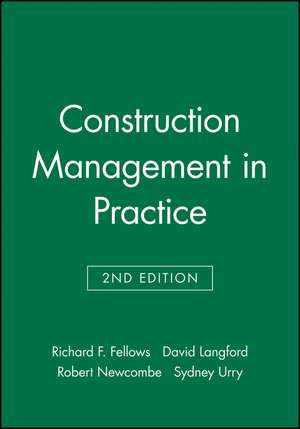
Construction Management Practice 2e
Autor Fellows, Langford Davi, Newcombe Robeen Limba Engleză Paperback – 31 dec 2001
- Business strategy
- Industrial relations
- Health and safety
- Managing people
- Financial management
- Quantitative methods
Since the book was first written in 1982 much has changed. The Second Edition has been thoroughly revised and takes account of the increased globalisation of construction, the move from public to private sector work, the drive for productivity, changing procurement methods, new emphasis on life cycle costing and much more.
It will provide a valuable text for undergraduate and postgraduate courses
in construction management, surveying and civil engineering as well as
offering useful insights for practitioners undertaking CPD activities.
Preț: 468.93 lei
Preț vechi: 609.00 lei
-23%
Puncte Express: 703
Carte tipărită la comandă
Livrare economică 27 noiembrie-11 decembrie
Livrare prin curier în România Termenul estimat este afișat lângă disponibilitate.
Transport gratuit pentru acest produs Plată online sau ramburs, în funcție de opțiunile comenzii.
Retur gratuit în 14 zile Comandă securizată și suport în română.
Specificații
ISBN-13: 9780632064021
ISBN-10: 0632064021
Pagini: 394
Dimensiuni: 170 x 244 x 21 mm
Greutate: 0.62 kg
Ediția:2. Auflage
Editura: Wiley
Locul publicării:Chichester, United Kingdom
ISBN-10: 0632064021
Pagini: 394
Dimensiuni: 170 x 244 x 21 mm
Greutate: 0.62 kg
Ediția:2. Auflage
Editura: Wiley
Locul publicării:Chichester, United Kingdom
V-ar putea interesa
-
 Introduction to ManagementColin Combe-20%Preț: 529.10 lei661.06 lei
 -
 Essentials of ManagementDavid Boddy-13%Preț: 571.93 lei657.39 lei
 -
 Introduction to Building ManagementD. Coles-39%Preț: 330.80 lei544.89 lei
 -
 Lifestyle Business PlaybookDaniel PriestleyPreț: 90.11 lei
 -
 Preț: 251.75 lei
 -
 -19%Preț: 414.50 lei511.72 lei
 -
 Construction ContractingRichard H Clough-11%Preț: 707.48 lei794.93 lei
 -
 Construction Project ManagementS Keoki Sears-11%Preț: 647.59 lei727.63 lei
 -
 -20%Preț: 322.93 lei403.66 lei
 -
 -19%Preț: 451.56 lei557.48 lei
 -
 -14%Preț: 1228.44 lei1428.41 lei
 -
 Project Management in the Construction IndustrySaleh A. Mubarak-23%Preț: 703.02 lei913.01 lei
 -
 The Caring CompanyIsaac GetzPreț: 183.45 lei
 -
 The Consultant¿s HandbookSamir ParikhPreț: 190.93 lei
 -
 The New Nature of BusinessAndre HoffmannPreț: 116.02 lei
 -
 Principles of Basic Construction Economics in the 21st CenturyAndrew Ebekozien-19%Preț: 483.22 lei596.56 lei
 -
 Management Theory and PracticeG. A. Cole-7%Preț: 409.26 lei438.63 lei
 -
 LET It HappenMau Espinosa-11%Preț: 83.92 lei93.89 lei
 -
 Shadows At WorkSteven D'SouzaPreț: 112.53 lei
 -
 -33%Preț: 372.42 lei555.53 lei
Notă biografică
Richard Fellows is joint coordinator of CIB TG-23, Culture in Construction and lectures at the University of Hong Kong. David Langford holds the Barr Chair of Construction at Strathclyde University, Glasgow.
Robert Newcombe is an MBA Course Director in the Department of Construction Management & Engineering at the University of Reading.
Sydney Urry was Professor Emeritus and Head of the Department of Building Technology at Brunel University.
Robert Newcombe is an MBA Course Director in the Department of Construction Management & Engineering at the University of Reading.
Sydney Urry was Professor Emeritus and Head of the Department of Building Technology at Brunel University.
Cuprins
Preface. Authors' note.
Acknowledgements.
Abbreviations.
1 Construction Management in Practice.
1.1 Characteristics of the construction industry.
1.2 Construction management in practice.
1.3 Strategic management.
1.4 Managing people.
1.5 Managing money.
1.6 Decision-making techniques.
References and bibliography.
2 Introduction to Strategic Management.
2.1 Concepts and definitions.
2.2 The evolution of strategic management.
Summary.
Questions.
References and bibliography.
3 Strategy Systems.
3.1 Strategic planning.
3.2 Strategic vision.
3.3 Strategic learning.
3.4 A hybrid approach.
Summary.
Questions.
References and bibliography.
4 Industrial Relations.
4.1 The history and development of industrial relations.
4.2 The role of employers' associations in construction.
4.3 The structure of employers' associations.
4.4 The role of the trade unions.
4.5 Management responsibilities in industrial relations.
4.6 Empowerment and worker participation.
4.7 The industrial relations machinery.
Summary.
Questions.
References and bibliography.
5 Health and Safety in Construction.
5.1 The magnitude of the problem.
5.2 Health and safety legislation.
5.3 The cost of safety.
5.4 The role of the safety officer.
5.5 Changing attitudes to safety.
Summary.
Questions.
References and bibliography.
6 Managing People.
Part A Planning Human Resources.
6.1 Objectives of human resource planning.
6.2 Procedures for human resource planning.
Part B Managing Human Resources.
6.3 Recruitment to the industry.
6.4 Recruitment to a trade or profession.
6.5 Recruitment to the company.
6.6 Training.
6.7 Investors in People standards.
Summary.
Questions.
References and bibliography.
7 Financing Business Units.
7.1 Types of business unit.
7.2 Sources of capital.
7.3 Capital structures.
Summary.
Questions.
References and bibliography.
8 Budgeting.
8.1 Costs.
8.2 Profit.
8.3 Financial policy.
8.4 Revenues.
8.5 Monitoring and control.
8.6 Clients.
8.7 Consultants.
8.8 Investment appraisal.
Summary.
Questions.
References and bibliography.
9 Financial Performance.
9.1 Value management.
9.2 Decisions.
9.3 Financial reporting.
9.4 Financial management.
Summary.
Questions.
References and bibliography.
10 Quantitative Decision-making.
10.1 Cost models.
10.2 Probability.
10.3 Some statistical ideas.
10.4 Linear regression.
10.5 Stock control.
10.6 Just-in-time.
Summary.
Questions.
References and bibliography.
11 Operational Research.
11.1 Network analysis.
11.2 Linear programming.
11.3 Queueing.
Summary.
Questions.
References and bibliography.
Appendix A Discounted Cash Flow Tables.
Appendix B Properties of the Normal Curve.
Appendix C Use of Current Cost Accounting.
Appendix D Recording Transactions.
Index.
Acknowledgements.
Abbreviations.
1 Construction Management in Practice.
1.1 Characteristics of the construction industry.
1.2 Construction management in practice.
1.3 Strategic management.
1.4 Managing people.
1.5 Managing money.
1.6 Decision-making techniques.
References and bibliography.
2 Introduction to Strategic Management.
2.1 Concepts and definitions.
2.2 The evolution of strategic management.
Summary.
Questions.
References and bibliography.
3 Strategy Systems.
3.1 Strategic planning.
3.2 Strategic vision.
3.3 Strategic learning.
3.4 A hybrid approach.
Summary.
Questions.
References and bibliography.
4 Industrial Relations.
4.1 The history and development of industrial relations.
4.2 The role of employers' associations in construction.
4.3 The structure of employers' associations.
4.4 The role of the trade unions.
4.5 Management responsibilities in industrial relations.
4.6 Empowerment and worker participation.
4.7 The industrial relations machinery.
Summary.
Questions.
References and bibliography.
5 Health and Safety in Construction.
5.1 The magnitude of the problem.
5.2 Health and safety legislation.
5.3 The cost of safety.
5.4 The role of the safety officer.
5.5 Changing attitudes to safety.
Summary.
Questions.
References and bibliography.
6 Managing People.
Part A Planning Human Resources.
6.1 Objectives of human resource planning.
6.2 Procedures for human resource planning.
Part B Managing Human Resources.
6.3 Recruitment to the industry.
6.4 Recruitment to a trade or profession.
6.5 Recruitment to the company.
6.6 Training.
6.7 Investors in People standards.
Summary.
Questions.
References and bibliography.
7 Financing Business Units.
7.1 Types of business unit.
7.2 Sources of capital.
7.3 Capital structures.
Summary.
Questions.
References and bibliography.
8 Budgeting.
8.1 Costs.
8.2 Profit.
8.3 Financial policy.
8.4 Revenues.
8.5 Monitoring and control.
8.6 Clients.
8.7 Consultants.
8.8 Investment appraisal.
Summary.
Questions.
References and bibliography.
9 Financial Performance.
9.1 Value management.
9.2 Decisions.
9.3 Financial reporting.
9.4 Financial management.
Summary.
Questions.
References and bibliography.
10 Quantitative Decision-making.
10.1 Cost models.
10.2 Probability.
10.3 Some statistical ideas.
10.4 Linear regression.
10.5 Stock control.
10.6 Just-in-time.
Summary.
Questions.
References and bibliography.
11 Operational Research.
11.1 Network analysis.
11.2 Linear programming.
11.3 Queueing.
Summary.
Questions.
References and bibliography.
Appendix A Discounted Cash Flow Tables.
Appendix B Properties of the Normal Curve.
Appendix C Use of Current Cost Accounting.
Appendix D Recording Transactions.
Index.
Descriere
aeo first update since 1983 -- major developments in construction management since then aeo other textbooks concentrate on the management of projects -- this deals with managing a contractora s business aeo well established text with well known authors aeo first edition published by Longman Pearson 0--852--30522--5.