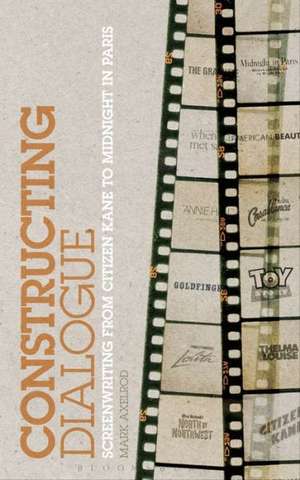
Constructing Dialogue
Autor Mark Axelroden Limba Engleză Paperback – 7 noi 2013
| Toate formatele și edițiile | Preț | Express |
|---|---|---|
| Paperback (1) | 173.54 lei 6-8 săpt. | |
| BLOOMSBURY 3PL – 7 noi 2013 | 173.54 lei 6-8 săpt. | |
| Hardback (1) | 588.58 lei 6-8 săpt. | |
| Bloomsbury Publishing – 2014 | 588.58 lei 6-8 săpt. |
Preț: 173.54 lei
Preț vechi: 209.31 lei
-17% Nou
Puncte Express: 260
Preț estimativ în valută:
30.71€ • 36.01$ • 26.97£
30.71€ • 36.01$ • 26.97£
Carte tipărită la comandă
Livrare economică 07-21 februarie 26
Preluare comenzi: 021 569.72.76
Specificații
ISBN-13: 9781441108517
ISBN-10: 1441108513
Pagini: 328
Ilustrații: black & white illustrations
Dimensiuni: 152 x 229 x 18 mm
Greutate: 0.48 kg
Ediția:New.
Editura: BLOOMSBURY 3PL
Locul publicării:New York, United States
ISBN-10: 1441108513
Pagini: 328
Ilustrații: black & white illustrations
Dimensiuni: 152 x 229 x 18 mm
Greutate: 0.48 kg
Ediția:New.
Editura: BLOOMSBURY 3PL
Locul publicării:New York, United States
V-ar putea interesa
-
 Alan PartridgeSteve CooganPreț: 108.05 lei
 -
 StoryRobert McKeePreț: 254.94 lei
 -
 Scriptwriting for the ScreenCharlie MoritzPreț: 352.05 lei
 -
 North by NorthwestErnest LehmanPreț: 89.09 lei
 -
 The Thirty-Six Dramatic SituationsMike FiggisPreț: 101.92 lei
 -
 Franco, J: Directing Herbert WhiteJames FrancoPreț: 67.68 lei
 -
 Inside The Writers' Room: Conversations with American TV WritersChristina Kallas-27%Preț: 181.98 lei250.50 lei
 -
 -18%Preț: 1176.93 lei1435.29 lei
 -
 Writing for the ScreenAnna Weinstein-18%Preț: 1016.64 lei1239.80 lei
 -
 The Creative Screenwriter: Exercises to Expand Your CraftDr. Craig Batty-13%Preț: 121.64 lei139.80 lei
 -
 Preț: 355.37 lei
 -
 -17%Preț: 172.16 lei208.52 lei
 -
 The Psychology of ScreenwritingJason Lee-18%Preț: 196.39 lei240.03 lei
 -
 Writing for TV and RadioSue Teddern-43%Preț: 118.98 lei206.97 lei
 -
 Writing the Horror MovieMarc Blake-23%Preț: 185.56 lei241.41 lei
 -
 The Gardener's SonCormac McCarthyPreț: 38.10 lei
 -
 DialogueRobert McKeePreț: 194.46 lei
 -
 Preț: 398.66 lei
 -
 Filming the UnfilmableBen Hellman-18%Preț: 202.56 lei248.09 lei
Caracteristici
Covers screenplays from the last 70 years, including Jules & Jim, Sunset Boulevard, Thelma and Louise, Lolita and Midnight in Paris
Notă biografică
Mark Axelrod is a Full Professor of English and Comparative Literature, and Director of the John Fowles Center for Creative Writing, at Chapman University, USA.
Cuprins
1. Introduction 2. Citizen Kane (1941) Herman J. Mankiewicz, Orson Welles 3. Casablanca (1942) Murray Burnett, Joan Alison, Julius J. Epstein, Philip G. Epstein, Howard Koch, Casey Robinson 4. Sunset Boulevard (1950) Billy Wilder 5. North by Northwest (1959) Ernest Lehman 6. Jules & Jim (1962) François Truffaut, Jean Gruault 7. Lolita (1963) Vladimir Nabokov, Stanley Kubrick 8. Goldfinger (1964) Richard Maibaum, Paul Dehn 9. The Graduate (1969) Calder Willingham, Buck Henry 10. Midnight Cowboy (1969) Waldo Salt 11. Chinatown (1973) Robert Towne12. Annie Hall (1977) Woody Allen, Marshall Brickman 13. When Harry Met Sally (1989) Nora Ephron 14. The Fisher King (1991) Richard LaGravanese 15. Thelma & Louise (1991) Callie Khouri 16. Toy Story (1995) John Lasseter 17. Good Will Hunting (1997) Matt Damon, Ben Affleck 18. Run Lola Run (1998) Tom Tykwer 19. American Beauty (1999) Alan Ball 20. Midnight in Paris (2010) Woody Allen ExercisesScreenplay BibliographyIndex
Recenzii
Constructing Dialogue reveals unprecedented insights into the pivotal impact of dialogue on cinematic craftsmanship. Axelrod's nuanced analysis of great Hollywood scripts investigates dialogue as an active tactical element that operates with, rather than against, visual artistry. At once gleeful, rigorous and practical, Axelrod shows that the best feature screenplays are structured down to even the "micro" level of a single well-crafted line. Crucial reading for aspiring screenwriters, film students, seasoned filmmakers and film buffs alike, Axelrod uncovers the bare bones of the screenplay, the writer's ecstatic dance with words, structure and story.
I wish I could have had at hand such a great screenwriting guide in my first steps as a student and filmmaker. It could have saved me a lot of trouble, by speeding up my own development in this area. Script doctor and visionary creative writer Axelrod provides the art of motion pictures - and film industry in general - with a unique guide that will certainly expand film possibilities over the years to come. Axelrod's book on dialogue construction can perfectly match Joseph Campbell's revolutionary writings that changed film narrative forever.
Axelrod does what Axelrod does best: knows dialogue. This unique text elucidates what the preeminent screenwriters have known and accomplished for years; namely, how to say the most with brevity and precision and move the story along. Axelrod shows that in a very succinct, if not unique, way. Anyone interested in the art of dialogue writing should read this.
I wish I could have had at hand such a great screenwriting guide in my first steps as a student and filmmaker. It could have saved me a lot of trouble, by speeding up my own development in this area. Script doctor and visionary creative writer Axelrod provides the art of motion pictures - and film industry in general - with a unique guide that will certainly expand film possibilities over the years to come. Axelrod's book on dialogue construction can perfectly match Joseph Campbell's revolutionary writings that changed film narrative forever.
Axelrod does what Axelrod does best: knows dialogue. This unique text elucidates what the preeminent screenwriters have known and accomplished for years; namely, how to say the most with brevity and precision and move the story along. Axelrod shows that in a very succinct, if not unique, way. Anyone interested in the art of dialogue writing should read this.