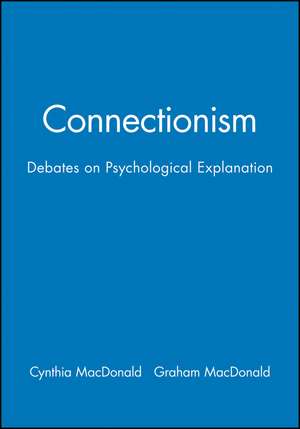
Connectionism Explanation
Autor Macdonald, MacDonald Gen Limba Engleză Paperback – 30 noi 1899
Preț: 513.31 lei
Puncte Express: 770
Carte tipărită la comandă
Livrare economică 12-26 noiembrie
Livrare prin curier în România Termenul estimat este afișat lângă disponibilitate.
Transport gratuit pentru acest produs Plată online sau ramburs, în funcție de opțiunile comenzii.
Retur gratuit în 14 zile Comandă securizată și suport în română.
Specificații
ISBN-13: 9780631197454
ISBN-10: 0631197451
Pagini: 444
Dimensiuni: 152 x 229 x 24 mm
Greutate: 0.64 kg
Ediția:New.
Editura: Wiley
Locul publicării:Chichester, United Kingdom
ISBN-10: 0631197451
Pagini: 444
Dimensiuni: 152 x 229 x 24 mm
Greutate: 0.64 kg
Ediția:New.
Editura: Wiley
Locul publicării:Chichester, United Kingdom
V-ar putea interesa
-
 -33%Preț: 868.46 lei1290.82 lei
 -
 TeleosemanticsGraham Macdonald-20%Preț: 364.30 lei453.27 lei
 -
 Understanding Vision: Theory, Models, and DataLi Zhaoping-32%Preț: 670.26 lei991.00 lei
 -
 -31%Preț: 797.12 lei1151.25 lei
 -
 Perception: Essays After FregeCharles Travis-31%Preț: 746.60 lei1079.91 lei
 -
 Possibilities of PerceptionJennifer Church-31%Preț: 567.10 lei819.00 lei
 -
 -33%Preț: 1418.25 lei2103.71 lei
 -
 -33%Preț: 949.34 lei1410.41 lei
 -
 Perception and Its ModalitiesDustin Stokes-28%Preț: 357.99 lei494.80 lei
 -
 Karl Popper: Critical AppraisalsPhilip Catton-18%Preț: 1118.30 lei1363.78 lei
 -
 Foucault & the Politics of HearingLauri Siisiäinen-18%Preț: 1249.58 lei1523.89 lei
 -
 Semantics and Social ScienceGraham MacDonald-18%Preț: 1115.17 lei1359.96 lei
 -
 Semantics and Social ScienceGraham MacDonald-15%Preț: 459.55 lei540.65 lei
 -
 The Psychology of Visual ArtGeorge MatherPreț: 432.22 lei
 -
 CONTEMP RDGS FNDNS METAPHYSICSLaurencePreț: 434.31 lei
Public țintă
advanced undergraduates, graduates, academics and researchers in cognitiveccccscience, philosophy of mind, cognitive psychologyNotă biografică
Will The Dark Emperor be able to defeat Mir Meow, his once adopted cat turned enemy? Only if he has the life crown. But just as The Dark Emperor is about to launch the attack, he discovers the truth of his lost memories.
Cuprins
Part I: Subdoxastic Explanation I: Connectionism and Classical Architecture:. 1. Introduction: Classicism v. Connectionism: Cynthia MacDonald.
2. On the Proper Treatment of Connectionism: Paul Smolensky.
3. Connectionism and Cognitive Architecture: A Critical Analysis: Jerry A. Foder and Zenon W. Pylyshyn.
4. Connectionism, Constituency and the Language of Thought: Paul Smolensky.
5. Connectionism and the Problem of Systematicity: Why Smolensky's Solution Doesn't Work: Jerry A. Foder and Brian P. McLaughlin.
6. Reply: Constituent Structure and Explanation in an Integrated Connectionist/Symbolic Cognitive Architecture: Paul Smolensky.
Part II: Subdoxastic Explanation II: Connectionism and Eliminativism: .
7. Introduction: Connectionism and Eliminativism: Cynthia Macdonald.
8. Connectionism, Eliminativism and the Future of Folk Psychology: William Ramsey, Stephen Stich and Joseph Garon.
9. Connectionist Minds: Andy Clark.
10. On the Projectable Predicates of Connectionist Psychology: A Case for Belief: Paul Smolensky.
11. Reply to Clark and Smolensky: Do Connectionists Minds Have Beliefs?: Stephen Stich and Ted Warfield.
Index.
2. On the Proper Treatment of Connectionism: Paul Smolensky.
3. Connectionism and Cognitive Architecture: A Critical Analysis: Jerry A. Foder and Zenon W. Pylyshyn.
4. Connectionism, Constituency and the Language of Thought: Paul Smolensky.
5. Connectionism and the Problem of Systematicity: Why Smolensky's Solution Doesn't Work: Jerry A. Foder and Brian P. McLaughlin.
6. Reply: Constituent Structure and Explanation in an Integrated Connectionist/Symbolic Cognitive Architecture: Paul Smolensky.
Part II: Subdoxastic Explanation II: Connectionism and Eliminativism: .
7. Introduction: Connectionism and Eliminativism: Cynthia Macdonald.
8. Connectionism, Eliminativism and the Future of Folk Psychology: William Ramsey, Stephen Stich and Joseph Garon.
9. Connectionist Minds: Andy Clark.
10. On the Projectable Predicates of Connectionist Psychology: A Case for Belief: Paul Smolensky.
11. Reply to Clark and Smolensky: Do Connectionists Minds Have Beliefs?: Stephen Stich and Ted Warfield.
Index.
Descriere
This volume provides an introduction to and review of key contemporary debates concerning connectionism, and the nature of explanation and methodology in cognitive psychology. The first debate centers on the question of whether human cognition is best modeled by classical or by connectionist architectures.