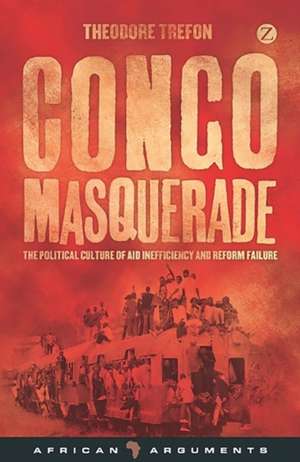
Congo Masquerade: The Political Culture of Aid Inefficiency and Reform Failure: African Arguments
Autor Theodore Trefonen Limba Engleză Paperback – 8 sep 2011
Startling and provocative, Congo Masquerade offers a critical examination of why aid is not helping the Congo.
Din seria African Arguments
-
 Preț: 233.21 lei
 - 35%
 Preț: 89.10 lei
 - 18%
 Preț: 141.88 lei
 - 41%
 Preț: 76.96 lei
 - 18%
 Preț: 133.10 lei
 -
 Preț: 233.10 lei
 - 17%
 Preț: 135.68 lei
 - 17%
 Preț: 136.27 lei
 -
 Preț: 215.93 lei
 - 18%
 Preț: 142.25 lei
 -
 Preț: 231.27 lei
 - 17%
 Preț: 148.52 lei
 - 17%
 Preț: 147.03 lei
 - 17%
 Preț: 147.42 lei
 - 18%
 Preț: 141.20 lei
 - 18%
 Preț: 128.24 lei
 - 18%
 Preț: 129.04 lei
 - 11%
 Preț: 123.32 lei
 - 17%
 Preț: 130.44 lei
 - 24%
 Preț: 557.39 lei
 - 17%
 Preț: 157.73 lei
 - 16%
 Preț: 122.67 lei
 - 18%
 Preț: 129.04 lei
 - 15%
 Preț: 123.32 lei
 - 16%
 Preț: 122.23 lei
 - 21%
 Preț: 137.09 lei
 - 24%
 Preț: 550.53 lei
 - 30%
 Preț: 525.31 lei
 - 17%
 Preț: 157.73 lei
 - 38%
 Preț: 447.91 lei
 - 23%
 Preț: 129.77 lei
 - 16%
 Preț: 132.87 lei
 - 18%
 Preț: 129.63 lei
 - 27%
 Preț: 150.09 lei
 - 15%
 Preț: 89.24 lei
 - 30%
 Preț: 523.45 lei
 - 34%
 Preț: 529.38 lei
 - 25%
 Preț: 526.56 lei
Preț: 134.95 lei
Puncte Express: 202
Carte tipărită la comandă
Livrare economică 23 noiembrie-07 decembrie
Livrare prin curier în România Termenul estimat este afișat lângă disponibilitate.
Transport gratuit de la 400.00 lei Plată online sau ramburs, în funcție de opțiunile comenzii.
Retur gratuit în 14 zile Comandă securizată și suport în română.
Specificații
ISBN-13: 9781848138360
ISBN-10: 1848138369
Pagini: 176
Dimensiuni: 124 x 198 x 12 mm
Greutate: 0.2 kg
Editura: Bloomsbury Publishing
Colecția Zed Books
Seria African Arguments
Locul publicării:London, United Kingdom
ISBN-10: 1848138369
Pagini: 176
Dimensiuni: 124 x 198 x 12 mm
Greutate: 0.2 kg
Editura: Bloomsbury Publishing
Colecția Zed Books
Seria African Arguments
Locul publicării:London, United Kingdom
V-ar putea interesa
-
 Emergency Sex (And Other Desperate Measures)Andrew Thomson-25%Preț: 83.61 lei111.94 lei
 -
 Aid and Other Dirty BusinessGiles Bolton-20%Preț: 95.12 lei119.41 lei
 -
 Dead AidDambisa Moyo-20%Preț: 63.04 lei78.35 lei
 -
 -33%Preț: 558.90 lei829.70 lei
 -
 Fragile Aid: Development Cooperation in Weak States and Conflict ContextsRachel M. Gisselquist-33%Preț: 538.29 lei808.59 lei
 -
 -17%Preț: 97.52 lei116.87 lei
 -
 Preț: 125.11 lei
 -
 Dead AidDambisa MoyoPreț: 102.95 lei
 -
 Hunger Inc.: Building Solidarity Beyond the Food BankKayleigh GarthwaitePreț: 122.16 lei
 -
 Aid and Reform in Africa: Lessons from Ten Case StudiesShantayanan DevarajanPreț: 249.82 lei
 -
 Failed StateSam Freedman-33%Preț: 52.15 lei78.31 lei
 -
 -22%Preț: 210.36 lei269.93 lei
 -
 The Blunders of Our GovernmentsAnthony KingPreț: 80.53 lei
 -
 Neither Devil Nor ChildTom YoungPreț: 153.52 lei
 -
 -26%Preț: 57.72 lei78.41 lei
 -
 Doom LoopEswar S. PrasadPreț: 185.03 lei
 -
 AfricaTom YoungPreț: 70.91 lei
 -
 -23%Preț: 166.00 lei215.38 lei
 -
 Preț: 206.94 lei
Cuprins
Preface and Acknowledgements
The Crocodile and the Scorpion: a Parable
Timeline
Map of Democratic Republic of Congo
1. Why State-Building is Not Working
2. The Political Economy of Broken Promises
3. A Patchwork of Unrealisitic Reforms
4. The Administrative Juggernaut
5. Culture Matters
6. Conclusion
Bibliography
The Crocodile and the Scorpion: a Parable
Timeline
Map of Democratic Republic of Congo
1. Why State-Building is Not Working
2. The Political Economy of Broken Promises
3. A Patchwork of Unrealisitic Reforms
4. The Administrative Juggernaut
5. Culture Matters
6. Conclusion
Bibliography
Recenzii
Indispensable reading for all those interested in post-conflict state-building.
Trefon has written a compelling and well-informed account of the ever unfolding catastrophe that is the Congo; he ably chronicles the mixtures of incompetence, venality, and short-sighted selfish interests on the part of domestic and international actors that have been that country's undoing. This is an excellent introduction to the Congo's complex problems.
An impressive piece of work. In 150 pages of concisely analyzed and carefully referenced data, Trefon covers the most salient features of the Congo's 'unending crisis'. There is plenty of blame to be shared, and Trefon evenhandedly identifies the tacit collusion that links the transnational networks of 'aid donors', INGO's, and local NGOs and Congolese actors. The combination of 'development aid' that 'neither aids nor develops with a largely impotent yet arbitrary state apparatus -the legitimacy of which has been in doubt for over fifty years- accounts in large part for the appalling gap between the Congo's potential and its enduring misery. In a nuanced yet compelling way, Trefon argues (as others have done for Liberia and Sierra Leone) for the need to 'put the state back in' and to reform it in such a way as to give it the capacity to deliver public goods. He also points out that, contrary to some Western stereotypes, the Congolese have maintained a genuine sense of national identity which (whether or not it represents a form of 'imagined community') suggests that the Congo is, in some ways, a nation in search of a state, and that 'state-building' may be a more urgent priority than 'nation-building.
A superb, richly-illustrated study of how culture thwarts the desire of foreigners and the Congolese alike to bring real, structural reform to the country's development administration.
Understanding the Congo -- formerly Zaïre -- is not easy, which explains why we tend easily to think according to clichés, old and new. If we are to move away from Manichean interpretations, including whether the Congo is or is not 'the heart of darkness', we need to rely on scholarship that is at once empirical and sensitive to the historical and cultural context of the country's present condition. Trefon's Congo Masquerade is an important contribution to such scholarship since it asks the right questions about why aid has failed to lead to the required reforms in the country. Focusing on the contemporary period, Trefon explains how state failure can be 'profitable' for those who control it and why the prevalent political culture prevents reform from taking root. Written in simple prose and short chapters, this book will provide a more convincing explanation of what is happening in the Congo than most other books available today. It should be mandatory reading for all those who are concerned with the country or are involved in efforts to reform the state and spur development.
Trefon's sweeping survey of reconstruction efforts in Congo, from bridge repairs to security sector reform, delivers a stinging indictment of both the Congolese government and its international partners, leaving no one unscathed. Sure to create controversy, this book makes for a compelling read and calls for an understanding of Congo and the Congolese on their own terms.
Trefon has written a compelling and well-informed account of the ever unfolding catastrophe that is the Congo; he ably chronicles the mixtures of incompetence, venality, and short-sighted selfish interests on the part of domestic and international actors that have been that country's undoing. This is an excellent introduction to the Congo's complex problems.
An impressive piece of work. In 150 pages of concisely analyzed and carefully referenced data, Trefon covers the most salient features of the Congo's 'unending crisis'. There is plenty of blame to be shared, and Trefon evenhandedly identifies the tacit collusion that links the transnational networks of 'aid donors', INGO's, and local NGOs and Congolese actors. The combination of 'development aid' that 'neither aids nor develops with a largely impotent yet arbitrary state apparatus -the legitimacy of which has been in doubt for over fifty years- accounts in large part for the appalling gap between the Congo's potential and its enduring misery. In a nuanced yet compelling way, Trefon argues (as others have done for Liberia and Sierra Leone) for the need to 'put the state back in' and to reform it in such a way as to give it the capacity to deliver public goods. He also points out that, contrary to some Western stereotypes, the Congolese have maintained a genuine sense of national identity which (whether or not it represents a form of 'imagined community') suggests that the Congo is, in some ways, a nation in search of a state, and that 'state-building' may be a more urgent priority than 'nation-building.
A superb, richly-illustrated study of how culture thwarts the desire of foreigners and the Congolese alike to bring real, structural reform to the country's development administration.
Understanding the Congo -- formerly Zaïre -- is not easy, which explains why we tend easily to think according to clichés, old and new. If we are to move away from Manichean interpretations, including whether the Congo is or is not 'the heart of darkness', we need to rely on scholarship that is at once empirical and sensitive to the historical and cultural context of the country's present condition. Trefon's Congo Masquerade is an important contribution to such scholarship since it asks the right questions about why aid has failed to lead to the required reforms in the country. Focusing on the contemporary period, Trefon explains how state failure can be 'profitable' for those who control it and why the prevalent political culture prevents reform from taking root. Written in simple prose and short chapters, this book will provide a more convincing explanation of what is happening in the Congo than most other books available today. It should be mandatory reading for all those who are concerned with the country or are involved in efforts to reform the state and spur development.
Trefon's sweeping survey of reconstruction efforts in Congo, from bridge repairs to security sector reform, delivers a stinging indictment of both the Congolese government and its international partners, leaving no one unscathed. Sure to create controversy, this book makes for a compelling read and calls for an understanding of Congo and the Congolese on their own terms.