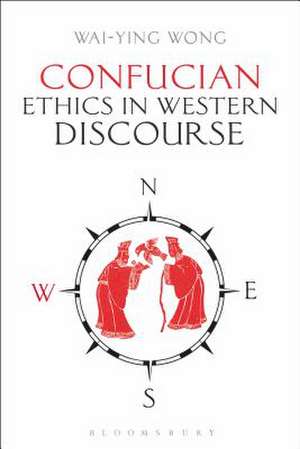
Confucian Ethics in Western Discourse
Autor Wai-ying Wongen Limba Engleză Paperback – 18 apr 2019
Through analysis of the meaning of virtues in Confucian ethics it draws comparison with virtues in Aristotlelian moral philosophy, and offers an in-depth review of the thought of Cheng Brothers in the Song Dynasty, shedding light on current ethical issues. With careful textual studies and philosophical perceptiveness, Confucian Ethics in Western Discourse connects ancient Chinese thought and contemporary problems in Western philosophy.
| Toate formatele și edițiile | Preț | Express |
|---|---|---|
| Paperback (1) | 238.99 lei 6-8 săpt. | |
| Bloomsbury Publishing – 18 apr 2019 | 238.99 lei 6-8 săpt. | |
| Hardback (1) | 737.26 lei 6-8 săpt. | |
| Bloomsbury Publishing – 19 oct 2017 | 737.26 lei 6-8 săpt. |
Preț: 238.99 lei
Preț vechi: 331.41 lei
-28%
Puncte Express: 358
Preț estimativ în valută:
42.29€ • 50.42$ • 36.78£
42.29€ • 50.42$ • 36.78£
Carte tipărită la comandă
Livrare economică 27 martie-10 aprilie
Specificații
ISBN-13: 9781350109087
ISBN-10: 1350109088
Pagini: 296
Dimensiuni: 156 x 234 x 18 mm
Greutate: 0.42 kg
Editura: Bloomsbury Publishing
Colecția Bloomsbury Academic
Locul publicării:London, United Kingdom
ISBN-10: 1350109088
Pagini: 296
Dimensiuni: 156 x 234 x 18 mm
Greutate: 0.42 kg
Editura: Bloomsbury Publishing
Colecția Bloomsbury Academic
Locul publicării:London, United Kingdom
V-ar putea interesa
-
 The Conference of the BirdsFarid Ud-Din Attar-20%Preț: 60.32 lei75.42 lei
 -
 The Art of WarSun TzuPreț: 62.68 lei
 -
 Zen MastersSteven HeinePreț: 308.78 lei
 -
 Perception: An Essay on Classical Indian Theories of KnowledgeBimal Krishna Matilal-28%Preț: 374.99 lei519.35 lei
 -
 -27%Preț: 629.25 lei860.65 lei
 -
 Preț: 383.69 lei
 -
 The Art of WarSun Tzu-22%Preț: 41.64 lei53.66 lei
 -
 Notes on Spiritual Discourses of Shri Atmananda: Volume 1Atmananda Shri AtmanandaPreț: 83.95 lei
 -
 Preț: 162.76 lei
 -
 Preț: 113.68 lei
 -
 Out of Your MindAlan WattsPreț: 96.45 lei
 -
 Preț: 102.34 lei
 -
 Die Kuh, die weinteAjahn BrahmPreț: 130.10 lei
Cuprins
Introduction
1. The Characteristics of Confucian Ethics
2. Confucian Ethics in Western Discourse
3. The Heritage and Development of Neo-Confucianism: The Thought of Cheng Brothers
4. Confucian Ethics and Contemporary Cultural Phenomena
Appendix
Endnotes
References
1. The Characteristics of Confucian Ethics
2. Confucian Ethics in Western Discourse
3. The Heritage and Development of Neo-Confucianism: The Thought of Cheng Brothers
4. Confucian Ethics and Contemporary Cultural Phenomena
Appendix
Endnotes
References
Recenzii
Wong . trims down the discussion of Confucianism to the moral dimensions of Confucian and Neo-Confucian thought, and their possible connections to traditional and contemporary Western ethical reflections. To be sure, this does not constitute a shortcoming of the book: rather, it is a deliberate decision by Wong to focus largely on the ethical considerations of an ever-evolving body of thought of Chinese origins. At that, it carries out an excellent job . [For] readers who are attracted to comparative ethical analyses, the work will likely appeal.
In this magnificent book, Wong brings ancient Chinese philosophy into dialogue with contemporary Western moral philosophy, showing how the former is not only still relevant to the latter, but also in what sense and to what extent it can significantly contribute to it.
This book explores and discusses some significant philosophical issues of ethics from the perspective of Confucianism. It is unique in the sense that it provides a dialogue between Confucianism and western ethics. People who are interested in Confucianism and ethics, especially those who adopt a comparative approach in ethics, will love to read this book.
This book contains the most up-to-date interpretation and reconstruction of the mainstream ideas of the two most creative contemporary Neo-Confucians, namely, Tang Junyi and Mou Zongsan. It relates these to the problems and concepts of Western ethics, engaging philosophers such as Aristotle and Hare, with a view of offering alternative perspectives and solutions to some of the most prominent ethical issues of today.
In this magnificent book, Wong brings ancient Chinese philosophy into dialogue with contemporary Western moral philosophy, showing how the former is not only still relevant to the latter, but also in what sense and to what extent it can significantly contribute to it.
This book explores and discusses some significant philosophical issues of ethics from the perspective of Confucianism. It is unique in the sense that it provides a dialogue between Confucianism and western ethics. People who are interested in Confucianism and ethics, especially those who adopt a comparative approach in ethics, will love to read this book.
This book contains the most up-to-date interpretation and reconstruction of the mainstream ideas of the two most creative contemporary Neo-Confucians, namely, Tang Junyi and Mou Zongsan. It relates these to the problems and concepts of Western ethics, engaging philosophers such as Aristotle and Hare, with a view of offering alternative perspectives and solutions to some of the most prominent ethical issues of today.