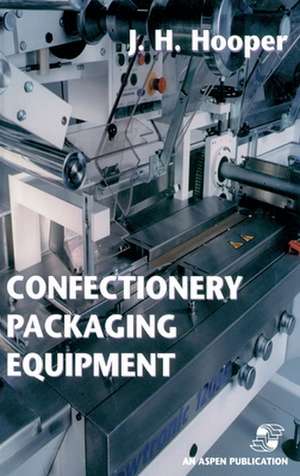
Confectionery Packaging Equipment
Autor Jeffrey H. Hooperen Limba Engleză Hardback – 30 sep 1998
Preț: 649.22 lei
Preț vechi: 763.78 lei
-15%
Puncte Express: 974
Carte tipărită la comandă
Livrare economică 19 noiembrie-03 decembrie
Livrare prin curier în România Termenul estimat este afișat lângă disponibilitate.
Transport gratuit pentru acest produs Plată online sau ramburs, în funcție de opțiunile comenzii.
Retur gratuit în 14 zile Comandă securizată și suport în română.
Specificații
ISBN-13: 9780834212374
ISBN-10: 0834212374
Pagini: 292
Ilustrații: XVII, 268 p.
Dimensiuni: 160 x 241 x 22 mm
Greutate: 0.61 kg
Ediția:1999
Editura: Springer
Locul publicării:New York, NY, United States
ISBN-10: 0834212374
Pagini: 292
Ilustrații: XVII, 268 p.
Dimensiuni: 160 x 241 x 22 mm
Greutate: 0.61 kg
Ediția:1999
Editura: Springer
Locul publicării:New York, NY, United States
V-ar putea interesa
-
 English Books and Readers 1558 1603H. S. BennettPreț: 302.79 lei
 -
 The Packaging User's HandbookFrank A. Paine-18%Preț: 1242.09 lei1514.74 lei
 -
 Packaging of Pharmaceuticals and Healthcare ProductsFrank A. Paine-15%Preț: 662.49 lei779.41 lei
 -
 CanmakingTerry A. Turner-18%Preț: 1433.35 lei1747.99 lei
 -
 Industrial and Specialty Papers, Volume 1, TechnologyRobert R. Mosher-9%Preț: 697.69 lei766.69 lei
 -
 Industrial and Specialty Papers, Volume 2, ManufactureRobert H. Mosher-9%Preț: 697.69 lei766.69 lei
 -
 Industrial and Specialty Papers, Volume 3, ApplicationsRobert H. Mosher-8%Preț: 563.38 lei612.36 lei
 -
 -18%Preț: 983.36 lei1199.22 lei
 -
 Packaging, Policy and the EnvironmentGeoffrey M. Levy-18%Preț: 987.20 lei1203.91 lei
 -
 Managing Packaging Design for Sustainable DevelopmentDaniel Hellström-8%Preț: 550.25 lei598.10 lei
 -
 Preț: 380.91 lei
 -
 Encyclopedia of Label TechnologyMichael Fairley-23%Preț: 813.73 lei1056.79 lei
 -
 Preț: 375.14 lei
 -
 Principles of Package DevelopmentRoger C. GriffinPreț: 382.05 lei
Public țintă
ResearchCuprins
1 An introduction to packaging machines.- 1.1 Fundamental questions.- 1.2 The start of the packaging machine industry.- 1.3 Types of packaging machines.- 1.4 Associated machinery.- 2 Common features in conventional wrapping machines.- 2.1 Basics of wrapping machine design.- 2.2 Conventional wrapping machines.- 2.3 The supply of aluminium foil and paper wrappers.- 2.4 Component parts used when supplying wrappers and foil from a reel.- 2.5 Adhesive application.- 2.6 Folding the wrapper.- 2.7 Stacking.- 2.8 Mechanical latches and trips and machine inhibition.- 2.9 Machine guards and safety mechanisms.- 2.10 Lubrication.- 2.11 Timing—the synchronization of machine operations.- 2.12 Other methods of machine synchronization.- 3 The distribution of produce from manufacture to packaging machines.- 3.1 Automatic feeding to bar wrapping machines.- 3.2 Automatic feeder developments.- 3.3 Summary of basic system.- 3.4 Controls.- 3.5 Automatic feeders for horizontal FFS (pillowpack) machines.- 3.6Simple distribution feeders.- 3.7 Waterfall feeders.- 4 Basic descriptions of some of the most used confectionery wrapping machines and machine interaction with materials.- 4.1 Wrapping machines for specific wrapping operations.- 4.2 Chocolate bar wrappers.- 4.3 Batch rollers, rope sizing and cut and wrap machines.- 4.4 Foiling machines.- 4.5 Egg foiling machines.- 4.6 Rollwrapping machines.- 4.7 Stickpack machines.- 4.8 Twist wrapping machines.- 4.9 A brief look at interaction between materials and machines.- 5 Equipment that complements packaging machines.- 5.1 Metal detectors.- 5.2 Checkweighers.- 5.3 Weighers and fillers.- 5.4 Robots (used as pick and place machines).- 5.5 Image recognition robots.- 5.6 Blister packing machines.- 5.7 Ancillary equipment.- 5.8 Splicing attachments.- 5.9 High speed fault analysis.- 6 Form, fill, seal wrapping machines.- 6.1 Form, fill, seal (FFS) machines.- 6.2 Horizontal FFS machines.- 6.3 Relationship between lengths, speeds and synchronization ofposition.- 6.4 Speed of machine elements.- 6.5 Synchronization of positions.- 6.6 Pack dimensions.- 6.7 Transfer assistance.- 6.8 Adjustments during production for mechanically operated machines.- 6.9 Changing a machine to facilitate different sizes.- 6.10 Electronic FFS machines.- 6.11 Common features in horizontal FFS wrapping machines.- 6.12 Vertical form, fill, seal machines.- 6.13 Multi-lane wrapping machines.- 6.14 Making multi-packs on horizontal FFS machines.- 6.15 Methods of feeding horizontal FFS type wrapping machines.- 6.16 Special machines.- 7 Equipment that is allied to packaging machinery.- 7.1 Allied machinery.- 7.2 Buffer storage.- 7.3 Carton erectors.- 7.4 Case erectors.- 7.5 Case sealers.- 7.6 Channelizers.- 7.7 Chillers.- 7.8 Collators.- 7.9 Conveyors.- 7.10 Automatic belt tracking devices.- 7.11 Conveyor access control (gates).- 7.12 Overwrapping machines.- 7.13 Pallet stretch wrapping machines.- 7.14 Palletizers.- 7.15 Special overwrapping applications.- 8 The operation of machines for filling cartons and cases.- 8.1 Loading and filling machines for cartons and cases.- 8.2 Machine 1—casing machine with mainly pneumatic operation.- 8.3 Machine 2—mechanically operated carton loading machine.- 8.4 Machine 3—casing machine with pneumatic operation and electronic control.- 8.5 Machine 4—mechanical collation and electronic control: machine principle suitable for both carton and case loading.- 8.6 Machine 5—pneumatic operation with PLC controls.- 8.7 Lined carton machines.- 8.8 Small tubes as cartons.- 8.9 Robots for carton filling.- 9 Factory services, maintenance and hygiene relative to packaging.- 9.1 Factory services.- 9.2 Electrical supplies to machines.- 9.3 Compressed air.- 9.4 Vacuum.- 9.5 Air conditioning.- 9.6 Cooling air.- 9.7 Drinking water and hot water.- 9.8 Cooling water.- 9.9 Waste extraction.- 9.10 Maintenance matters.- 9.11 Hygiene and packaging.- 10 A packaging project: machine performance and used machinery.- 10.1 The approach to apackaging project.- 10.2 Machine performance.- 10.3 Buying used machinery.