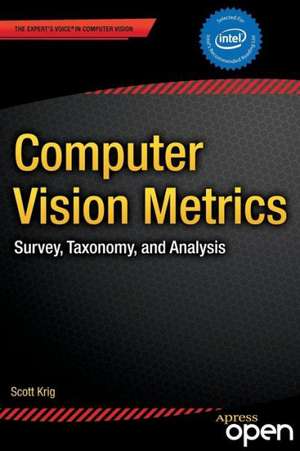
Computer Vision Metrics: Survey, Taxonomy, and Analysis
Autor Scott Krigen Limba Engleză Paperback – 29 mai 2014
| Toate formatele și edițiile | Preț | Express |
|---|---|---|
| Paperback (2) | 244.51 lei 6-8 săpt. | |
| Apress – 29 mai 2014 | 244.51 lei 6-8 săpt. | |
| Springer International Publishing – 14 iun 2018 | 590.40 lei 6-8 săpt. | |
| Hardback (2) | 707.57 lei 3-5 săpt. | |
| Springer International Publishing – 4 oct 2016 | 707.57 lei 3-5 săpt. | |
| Springer – 17 apr 2025 | 720.03 lei 6-8 săpt. |
Preț: 244.51 lei
Preț vechi: 305.64 lei
-20% Nou
Puncte Express: 367
Preț estimativ în valută:
43.27€ • 50.74$ • 37.100£
43.27€ • 50.74$ • 37.100£
Carte tipărită la comandă
Livrare economică 05-19 februarie 26
Preluare comenzi: 021 569.72.76
Specificații
ISBN-13: 9781430259299
ISBN-10: 1430259299
Pagini: 250
Ilustrații: XXXI, 508 p. 216 illus.
Dimensiuni: 178 x 254 x 32 mm
Greutate: 0.74 kg
Ediția:1st ed.
Editura: Apress
Colecția Apress
Locul publicării:Berkeley, CA, United States
ISBN-10: 1430259299
Pagini: 250
Ilustrații: XXXI, 508 p. 216 illus.
Dimensiuni: 178 x 254 x 32 mm
Greutate: 0.74 kg
Ediția:1st ed.
Editura: Apress
Colecția Apress
Locul publicării:Berkeley, CA, United States
V-ar putea interesa
-
 -29%Preț: 794.93 lei1112.53 lei
 -
 -20%Preț: 259.66 lei324.58 lei
 -
 Digital Image Compositing FundamentalsWallace Jackson-20%Preț: 173.50 lei216.88 lei
 -
 Foundation Dreamweaver MX 2004George McLachlan-20%Preț: 172.61 lei215.76 lei
 -
 Foundation ActionScript for Flash 8Kristian Besley-20%Preț: 231.65 lei289.55 lei
 -
 Digital Image Processing HandbookNiceto Salazar-20%Preț: 552.45 lei690.56 lei
 -
 -20%Preț: 319.92 lei399.90 lei
 -
 -20%Preț: 312.17 lei390.21 lei
 -
 -20%Preț: 318.67 lei398.33 lei
 -
 -20%Preț: 313.24 lei391.55 lei
 -
 -20%Preț: 320.24 lei400.30 lei
 -
 -20%Preț: 319.92 lei399.90 lei
 -
 -20%Preț: 330.23 lei412.79 lei
 -
 -20%Preț: 300.33 lei375.41 lei
 -
 -20%Preț: 247.77 lei309.71 lei
 -
 Pathological Brain DetectionShui-Hua Wang-20%Preț: 323.23 lei404.04 lei
 -
 -20%Preț: 310.23 lei387.79 lei
Public țintă
Popular/generalCuprins
Chapter 1. Image Capture and Representation
Chapter 2. Image Pre-Processing
Chapter 3. Global and Regional Features
Chapter 4. Local Feature Design Concepts, Classification, and Learning
Chapter 5. Taxonomy Of Feature Description Attributes
Chapter 6. Interest Point Detector and Feature Descriptor Survey
Chapter 7. Ground Truth Data, Data, Metrics, and Analysis
Chapter 8. Vision Pipelines and Optimizations
Appendix A. Synthetic Feature Analysis
Appendix B. Survey of Ground Truth Datasets
Appendix C. Imaging and Computer Vision Resources
Appendix D. Extended SDM Metrics
Chapter 2. Image Pre-Processing
Chapter 3. Global and Regional Features
Chapter 4. Local Feature Design Concepts, Classification, and Learning
Chapter 5. Taxonomy Of Feature Description Attributes
Chapter 6. Interest Point Detector and Feature Descriptor Survey
Chapter 7. Ground Truth Data, Data, Metrics, and Analysis
Chapter 8. Vision Pipelines and Optimizations
Appendix A. Synthetic Feature Analysis
Appendix B. Survey of Ground Truth Datasets
Appendix C. Imaging and Computer Vision Resources
Appendix D. Extended SDM Metrics
Notă biografică
Scott Krig is a pioneer in computer imaging, computer vision, and graphics visualization. He founded Krig Research in 1988 (krigresearch.com), providing the world’s first imaging and vision systems based onhigh-performance engineering workstations, super-computers, and dedicated imaging hardware, serving customers worldwide in 25 countries. Scott has provided imaging and vision solutions around the globe, and has worked closely with many industries, including aerospace, military, intelligence, law enforcement, government research, and academic organizations.More recently, Scott has worked for major corporations and startups serving commercial markets, solving problems in the areas of computer vision, imaging, graphics, visualization, robotics, process control, industrial automation, computer security, cryptography, and consumer applications of imaging and machine vision to PCs, laptops, mobile phones, and tablets. Most recently, Scott provided direction for Intel Corporation in the area of depth-sensing and computer vision methods for embedded systems and mobile platforms.Scott is the author of many patent applications worldwide in the areas of embedded systems, imaging, computer vision, DRM, and computer security, and studied at Stanford.
Caracteristici
Computer Vision Metrics provides an extensive survey and analysis of current and historical feature description and machine vision methods, with a detailed taxonomy for local, regional and global features.
The taxonomy includes search methods, spectra components, descriptor representation, shape, distance functions, accuracy, efficiency, robustness and invariance attributes, and more.
The taxonomy includes search methods, spectra components, descriptor representation, shape, distance functions, accuracy, efficiency, robustness and invariance attributes, and more.
Textul de pe ultima copertă
This 2nd Edition, based on the successful 2016 textbook, has been updated and expanded to cover 3rd generation Computer Vision and AI as it supersedes historical visual computing methods, providing a comprehensive survey of essential topics and methods in Computer Vision. With over 1,200 essential references, as well as chapter-by-chapter learning assignments, the book offers a valuable resource for students, researchers, scientists and engineers, helping them dig deeper into core computer vision and foundational visual computing and neuroscience topics.
As before, a historical survey of advances in Computer Vision is provided, updated to reflect the latest methods such as Vision Transformers, attention models, alternative features such as Fourier neurons and Binary neurons, hybrid DNN architectures, self-supervised and enhanced learning models, Associative Multimodal Learning, Continuous Learning, View Synthesis, intelligent Scientific Imaging, and advances in training protocols. Updates have also been added for 2d/3d cameras, software libraries and open source resources, computer vision cloud services, and vision/AI hardware accelerators. Discussion and analysis are provided to uncover intuition and delve into the essence of key advancements, applied and forward-looking topics.