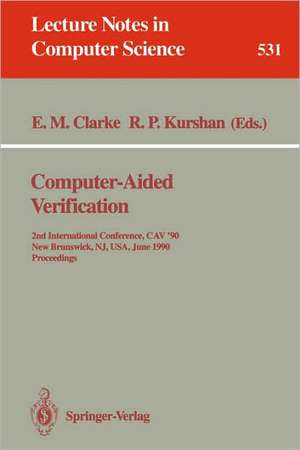
Computer-Aided Verification
Editat de Edmund M. Clarke, Robert P. Kurshanen Limba Engleză Paperback – 2 oct 1991
Preț: 381.74 lei
Puncte Express: 573
Carte tipărită la comandă
Livrare economică 26 noiembrie-10 decembrie
Livrare prin curier în România Termenul estimat este afișat lângă disponibilitate.
Transport gratuit de la 400.00 lei Plată online sau ramburs, în funcție de opțiunile comenzii.
Retur gratuit în 14 zile Comandă securizată și suport în română.
Specificații
ISBN-13: 9783540544777
ISBN-10: 3540544771
Pagini: 392
Ilustrații: XIV, 378 p.
Dimensiuni: 155 x 235 x 22 mm
Greutate: 0.59 kg
Ediția:1991
Editura: Springer
Locul publicării:Berlin, Heidelberg, Germany
ISBN-10: 3540544771
Pagini: 392
Ilustrații: XIV, 378 p.
Dimensiuni: 155 x 235 x 22 mm
Greutate: 0.59 kg
Ediția:1991
Editura: Springer
Locul publicării:Berlin, Heidelberg, Germany
V-ar putea interesa
-
 Not Exactly: In Praise of VaguenessKees van Deemter-16%Preț: 123.57 lei147.89 lei
 -
 Notes on Set TheoryYiannis MoschovakisPreț: 472.08 lei
 -
 A Course in Model TheoryBruno Poizat-15%Preț: 612.43 lei720.50 lei
 -
 -27%Preț: 683.97 lei936.94 lei
 -
 Lambda Calculus with TypesHenk Barendregt-11%Preț: 698.84 lei785.21 lei
 -
 Theory of Computational ComplexityDing-Zhu Du-9%Preț: 850.00 lei934.08 lei
 -
 Logic and Discrete Mathematics - A ConciseIntroductionWillem ConradiePreț: 545.64 lei
 -
 Preț: 183.57 lei
 -
 Mathematical Logic for Computer ScienceMordechai Ben-Ari-20%Preț: 395.53 lei494.41 lei
 -
 Preț: 497.59 lei
 -
 Introducing InfinityBrian CleggPreț: 63.40 lei
 -
 Sets, Logic and CategoriesPeter J. CameronPreț: 280.57 lei
 -
 The Life and Work of Leon HenkinMaría ManzanoPreț: 398.56 lei
 -
 -15%Preț: 735.59 lei865.39 lei
 -
 Preț: 419.31 lei
Public țintă
ResearchCuprins
Temporal logic model checking: Two techniques for avoiding the state explosion problem.- Automatic verification of extensions of hardware descriptions.- Papetri : Environment for the analysis of PETRI nets.- Verifying temporal properties of sequential machines without building their state diagrams.- Formal verification of digital circuits using symbolic ternary system models.- Vectorized model checking for computation tree logic.- to a computational theory and implementation of sequential hardware equivalence.- Auto/autograph.- A data path verifier for register transfer level using temporal logic language Tokio.- The use of model checking in ATPG for sequential circuits.- Compositional design and verification of communication protocols, using labelled petri nets.- Issues arising in the analysis of L.0.- Automated RTL verification based on predicate calculus.- On using protean to verify ISO FTAM protocol.- Quantitative temporal reasoning.- Using partial-order semantics to avoid the state explosion problem in asynchronous systems.- A stubborn attack on state explosion.- Using optimal simulations to reduce reachability graphs.- Using partial orders to improve automatic verification methods.- Compositional minimization of finite state systems.- Minimal model generation.- A context dependent equivalence relation between kripke structures.- The modular framework of computer-aided verification.- Verifying liveness properties by verifying safety properties.- Memory efficient algorithms for the verification of temporal properties.- A unified approach to the deadlock detection problem in networks of communicating finite state machines.- Branching time regular temporal logic for model checking with linear time complexity.- The algebraic feedback product of automata.- Synthesizing processes and schedulers from temporal specifications.- Task-driven supervisory control of discrete event systems.- A proof lattice-based technique for analyzing liveness of resource controllers.- Verification of a multiprocessor cache protocol using simulation relations and higher-order logic (summary).- Computer assistance for program refinement.- Program verification by symbolic execution of hyperfinite ideal machines.- Extension of the Karp and miller procedure to lotos specifications.- An algebra for delay-insensitive circuits.- Finiteness conditions and structural construction of automata for all process algebras.- On automatically explaining bisimulation inequivalence.