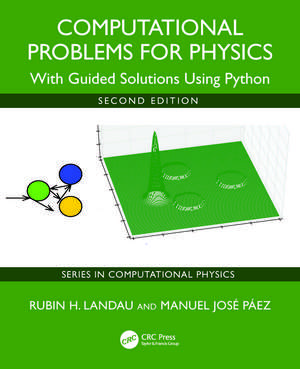
Computational Problems for Physics: With Guided Solutions Using Python: Series in Computational Physics
Autor Rubin H. Landau, Manuel José Páezen Limba Engleză Paperback – 18 noi 2026
- A chapter on neural networks, machine learning, and artificial intelligence, with the building of simple networks, and the use of machine learning software.
- A chapter on quantum computing with some problems to be run on the IBM Quantum Computer.
- A chapter on general relativity with manipulations of the field equations and with computation of GR corrections to classical mechanics.
- An expanded coverage of principal component analysis.



Preț: 433.61 lei
Preț vechi: 545.76 lei
-21% Precomandă
Puncte Express: 650
Carte nepublicată încă
Livrare prin curier în România Precomanda se expediază când titlul devine disponibil.
Transport gratuit pentru acest produs Plată online sau ramburs, în funcție de opțiunile comenzii.
Retur gratuit în 14 zile Comandă securizată și suport în română.
Doresc să fiu notificat când acest titlu va fi disponibil:
Se trimite...
Specificații
ISBN-13: 9781041191780
ISBN-10: 1041191782
Pagini: 490
Ilustrații: 358
Dimensiuni: 191 x 235 mm
Ediția:2
Editura: CRC Press
Colecția CRC Press
Seria Series in Computational Physics
ISBN-10: 1041191782
Pagini: 490
Ilustrații: 358
Dimensiuni: 191 x 235 mm
Ediția:2
Editura: CRC Press
Colecția CRC Press
Seria Series in Computational Physics
Public țintă
Postgraduate and Undergraduate AdvancedCuprins
1. Basic Computational Tools 2. Data Analytics 3. Classical and Nonlinear Dynamics 4. Waves and Fluids 5. Electricity and Magnetism 6. Special and General Relativity 7. Quantum Mechanics 8. Quantum Computing (QC) 9. Neural Networks and Artificial Intelligence 10. Statistical Simulations MC, Thermal, MD 11. Population Dynamics and Growth Models 12. Some Entry-Level Problems
Notă biografică
Rubin Landau is a Distinguished Professor Emeritus in the Department of Physics at Oregon State University in Corvallis and a Fellow of the American Physical Society (Division of Computational Physics). His research specialty is computational studies of the scattering of elementary particles from subatomic systems and momentum space quantum mechanics (over 100 papers). Landau has taught courses throughout the undergraduate and graduate curricula, and, for over 20 years, in computational physics, as well as authoring a number of textbooks. He was the founder of the OSU Computational Physics degree program, an Executive Committee member of the APS Division of Computational Physics, the AAPT Technology Committee, the Extreme Science and Engineering Discovery Environment (XSEDE) advisory committee, and has been part of the Education Program at the SuperComputing (SC) conferences for over a decade.
Manuel José Páez-Mejia has been a Professor of Physics at Universidad de Antioquia in Medellín, Colombia, since January 1969. He has been teaching courses in Modern Physics, Nuclear Physics, Computational Physics, Numerical Methods, Mathematical Physics, and Programming in Fortran, Pascal, and C languages. He has authored scientific papers in nuclear physics and computational physics, as well as texts on the C Language, General Physics, and Computational Physics (coauthored with Rubin Landau and Cristian Bordeianu). In the past, he and Landau conducted pioneering computational investigations of the interactions of mesons and nucleons with few-body nuclei. Professor Paez has led workshops in Computational Physics throughout Latin America, and has been Director of Graduate Studies in Physics at the Universidad de Antioquia.
Manuel José Páez-Mejia has been a Professor of Physics at Universidad de Antioquia in Medellín, Colombia, since January 1969. He has been teaching courses in Modern Physics, Nuclear Physics, Computational Physics, Numerical Methods, Mathematical Physics, and Programming in Fortran, Pascal, and C languages. He has authored scientific papers in nuclear physics and computational physics, as well as texts on the C Language, General Physics, and Computational Physics (coauthored with Rubin Landau and Cristian Bordeianu). In the past, he and Landau conducted pioneering computational investigations of the interactions of mesons and nucleons with few-body nuclei. Professor Paez has led workshops in Computational Physics throughout Latin America, and has been Director of Graduate Studies in Physics at the Universidad de Antioquia.
Descriere
Fully revised, this second edition offers a large number of worked examples and problems with fully guided solutions in Python (as well as Mathematica, Java, C, Fortran, and Maple on the Web). A crucial resource for students beginning their study of computational physics with in-depth and engaging problems and exercises.