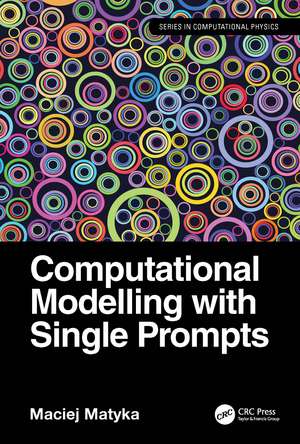
Computational Modelling with Single Prompts: Series in Computational Physics
Autor Maciej Matykaen Limba Engleză Hardback – 7 iul 2026
Key Features:
- Provides a large collection of very diverse models, the compilation of which is unique
- Includes elements of AI and the use of large language models (LLM).
- Consists of a collection of new ideas and additional tasks to be completed independently by the readers.



Preț: 673.10 lei
Preț vechi: 891.32 lei
-24%
Puncte Express: 1010
Carte indisponibilă temporar
Doresc să fiu notificat când acest titlu va fi disponibil:
Se trimite...
Specificații
ISBN-13: 9781041223603
ISBN-10: 1041223609
Pagini: 236
Ilustrații: 270
Dimensiuni: 178 x 254 mm
Greutate: 0.6 kg
Ediția:1
Editura: CRC Press
Colecția CRC Press
Seria Series in Computational Physics
ISBN-10: 1041223609
Pagini: 236
Ilustrații: 270
Dimensiuni: 178 x 254 mm
Greutate: 0.6 kg
Ediția:1
Editura: CRC Press
Colecția CRC Press
Seria Series in Computational Physics
Public țintă
PostgraduateCuprins
Introduction.
Chapter One: Model 1. Monopoly.
Chapter Two: Model 2. Stripes on the Zebra.
Chapter Three: Model 3. The Game of Life.
Chapter Four: Model 4. Larger than Life.
Chapter Five: Model 5. Smooth Life.
Chapter Six: Model 6. Simple Waves.
Chapter Seven: Model 7. Lorenz Butterfly.
Chapter Eight: Model 8. Langton Ant.
Chapter Nine: Model 9. Bacterial clusters (Eden Model).
Chapter Ten: Model 10. Diffusion-Limited Aggregate.
Chapter Eleven: Model 11. Mandelbrot Set.
Chapter Twelve: Model 12. The Three-Body Problem.
Chapter Thirteen: Model 13. Random Walk.
Chapter Fourteen: Model 14. Galton Board.
Chapter Fifteen: Model 15. Ising Model.
Chapter Sixteen: Model 16. Grains in a Silo.
Chapter Seventeen: Model 17. Double Pendulum.
Chapter Eighteen: Model 18. Chaos in Double Pendulums.
Chapter Nineteen: Model 19. Logistic Map.
Chapter Twenty: Model 20. Self-Avoiding Random Walk.
Chapter Twenty-one: Model 21. Snowflake.
Chapter Twenty-two: Model 22. Chaos in Double Numbers.
Chapter Twenty-three: Model 23. Monte Carlo π Estimation.
Chapter Twenty-four: Model 24. Maxwell-Boltzmann Distribution in Gases.
Chapter Twenty-five: Model 25. Forest Fire (Percolation).
Chapter Twenty-six: Model 26. Gravitational Potential.
Chapter Twenty-seven: Model 27. Sand Cellular Automata.
Chapter Twenty-eight: Model 28. Sierpiński Triangle.
Chapter Twenty-nine: Model 29. Dense packing.
Chapter Thirty: Model 30. Lissajous Figures.
Chapter Thirty-one: Model 31. Off-Grid Bacterial Clusters.
Chapter Thirty-two: Model 32. Spring-Mass System (Soda Constructor).
Chapter Thirty-three: Model 33. Soft Body.
Chapter Thirty-four: Model 34. Ballistic Deposition (Cluster).
Chapter Thirty-five: Model 35. Traffic Jam.
Chapter Thirty-six: Model 36. Chromostereopsis.
Chapter Thirty-seven: Model 37. Strange Attractor.
Chapter Thirty-eight: Model 38. The Lattice Boltzmann Method (LBM).
Chapter Thirty-nine: Model 39. Agent-Based Epidemic Spreading.
Chapter Forty: Model 40. L-System Tree.
Chapter Forty-one: Model 41. Dragon Curve.
Chapter Forty-two: Model 42. Granular Matter with Friction.
Chapter Forty-three: Model 43. Standard Map.
Chapter Forty-four: Model 44. Excitation Model and Spiral Waves.
Chapter Forty-five: Model 45. Paper, Stone, Scissors.
Chapter Forty-six: Model 46. Classical Billiards.
Chapter Forty-seven: Model 47. Planetary Systems.
Chapter Forty-eight: Model 48. Diffusive Tortuosity.
Chapter Forty-nine: Model 49. Gray-Scott Diffusion Reaction.
Chapter Fifty: Model 50. Ant Colony.
Chapter Fifty-one: Model 51. Wave Equation.
Chapter Fifty-two: Model 52. Electron in a Magnetic Field.
Chapter Fifty-three: Model 53. Smoothed Particle Hydrodynamics (SPH).
Chapter Fifty-four: Model 54. Hydraulic Tortuosity (Research).
Chapter Fifty-five: Model 55. Shallow Water.
Chapter Fifty-six: Model 56. Molecular Dynamics.
Chapter Fifty-seven: Model 57. Predator Prey Systems.
Chapter Fifty-eight: Model 58. Heat Transfer.
Chapter Fifty-nine: Model 59. Crowd Evacuation.
Chapter Sixty: Model 60. SIMPLE (Computational Fluid Dynamics).
Chapter Sixty-one: Model 61. Sphere Tracing.
Chapter Sixty-two: Model 62. Stalagmites Growth.
Chapter Sixty-three: Model 63. Jetpack - A Computer Game with Physics.
Chapter Sixty-four: Model 64. Chain Fountain (Mould Effect).
Postscript.
Prompts.
Bibliography.
Chapter One: Model 1. Monopoly.
Chapter Two: Model 2. Stripes on the Zebra.
Chapter Three: Model 3. The Game of Life.
Chapter Four: Model 4. Larger than Life.
Chapter Five: Model 5. Smooth Life.
Chapter Six: Model 6. Simple Waves.
Chapter Seven: Model 7. Lorenz Butterfly.
Chapter Eight: Model 8. Langton Ant.
Chapter Nine: Model 9. Bacterial clusters (Eden Model).
Chapter Ten: Model 10. Diffusion-Limited Aggregate.
Chapter Eleven: Model 11. Mandelbrot Set.
Chapter Twelve: Model 12. The Three-Body Problem.
Chapter Thirteen: Model 13. Random Walk.
Chapter Fourteen: Model 14. Galton Board.
Chapter Fifteen: Model 15. Ising Model.
Chapter Sixteen: Model 16. Grains in a Silo.
Chapter Seventeen: Model 17. Double Pendulum.
Chapter Eighteen: Model 18. Chaos in Double Pendulums.
Chapter Nineteen: Model 19. Logistic Map.
Chapter Twenty: Model 20. Self-Avoiding Random Walk.
Chapter Twenty-one: Model 21. Snowflake.
Chapter Twenty-two: Model 22. Chaos in Double Numbers.
Chapter Twenty-three: Model 23. Monte Carlo π Estimation.
Chapter Twenty-four: Model 24. Maxwell-Boltzmann Distribution in Gases.
Chapter Twenty-five: Model 25. Forest Fire (Percolation).
Chapter Twenty-six: Model 26. Gravitational Potential.
Chapter Twenty-seven: Model 27. Sand Cellular Automata.
Chapter Twenty-eight: Model 28. Sierpiński Triangle.
Chapter Twenty-nine: Model 29. Dense packing.
Chapter Thirty: Model 30. Lissajous Figures.
Chapter Thirty-one: Model 31. Off-Grid Bacterial Clusters.
Chapter Thirty-two: Model 32. Spring-Mass System (Soda Constructor).
Chapter Thirty-three: Model 33. Soft Body.
Chapter Thirty-four: Model 34. Ballistic Deposition (Cluster).
Chapter Thirty-five: Model 35. Traffic Jam.
Chapter Thirty-six: Model 36. Chromostereopsis.
Chapter Thirty-seven: Model 37. Strange Attractor.
Chapter Thirty-eight: Model 38. The Lattice Boltzmann Method (LBM).
Chapter Thirty-nine: Model 39. Agent-Based Epidemic Spreading.
Chapter Forty: Model 40. L-System Tree.
Chapter Forty-one: Model 41. Dragon Curve.
Chapter Forty-two: Model 42. Granular Matter with Friction.
Chapter Forty-three: Model 43. Standard Map.
Chapter Forty-four: Model 44. Excitation Model and Spiral Waves.
Chapter Forty-five: Model 45. Paper, Stone, Scissors.
Chapter Forty-six: Model 46. Classical Billiards.
Chapter Forty-seven: Model 47. Planetary Systems.
Chapter Forty-eight: Model 48. Diffusive Tortuosity.
Chapter Forty-nine: Model 49. Gray-Scott Diffusion Reaction.
Chapter Fifty: Model 50. Ant Colony.
Chapter Fifty-one: Model 51. Wave Equation.
Chapter Fifty-two: Model 52. Electron in a Magnetic Field.
Chapter Fifty-three: Model 53. Smoothed Particle Hydrodynamics (SPH).
Chapter Fifty-four: Model 54. Hydraulic Tortuosity (Research).
Chapter Fifty-five: Model 55. Shallow Water.
Chapter Fifty-six: Model 56. Molecular Dynamics.
Chapter Fifty-seven: Model 57. Predator Prey Systems.
Chapter Fifty-eight: Model 58. Heat Transfer.
Chapter Fifty-nine: Model 59. Crowd Evacuation.
Chapter Sixty: Model 60. SIMPLE (Computational Fluid Dynamics).
Chapter Sixty-one: Model 61. Sphere Tracing.
Chapter Sixty-two: Model 62. Stalagmites Growth.
Chapter Sixty-three: Model 63. Jetpack - A Computer Game with Physics.
Chapter Sixty-four: Model 64. Chain Fountain (Mould Effect).
Postscript.
Prompts.
Bibliography.
Notă biografică
Maciej Matyka, born in 1980 in Wrocław, is a computer physicist and programmer. He is a graduate of computer physics at the Faculty of Physics and Astronomy, University of Wrocław, where he is currently a research and teaching fellow at the Institute of Theoretical Physics. His professional interests include fluid flow through porous media and computer simulation methods. He independently programs algorithms he has developed and is a practitioner. He enjoys projects and working with students. He is also interested in programming and new technologies in computer science – parallel computing and machine learning. He has always had a passion for graphics and animation based on physical modeling, which he uses on computer demoscene. He is the author of numerous scientific publications in computational physics and fluid dynamics, two stand-alone books (including a book on computer simulations), and several chapters in books published in Poland and abroad.
Descriere
Computational Modelling with Single Prompts provides an overview of computer models of physical phenomena and more.