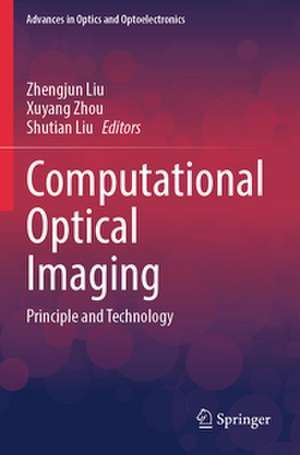
Computational Optical Imaging: Advances in Optics and Optoelectronics
Editat de Zhengjun Liu, Xuyang Zhou, Shutian Liuen Limba Engleză Paperback – 11 mai 2025
| Toate formatele și edițiile | Preț | Express |
|---|---|---|
| Paperback (1) | 812.96 lei 38-44 zile | |
| Springer – 11 mai 2025 | 812.96 lei 38-44 zile | |
| Hardback (1) | 870.40 lei 3-5 săpt. | |
| Springer Nature Singapore – 23 apr 2024 | 870.40 lei 3-5 săpt. |


Preț: 812.96 lei
Preț vechi: 1069.70 lei
-24%
Puncte Express: 1219
Preț estimativ în valută:
143.73€ • 169.47$ • 125.66£
143.73€ • 169.47$ • 125.66£
Carte tipărită la comandă
Livrare economică 31 martie-06 aprilie
Specificații
ISBN-13: 9789819714575
ISBN-10: 9819714575
Pagini: 424
Dimensiuni: 155 x 235 x 22 mm
Greutate: 0.72 kg
Editura: Springer
Seria Advances in Optics and Optoelectronics
ISBN-10: 9819714575
Pagini: 424
Dimensiuni: 155 x 235 x 22 mm
Greutate: 0.72 kg
Editura: Springer
Seria Advances in Optics and Optoelectronics
V-ar putea interesa
-
 Computational ImagingAchuta Kadambi-14%Preț: 405.06 lei471.00 lei
 -
 -20%Preț: 629.77 lei787.21 lei
 -
 -30%Preț: 602.82 lei866.21 lei
 -
 Obstetric Imaging: Fetal Diagnosis and CareJoshua A. Copel-29%Preț: 1637.96 lei2302.44 leiRecomandat
 -
 -23%Preț: 792.17 lei1028.80 lei
 -
 Webb's Physics of Medical ImagingM Flower-5%Preț: 758.82 lei798.76 lei
 -
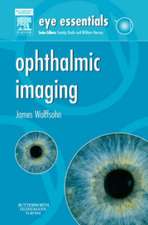 Eye Essentials: Ophthalmic ImagingJames Wolffsohn-27%Preț: 195.13 lei267.91 lei
 -
 -20%Preț: 893.66 lei1117.07 lei
 -
 Remote Sensing and Image InterpretationThomas Lillesand-18%Preț: 1288.97 lei1571.92 lei
 -
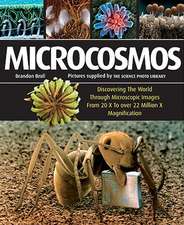 MicrocosmosBrandon BrollPreț: 136.69 lei
 -
 Advances in Digital Holography ResearchElla Myers-26%Preț: 705.22 lei954.01 lei
 -
 Computer Analysis of Images and PatternsModesto Castrillón-Santana-20%Preț: 324.29 lei405.36 lei
 -
 The NeuronomiconGrayson W. Hooper-5%Preț: 422.08 lei444.29 lei
 -
 Cardiovascular OCT ImagingIk-Kyung Jang-5%Preț: 1009.43 lei1062.56 lei
 -
 -14%Preț: 761.19 lei885.11 lei
 -
 -5%Preț: 866.51 lei912.12 lei
 -
 -24%Preț: 1122.13 lei1476.49 lei
 -
 Advanced Optical Sensors for Aerospace ApplicationsCarlos Marques-18%Preț: 768.39 lei937.05 lei
 -
 Intelligent Analysis of Optical ImagesZhengjun Liu-18%Preț: 864.86 lei1054.70 lei
 -
 Plenoptic Imaging and ProcessingLu Fang-20%Preț: 360.26 lei450.33 lei
Cuprins
Chapter 1: Introduction.- Chapter 2: Ghost imaging.- Chapter 3: Imaging methods based on compressed sensing.- Chapter 4: Computerized tomography.- Chapter 5: Computer generated holography.- Chapter 6: Non-line-of-sight imaging.- Chapter 7: Coded aperture imaging.- Chapter 8: Phase imaging.- Chapter 9: Light field camera.- Chapter 10: Adaptive optical imaging.- Chapter 11: Fluorescence imaging.- Chapter 12: Synthetic aperture imaging.- Chapter 13: Mask-modulated Lensless Imaging.- Chapter 14: Polarization imaging.
Notă biografică
Zhengjun Liu is a professor of the School of Physics, Harbin Institute of Technology, China. He received his PhD in physics from Harbin Institute of Technology, in 2007, and worked at the School of Electrical Engineering of the university since then. He began to work in the School of Physics in 2021. He serves as a standing member of the Holographic Special Committee of the Chinese Optical Society and a senior member of the Optical Society of America. He is mainly engaged in the research in optical information processing, image processing and super-resolution imaging technology. He has published 175 papers in optics on peer reviewed journals. His H-index is 38.
Xuyang Zhou received his PhD in physics from Harbin Institute of Technology, China, in 2023. His research interests are auto-focusing and computational imaging. He has published more than 10 peer reviewed journal articles.
Shutian Liu received his MS and PhD in 1987 and 1990, respectively, from Harbin Institute of Technology, China. He is currently a professor in the School of Physics there. His current research interests include optical information processing, optical information security, nonlinear optics, and quantum optics. He has published more than 300 papers on peer reviewed journal.
Xuyang Zhou received his PhD in physics from Harbin Institute of Technology, China, in 2023. His research interests are auto-focusing and computational imaging. He has published more than 10 peer reviewed journal articles.
Shutian Liu received his MS and PhD in 1987 and 1990, respectively, from Harbin Institute of Technology, China. He is currently a professor in the School of Physics there. His current research interests include optical information processing, optical information security, nonlinear optics, and quantum optics. He has published more than 300 papers on peer reviewed journal.
Textul de pe ultima copertă
This book highlights a comprehensive introduction to the principles and calculation methods of computational optical imaging. Integrating optical imaging and computing technology to achieve significant performance improvements, computational optical imaging has become an active research field in optics. It has given rise to the emerging of new concepts such as computational imaging, computational measurement and computational photography. As high-performance image detectors make image measurements discrete and digital, images are mostly recorded in the form of discrete data, almost replacing the continuous medium used for pattern recording. Computational optical imaging technology has become an effective way for people to study microscopic imaging. At present, different imaging systems are composed of continuous optical elements such as lenses and prisms or discrete optical elements such as spatial light modulators or digital micro-mirror devices. The current computing technology has permeated all aspects of imaging systems and gradually promotes the digitization of optical imaging systems. This book summarizes the representative work done in this field and introduces the latest results. Computing technology plays an important bridging role between theories of optics and experimental systems, which inspires more comprehensive and in-depth research. It has the advantages of high repeatability, flexibility, strong computing power and low cost. In this multidisciplinary field, researchers in computer science, optics and information science have joined together to extend its depth and breadth. Targeting cutting-edge issues to be solved in computational optics, this book introduces a variety of methods that involve theoretical innovations and technical breakthroughs in imaging resolution, the field of view, imaging speed, and computing speed. It intends to provide a handy reference and technical support for graduate students, researchers and professionals engaged in the study and practice of computational optical imaging.
Caracteristici
Highlights latest theoretical innovations and technical breakthroughs Includes a comprehensive introduction to the principles and calculation methods of computational optical imaging Provides solutions to cutting-edge issues in computational optics