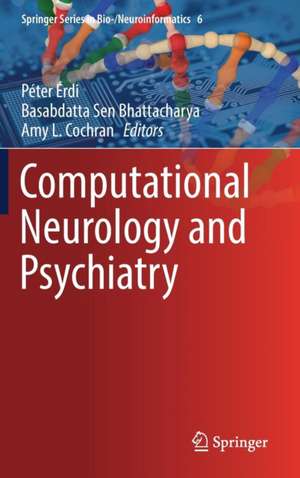
Computational Neurology and Psychiatry: Springer Series in Bio-/Neuroinformatics, cartea 6
Editat de Péter Érdi, Basabdatta Sen Bhattacharya, Amy L. Cochranen Limba Engleză Hardback – 9 feb 2017


Preț: 1034.36 lei
Preț vechi: 1292.96 lei
-20%
Puncte Express: 1552
Carte tipărită la comandă
Livrare economică 16-30 noiembrie
Livrare prin curier în România Termenul estimat este afișat lângă disponibilitate.
Transport gratuit pentru acest produs Plată online sau ramburs, în funcție de opțiunile comenzii.
Retur gratuit în 14 zile Comandă securizată și suport în română.
Specificații
ISBN-13: 9783319499581
ISBN-10: 3319499580
Pagini: 456
Ilustrații: VI, 448 p. 157 illus., 119 illus. in color.
Dimensiuni: 160 x 241 x 30 mm
Greutate: 0.85 kg
Ediția:1st edition 2017
Editura: Springer
Colecția Springer Series in Bio-/Neuroinformatics
Seria Springer Series in Bio-/Neuroinformatics
Locul publicării:Cham, Switzerland
ISBN-10: 3319499580
Pagini: 456
Ilustrații: VI, 448 p. 157 illus., 119 illus. in color.
Dimensiuni: 160 x 241 x 30 mm
Greutate: 0.85 kg
Ediția:1st edition 2017
Editura: Springer
Colecția Springer Series in Bio-/Neuroinformatics
Seria Springer Series in Bio-/Neuroinformatics
Locul publicării:Cham, Switzerland
V-ar putea interesa
-
 -16%Preț: 281.70 lei335.44 lei
 -
 Data-driven Generation of PoliciesAustin Parker-20%Preț: 308.66 lei385.82 lei
 -
 Stochastic Chemical KineticsPéter ÉrdiPreț: 375.31 lei
 -
 -20%Preț: 1282.56 lei1603.20 lei
 -
 Constraint Programming and Decision MakingMartine Ceberio-54%Preț: 516.22 lei1127.45 lei
 -
 -20%Preț: 1001.94 lei1252.42 lei
 -
 Soft Computing in Intelligent ControlSungshin Kim-20%Preț: 982.03 lei1227.54 lei
 -
 Validating Neuro-Computational Models of Neurological and Psychiatric DisordersBasabdatta Sen Bhattacharya-15%Preț: 626.84 lei737.46 lei
 -
 Soft Computing for Information Processing and AnalysisMasoud Nikravesh-20%Preț: 1006.22 lei1257.76 lei
 -
 Advances in Intelligent Data Analysis VMichael R. Berthold-20%Preț: 667.49 lei834.35 lei
 -
 European Workshop on PlanningJoachim Hertzberg-20%Preț: 313.77 lei392.22 lei
 -
 The Dynamics of ConceptsPhilip R. van Loocke-20%Preț: 325.25 lei406.56 lei
 -
 -20%Preț: 318.89 lei398.61 lei
 -
 Fuzzy Logic in Artificial IntelligenceAnca Ralescu-20%Preț: 327.87 lei409.85 lei
 -
 Grammatical Inference and ApplicationsRafael C. Carrasco-20%Preț: 322.59 lei403.23 lei
 -
 Theorem Proving with Analytic Tableaux and Related MethodsPeter Baumgartner-20%Preț: 338.85 lei423.56 lei
 -
 -20%Preț: 336.52 lei420.65 lei
 -
 -20%Preț: 325.83 lei407.29 lei
 -
 Artificial Neural Networks and Machine Learning -- ICANN 2012Alessandro Villa-20%Preț: 351.88 lei439.85 lei
 -
 Possibility Theory and the RiskIrina Georgescu-20%Preț: 613.08 lei766.34 lei
 -
 -20%Preț: 556.83 lei696.04 lei
 -
 Autonomous SearchYoussef Hamadi-20%Preț: 630.31 lei787.89 lei
 -
 Industrial Applications of Evolutionary AlgorithmsErnesto Sanchez-20%Preț: 640.65 lei800.81 lei
 -
 Fuzzy Evidence in Identification, Forecasting and DiagnosisAlexander P. Rotshtein-20%Preț: 954.49 lei1193.11 lei
 -
 Recommender Systems for the Social WebJosé J. Pazos Arias-20%Preț: 645.95 lei807.45 lei
 -
 PhysicomimeticsWilliam M. Spears-20%Preț: 668.97 lei836.22 lei
 -
 Topology of Digital ImagesJames F. Peters-20%Preț: 661.62 lei827.02 lei
 -
 Transactions on Computational Collective Intelligence XIIINgoc Thanh Nguyen-20%Preț: 331.42 lei414.27 lei
 -
 -20%Preț: 1041.48 lei1301.85 lei
Cuprins
From the Content.- Introduction.- Outgrowing Neurological Diseases: Microcircuits, Conduction Delay and Dynamic Diseases.- Extracellular Potassium and Focal Seizures – Insight From in Silico Study.-
Time Series and Interactions: Data Processing in Epilepsy Research.
Time Series and Interactions: Data Processing in Epilepsy Research.
Textul de pe ultima copertă
This book presents the latest research in computational methods for modeling and simulating brain disorders. In particular, it shows how mathematical models can be used to study the relationship between a given disorder and the specific brain structure associated with that disorder. It also describes the emerging field of computational psychiatry, including the study of pathological behavior due to impaired functional connectivity, pathophysiological activity, and/or aberrant decision-making. Further, it discusses the data analysis techniques that will be required to analyze the increasing amount of data being generated about the brain. Lastly, the book offers some tips on the application of computational models in the field of quantitative systems pharmacology. Mainly written for computational scientists eager to discover new application fields for their model, this book also benefits neurologists and psychiatrists wanting to learn about new methods.
Caracteristici
Reports on computational studies of brain and mind disease Describes computational models and their use in practice Includes background information on the biology of the diseases With take-home messages for both neurologists and computer scientists Includes supplementary material: sn.pub/extras