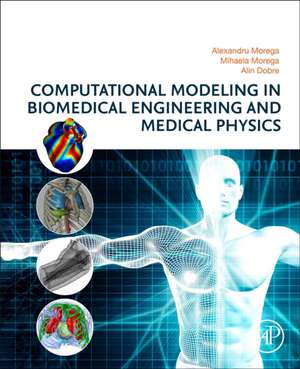
Computational Modeling in Biomedical Engineering and Medical Physics
Autor Alexandru Morega, Mihaela Morega, Alin Dobreen Limba Engleză Paperback – 18 sep 2020
Computational Medical Engineering presents a number of engineering for medicine problems that may be encountered in medical physics, procedures, diagnosis and monitoring techniques, including electrical activity of the heart, hemodynamic activity monitoring, magnetic drug targeting, bioheat models and thermography, RF and microwave hyperthermia, ablation, EMF dosimetry, and bioimpedance methods. The authors discuss the core approach methodology to pose and solve different problems of medical engineering, including essentials of mathematical modelling (e.g., criteria for well-posed problems); physics scaling (homogenization techniques); Constructal Law criteria in morphing shape and structure of systems with internal flows; computational domain construction (CAD and, or reconstruction techniques based on medical images); numerical modelling issues, and validation techniques used to ascertain numerical simulation results. In addition, new ideas and venues to investigate and understand finer scale models and merge them into continuous media medical physics are provided as case studies.
- Presents the fundamentals of mathematical and numerical modeling of engineering problems in medicine
- Discusses many of the most common modelling scenarios for Biomedical Engineering, including, electrical activity of the heart hemodynamic activity monitoring, magnetic drug targeting, bioheat models and thermography, RF and microwave hyperthermia, ablation, EMF dosimetry, and bioimpedance methods
- Includes discussion of the core approach methodology to pose and solve different problems of medical engineering, including essentials of mathematical modelling, physics scaling, Constructal Law criteria in morphing shape and structure of systems with internal flows, computational domain construction, numerical modelling issues, and validation techniques used to ascertain numerical simulation results
Preț: 776.94 lei
Preț vechi: 1078.17 lei
-28%
Puncte Express: 1165
Carte tipărită la comandă
Livrare economică 17 noiembrie-01 decembrie
Livrare prin curier în România Termenul estimat este afișat lângă disponibilitate.
Transport gratuit pentru acest produs Plată online sau ramburs, în funcție de opțiunile comenzii.
Retur gratuit în 14 zile Comandă securizată și suport în română.
Specificații
ISBN-13: 9780128178973
ISBN-10: 0128178973
Pagini: 314
Dimensiuni: 191 x 235 x 28 mm
Greutate: 0.55 kg
Editura: ELSEVIER SCIENCE
ISBN-10: 0128178973
Pagini: 314
Dimensiuni: 191 x 235 x 28 mm
Greutate: 0.55 kg
Editura: ELSEVIER SCIENCE
V-ar putea interesa
-
 -12%Preț: 1307.41 lei1482.34 lei
 -
 Encyclopedia of Biomedical EngineeringRoger Narayan-24%Preț: 9083.35 lei11978.47 lei
 -
 Applied Biomechatronics Using Mathematical ModelsJorge Garza Ulloa-37%Preț: 769.81 lei1229.74 lei
 -
 -39%Preț: 775.04 lei1267.52 lei
 -
 -5%Preț: 727.23 lei765.50 lei
 -
 -29%Preț: 965.05 lei1365.43 lei
 -
 Medical Innovation: Concept to CommercializationKevin E. Behrns-8%Preț: 405.92 lei441.21 lei
 -
 Advances in Numerical Heat Transfer, Volume 3W. J. Minkowycz-15%Preț: 608.78 lei716.21 lei
 -
 Digital Microfluidic Biochips: Design Automation and OptimizationKrishnendu Chakrabarty-15%Preț: 619.12 lei728.38 lei
 -
 Sensors for Chemical and Biological ApplicationsManoj Kumar Ram-15%Preț: 631.07 lei742.43 lei
 -
 -15%Preț: 610.22 lei717.90 lei
 -
 A Prescription for ChangeMichael Kinch-5%Preț: 298.31 lei314.01 lei
 -
 The Biofuels DeceptionOkbazghi Yohannes-5%Preț: 201.82 lei212.44 lei
 -
 Computational Anatomy Based on Whole Body ImagingHidefumi Kobatake-19%Preț: 643.38 lei794.29 lei
Public țintă
Students and researchers in biomedical engineering and computational biology who are interested in multi-domain, multi-physics simulations for a variety of clinical and engineering modelling cases.Cuprins
1. Physical, Mathematical and Numerical Modeling Essentials
2. Constructal Law criteria in morphing shape and structure of systems with internal flows
3. Computational domains
4. Electrical activity of heart
5. Bioimpedance methods
6. Magnetic drug tartegting
7. Magnetic stimulation
8. Hyperthermia and ablation (Thermotherapy methods)
2. Constructal Law criteria in morphing shape and structure of systems with internal flows
3. Computational domains
4. Electrical activity of heart
5. Bioimpedance methods
6. Magnetic drug tartegting
7. Magnetic stimulation
8. Hyperthermia and ablation (Thermotherapy methods)
Notă biografică
Alexandru M. Morega is professor of electrical engineering at the University Politehnica of Bucharest, the Faculty of Electrical Engineering and the Department of Bioengineering and Biotechnology, the Faculty of Medical Engineering. He received the Dipl. Eng. (1980), and the Doctoral (1987) degrees in EE from the same university, and the Ph.D. degree in ME (1993) from Duke University of Durham, North Carolina, USA. Alexandru Morega is founding member of the Laboratory for Electrical Engineering in Medicine (1998), at the Faculty of Electrical Engineering, and of the Department of Bioengineering and Biotechnology (2002) and the Faculty of Medical Engineering (2010), at the University Politehnica of Bucharest.