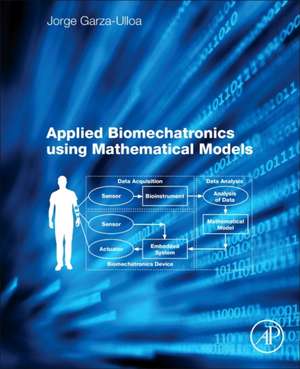
Applied Biomechatronics Using Mathematical Models
Autor Jorge Garza Ulloaen Limba Engleză Paperback – 9 iun 2018
With the use of appropriate electronic sensors at specific areas connected to bio-instruments, we can obtain enough information to create a mathematical model for assistive devices by analyzing the kinematics and kinetics of the human body. The mathematical models developed in this book can provide more effective devices for use in aiding and improving the function of the body in relation to a variety of injuries and diseases.
- Focuses on the mathematical modeling of human kinematics and kinetics
- Teaches users how to obtain faster results with these mathematical models
- Includes a companion website with additional content that presents MATLAB examples
Preț: 793.04 lei
Preț vechi: 1250.45 lei
-37%
Puncte Express: 1190
Carte tipărită la comandă
Livrare economică 30 noiembrie-14 decembrie
Livrare prin curier în România Termenul estimat este afișat lângă disponibilitate.
Transport gratuit pentru acest produs Plată online sau ramburs, în funcție de opțiunile comenzii.
Retur gratuit în 14 zile Comandă securizată și suport în română.
Specificații
ISBN-13: 9780128125946
ISBN-10: 0128125942
Pagini: 662
Dimensiuni: 191 x 235 mm
Greutate: 1.12 kg
Editura: ELSEVIER SCIENCE
ISBN-10: 0128125942
Pagini: 662
Dimensiuni: 191 x 235 mm
Greutate: 1.12 kg
Editura: ELSEVIER SCIENCE
V-ar putea interesa
-
 -30%Preț: 934.01 lei1343.43 lei
 -
 Extracellular Matrix-derived Implants in Clinical MedicineDaniel L Mooradian-27%Preț: 1097.26 lei1508.35 lei
 -
 Heat Transfer and Fluid Flow in Biological ProcessesSid M. Becker-25%Preț: 563.87 lei752.41 lei
 -
 -23%Preț: 669.47 lei865.67 lei
 -
 Contextual Inquiry for Medical Device DesignMary Beth Privitera-17%Preț: 630.16 lei757.15 lei
 -
 -27%Preț: 893.59 lei1225.04 lei
 -
 Clinical Engineering: From Devices to SystemsRoberto Miniati-22%Preț: 446.24 lei574.71 lei
 -
 Tissue Engineering Made EasyFarhana Akter-27%Preț: 284.62 lei389.03 lei
 -
 -27%Preț: 930.28 lei1280.12 lei
 -
 Handbook of BioelectronicsSandro Carrara-5%Preț: 2357.93 lei2482.03 lei
 -
 Statistical Optimization of Biological SystemsTapobrata Panda-9%Preț: 1328.41 lei1459.79 lei
 -
 -18%Preț: 1441.66 lei1758.12 lei
 -
 Medical Device Use Error: Root Cause AnalysisMichael Wiklund-18%Preț: 1253.77 lei1528.98 lei
 -
 Nanocomposites for Musculoskeletal Tissue RegenerationHuinan H. Liu-29%Preț: 1716.81 lei2411.10 lei
 -
 Somatic alterations in critical genes in malignant melanomaSandra Blöthner-5%Preț: 494.23 lei520.23 lei
 -
 Smart Sensors for Health and Environment MonitoringChong-Min Kyung-15%Preț: 732.40 lei861.65 lei
 -
 Nanomedicine: Science, Business, and ImpactMichael Hehenberger-5%Preț: 671.21 lei706.54 lei
 -
 Nanomaterials: Science and ApplicationsDeborah M. Kane-5%Preț: 1055.07 lei1110.60 lei
 -
 EMERGING MEDICAL TECHNOLOGIESErmak Gennady-5%Preț: 219.04 lei230.57 lei
Cuprins
1. Introduction to Biomechatronics/ Biomedical Engineering2. Introduction to the Human Neuromusculoskeletal Systems3. Kinematic and Kinetic Measurements of Human Body4. Experiment Design, Data Acquisition and Signal Processing5. Methods to Develop Mathematical Models6. Application of Mathematical Models in Biomechatronics7. Cases Studies of Applied Biomechatronics Solutions based on MM
Notă biografică
Dr. Jorge Garza-Ulloa is the CEO/Director of Garzaulloa.org Research Consulting Services. He graduated from the doctoral program in Electrical & Computer Eng. at University of Texas El Paso (UTEP). Dr. Garza-Ulloa has focused his research in the development of mathematical models for Electrical and Computer Engineering: Biomedical applications, such as his Mathematical Model for the Validation of the Ground Reaction Force Sensor in Human Gait Analysis, the Mathematical model to predict Transition-to-Fatigue during isometric exercise on muscles of the lower extremities, his mathematical model to be used in the Assessment and evaluation of dynamic behavior of muscles with special reference to subjects with Diabetes Mellitus (dissertation) . Besides: his natural fuzzy logic model for differential analysis in muscle/joint activation point using infer T equation for muscle/joint, Extension of the T-Fuzzy inference equation using Fuzzy Mapping for Human Gait Analysis to identify the eight-basic pathologic gait attributed to neurological conditions (Academic press book: Applied Biomechatronic Using Mathematical Models), many others. In this book introduces: Cognitive Learning models and its relationship with neuroscience of reasoning under Cognitive Learning- Reasoning (CL&R) applying Cognitive Computing (CC), and many others to be integrated at the Proposed General Architecture framework of a Cognitive Computing Agents System (AI-CCAS). Dr. Garza-Ulloa has been the recipient of numerous honors and awards including a University of Texas at El Paso Graduate School Research Award, Research Schellenberg Foundation, Stern Foundation, Elsevier grants, and others. Dr. Garza-Ulloa is currently teaching at the University of Texas at El Paso USA and continue his Biomedical Engineering research at Research Consultant Services at El Paso Texas, USA.