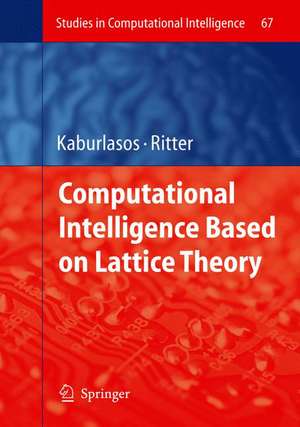
Computational Intelligence Based on Lattice Theory: Studies in Computational Intelligence, cartea 67
Editat de Vassilis G. Kaburlasos, Gerhard X. Ritteren Limba Engleză Hardback – 24 iul 2007
Din seria Studies in Computational Intelligence
- 18%
 Preț: 924.22 lei
 - 20%
 Preț: 1229.71 lei
 - 5%
 Preț: 1058.46 lei
 - 20%
 Preț: 1030.18 lei
 - 18%
 Preț: 849.88 lei
 - 15%
 Preț: 626.20 lei
 - 20%
 Preț: 562.99 lei
 - 24%
 Preț: 891.41 lei
 - 20%
 Preț: 317.05 lei
 - 20%
 Preț: 1105.37 lei
 - 20%
 Preț: 1230.68 lei
 - 20%
 Preț: 671.27 lei
 - 18%
 Preț: 980.46 lei
 - 18%
 Preț: 980.87 lei
 - 15%
 Preț: 665.10 lei
 - 18%
 Preț: 982.36 lei
 - 20%
 Preț: 1090.62 lei
 - 20%
 Preț: 1395.65 lei
 - 20%
 Preț: 1244.59 lei
 - 15%
 Preț: 661.64 lei
 - 15%
 Preț: 658.54 lei
 - 15%
 Preț: 655.95 lei
 - 15%
 Preț: 664.69 lei
 - 18%
 Preț: 975.20 lei
 - 20%
 Preț: 1014.94 lei
 - 20%
 Preț: 1066.64 lei
 - 18%
 Preț: 1280.90 lei
 - 18%
 Preț: 950.43 lei
 - 15%
 Preț: 663.45 lei
 - 18%
 Preț: 1381.17 lei
 - 15%
 Preț: 656.62 lei
 - 18%
 Preț: 979.20 lei
 - 18%
 Preț: 980.03 lei
Preț: 1034.44 lei
Preț vechi: 1293.05 lei
-20%
Puncte Express: 1552
Carte tipărită la comandă
Livrare economică 07-21 decembrie
Livrare prin curier în România Termenul estimat este afișat lângă disponibilitate.
Transport gratuit pentru acest produs Plată online sau ramburs, în funcție de opțiunile comenzii.
Retur gratuit în 14 zile Comandă securizată și suport în română.
Specificații
ISBN-13: 9783540726869
ISBN-10: 3540726861
Pagini: 392
Ilustrații: XVI, 375 p.
Dimensiuni: 160 x 241 x 27 mm
Greutate: 0.7 kg
Ediția:2007
Editura: Springer
Colecția Studies in Computational Intelligence
Seria Studies in Computational Intelligence
Locul publicării:Berlin, Heidelberg, Germany
ISBN-10: 3540726861
Pagini: 392
Ilustrații: XVI, 375 p.
Dimensiuni: 160 x 241 x 27 mm
Greutate: 0.7 kg
Ediția:2007
Editura: Springer
Colecția Studies in Computational Intelligence
Seria Studies in Computational Intelligence
Locul publicării:Berlin, Heidelberg, Germany
V-ar putea interesa
-
 -19%Preț: 92.35 lei114.22 lei
 -
 Handbook of Computer Vision Algorithms in Image AlgebraJoseph N. Wilson-20%Preț: 1781.06 lei2226.33 lei
 -
 Computer VisionSimon J. D. Prince-20%Preț: 582.72 lei728.39 lei
 -
 Machine LearningPeter Flach-20%Preț: 386.84 lei483.55 lei
 -
 Multi-Agent Machine LearningH M Schwartz-20%Preț: 675.81 lei844.77 lei
 -
 Wavelet Neural NetworksAntonios K Alexandridis-20%Preț: 634.18 lei792.72 lei
 -
 Practical Introduction to CompDawson-Howe-20%Preț: 518.21 lei647.76 lei
 -
 Machine Learning: An Algorithmic Perspective, Second EditionStephen Marsland-20%Preț: 625.22 lei781.53 lei
 -
 Natural Language Processing and Computational LinguisticsMohamed Zakaria Kurdi-9%Preț: 1021.06 lei1122.04 lei
 -
 -20%Preț: 625.27 lei781.60 lei
 -
 Believable BotsPhilip Hingston-20%Preț: 676.70 lei845.88 lei
Public țintă
ResearchCuprins
Neural Computation.- Granular Enhancement of Fuzzy ART/SOM Neural Classifiers Based on Lattice Theory.- Learning in Lattice Neural Networks that Employ Dendritic Computing.- Orthonormal Basis Lattice Neural Networks.- Generalized Lattices Express Parallel Distributed Concept Learning.- Mathematical Morphology Applications.- Noise Masking for Pattern Recall Using a Single Lattice Matrix Associative Memory.- Convex Coordinates From Lattice Independent Sets for Visual Pattern Recognition.- A Lattice-Based Approach to Mathematical Morphology for Greyscale and Colour Images.- Morphological and Certain Fuzzy Morphological Associative Memories for Classification and Prediction.- Machine Learning Applications.- The Fuzzy Lattice Reasoning (FLR) Classifier for Mining Environmental Data.- Machine Learning Techniques for Environmental Data Estimation.- Application of Fuzzy Lattice Neurocomputing (FLN) in Ocean Satellite Images for Pattern Recognition.- Genetically Engineered ART Architectures.- Fuzzy Lattice Reasoning (FLR) Classification Using Similarity Measures.- Logic and Inference.- Fuzzy Prolog: Default Values to Represent Missing Information.- Valuations on Lattices: Fuzzification and its Implications.- L-fuzzy Sets and Intuitionistic Fuzzy Sets.- A Family of Multi-valued t-norms and t-conorms.- The Construction of Fuzzy-valued t-norms and t-conorms.
Textul de pe ultima copertă
The emergence of lattice theory within the field of computational intelligence (CI) is partially due to its proven effectiveness in neural computation. Moreover, lattice theory has the potential to unify a number of diverse concepts and aid in the cross-fertilization of both tools and ideas within the numerous subfields of CI. The compilation of this eighteen-chapter book is an initiative towards proliferating established knowledge in the hope to further expand it. This edited book is a balanced synthesis of four parts emphasizing, in turn, neural computation, mathematical morphology, machine learning, and (fuzzy) inference/logic. The articles here demonstrate how lattice theory may suggest viable alternatives in practical clustering, classification, pattern analysis, and regression applications.
Caracteristici
Resent results of Computational Intelligence Based on Lattice Theory Outcome of a special session held during in WCCI 2006 Includes supplementary material: sn.pub/extras