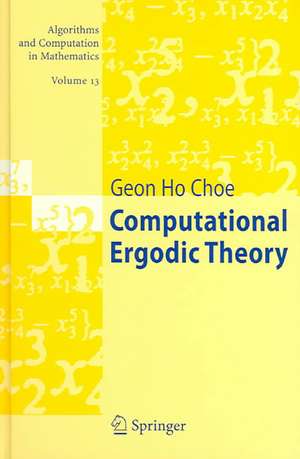
Computational Ergodic Theory: Algorithms and Computation in Mathematics, cartea 13
Autor Geon Ho Choeen Limba Engleză Hardback – 11 feb 2005
Ne-a atras atenția Computational Ergodic Theory prin modul în care reușește să transforme un subiect arid și tehnic, bazat pe teoria măsurii, într-o disciplină accesibilă prin intermediul simulărilor numerice. Față de literatura existentă, această lucrare din seria Algorithms and Computation in Mathematics nu se limitează la demonstrații formale, ci propune o metodologie în care conceptele teoretice sunt absorbite treptat, pe măsură ce cititorul rulează experimente pe calculator. Această abordare este esențială pentru studenții de la facultățile de fizică sau pentru cercetătorii care doresc să își verifice rapid ipotezele fără a se împotmoli în formalismul matematic extrem.
Structura volumului reflectă o progresie logică, pornind de la măsurile invariante și The Birkhoff Ergodic Theorem, trecând prin studiul sistemelor dinamice unidimensionale și multidimensionale prin prisma exponenților Lyapunov, până la varietăți stabile și instabile. Cititorii familiarizați cu A First Course in Ergodic Theory de Karma Dajani vor aprecia aici accentul pus pe latura computațională, care oferă o ancoră vizuală și practică pentru teoremele abstracte. Dacă lucrările clasice precum Foundations of Ergodic Theory se concentrează pe rigoarea demonstrațiilor, Geon Ho Choe alege să prezinte exemplele dintr-o perspectivă diferită, facilitând intuiția prin simulări simple, dar cu implicații teoretice profunde.
Găsim în această carte aceeași preocupare pentru metodele de calcul pe care autorul a manifestat-o și în Stochastic Analysis for Finance with Simulations. Totuși, în Computational Ergodic Theory, Geon Ho Choe extinde orizontul către teoria informației. Ultimul capitol, dedicat relației dintre entropie și compresia datelor, oferă o deschidere necesară către tehnologia digitală modernă, demonstrând relevanța practică a teoriei ergodice în societatea informațională actuală.
Din seria Algorithms and Computation in Mathematics
- 19%
 Preț: 552.24 lei
 - 15%
 Preț: 567.24 lei
 - 18%
 Preț: 710.11 lei
 -
 Preț: 375.54 lei
 - 15%
 Preț: 647.43 lei
 - 20%
 Preț: 623.48 lei
 - 15%
 Preț: 593.01 lei
 - 20%
 Preț: 331.56 lei
 - 18%
 Preț: 815.22 lei
 - 15%
 Preț: 704.93 lei
 - 18%
 Preț: 842.07 lei
 - 18%
 Preț: 928.03 lei
 - 18%
 Preț: 875.91 lei
 -
 Preț: 511.03 lei
 - 20%
 Preț: 328.48 lei
 -
 Preț: 438.87 lei
 - 15%
 Preț: 616.28 lei
 -
 Preț: 382.85 lei
 - 15%
 Preț: 566.30 lei
Preț: 406.46 lei
Carte tipărită la comandă
Livrare economică 27 noiembrie-11 decembrie
Specificații
ISBN-10: 3540231218
Pagini: 472
Ilustrații: XX, 453 p. 250 illus.
Dimensiuni: 155 x 235 x 35 mm
Greutate: 0.82 kg
Ediția:2005
Editura: Springer Berlin, Heidelberg
Colecția Springer
Seria Algorithms and Computation in Mathematics
Locul publicării:Berlin, Heidelberg, Germany
V-ar putea interesa
-
 -10%Preț: 345.51 lei382.54 lei
 -
 Entropy: A Very Short IntroductionJames Binney-20%Preț: 56.63 lei70.80 lei
 -
 Concrete MathematicsRonald Graham-20%Preț: 560.73 lei700.91 lei
 -
 The Mathematical Theory of CommunicationClaude E ShannonPreț: 170.90 lei
 -
 -19%Preț: 430.60 lei531.60 lei
 -
 Number TheoryGeorge E Andrews-19%Preț: 85.05 lei104.43 lei
 -
 Lectures on Ergodic TheoryPaul R. Halmos-21%Preț: 69.24 lei87.36 lei
 -
 Probability Theory for Quantitative ScientistsLuca LeuzziPreț: 507.77 lei
 -
 Preț: 300.02 lei
 -
 Sipser, M: Introduction to the Theory of ComputationMichael (Massachusetts Institute of Technology) Sipser-25%Preț: 599.79 lei801.72 lei
 -
 -20%Preț: 134.29 lei167.85 lei
 -
 Quantum Computation and Quantum InformationJ. M. Landsberg-9%Preț: 637.48 lei700.53 lei
 -
 Probability Theory: A Comprehensive CourseAchim Klenke-15%Preț: 522.85 lei615.12 lei
 -
 Measure-Theoretic ProbabilityKenneth ShumPreț: 389.74 lei
 -
 Information Theoretic Principles for Agent LearningJerry D. GibsonPreț: 373.00 lei
 -
 Statistics for ScientistsUmberto Michelucci-20%Preț: 275.88 lei344.84 lei
 -
 Preț: 430.58 lei
 -
 -15%Preț: 618.50 lei727.65 lei
Public țintă
ResearchDe ce să citești această carte
Această carte este ideală pentru studenții și cercetătorii care găsesc teoria măsurii prea abstractă pentru studiul sistemelor dinamice. Cititorul câștigă o înțelegere intuitivă a teoremelor complexe prin experimente pe calculator, transformând matematica pură în instrumente de simulare aplicabile. Este o resursă valoroasă pentru cei care vor să facă trecerea de la teorie la implementare în cibernetică și teoria informației.
Descriere scurtă
Cuprins
Recenzii
"When I first read the title of this book I thought it would be about a subfield of ergodic theory, but it is not. It is an introduction to ergodic theory that utilizes computer experiments to illustrate the basic ideas and examples of the subject. Given the historical roots of ergodic theory, this approach seems entirely appropriate. […]
The book is designed so that the Maple experiments are an integral part of the book. The author includes actual Maple programs. There are numerical simulations, symbolic computations and graphics programs. The subjects covered in the book are chosen so that the Maple experimetns can give insight into the examples and theorems. Most of the basic ideas and examples of ergodic theory are covered and all have Maple programs to illustrate them. Some more advanced topics are also covered, including homeomorphisms of the circle, Lyapunov exponents, Hausdorff dimension and data compression. It provides a mathematical introduction to ergodic theory coupled with a hands-on experimental approach. It is a well thought-out book and illustrates very well how computer experiments can shed light on many aspects of ergodic theory."
Bruce Kitchens, Bulletin of the American Mathematical Society, Vol. 44, Number 1, Jan. 2007
"[…] Summarizing, I think this is a very interesting book to consider for an introductory course about dynamical systems. Figures produced by well chosen simulations will help the teacher explain abstract concepts, while students’ curiosity will surely be stimulated by the possibility of performing experiments themselves, by modifying the programs presented in the book (which are also downloadable from the author’s personal webpage)."
Stefano Galatolo, Mathematical Reviews Clippings from Issue 2005m
"What can a computer tell us about ergodic theory? Well, the answer is quite a lot, as this recent volume testifies.Before opening my review copy I had anticipated (hoped for?) a comprehensive survey of algorithms for computing objects of interest in ergodic theory - ... Instead, this book is really a unique dynamical systems text, in which the key ideas of measurable dynamics are presented in a way that renders them intelligible to the uninitiated reader. .....Computational ergodic theory is a very good book for the right audience: those who want to learn about ergodic aspects of dynamics, but lack a strong background in analysis. ..."
Rua Murray, University of Waterloo, New Zealand Mathematical Society Newsletter No. 96
"This substantial book contains a basic course in ergodic theory and related ideas … . In particular the results presented here are developed rigorously and often proved … . The novel feature is that essentially all the results are illustrated with well-chosen examples and attractive pictures and graphs. … this book is highly recommended. It does a uniquely good job of explaining what the statements in ergodic theory mean numerically when applied to simple examples."
Thomas Ward, Zentralblatt MATH, Vol. 1064, 2005
"A computational approach, as advocated by the book under review, can help to make ergodic theory appealing to a wide range of science students by providing some hands-on experience. … Overall, with its mixture of theoretical and experimental parts, Computational Ergodic Theory constitutes an interesting addition to the textbook literature on the subject. The expert reader will no doubt find several less widely known examples together with ideas for future courses on dynamical systems." (A. Berger, Zeitschrift für Angewandte Mathematik und Mechanik, Vol. 86 (9), 2006)