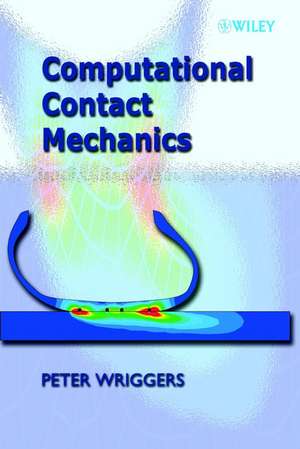
Computational Contact Mechanics
Autor Wriggersen Limba Engleză Hardback – 20 aug 2002
This book:
- applies to a wide variety of industrial applications,
- starts from a sound continuum mechanics background,
- introduces new discretisation techniques and algorithms, and
- includes thermo-mechanical considerations and adaptive methods.
Preț: 985.22 lei
Preț vechi: 1082.66 lei
-9%
Puncte Express: 1478
Carte tipărită la comandă
Livrare economică 23 noiembrie-07 decembrie
Livrare prin curier în România Termenul estimat este afișat lângă disponibilitate.
Transport gratuit pentru acest produs Plată online sau ramburs, în funcție de opțiunile comenzii.
Retur gratuit în 14 zile Comandă securizată și suport în română.
Specificații
ISBN-13: 9780471496809
ISBN-10: 0471496804
Pagini: 464
Dimensiuni: 175 x 250 x 29 mm
Greutate: 0.98 kg
Editura: Wiley
Locul publicării:Chichester, United Kingdom
ISBN-10: 0471496804
Pagini: 464
Dimensiuni: 175 x 250 x 29 mm
Greutate: 0.98 kg
Editura: Wiley
Locul publicării:Chichester, United Kingdom
V-ar putea interesa
-
 Matrix Structural AnalysisLewis P. Felton-27%Preț: 1379.44 lei1889.65 lei
 -
 -9%Preț: 981.18 lei1078.22 lei
 -
 Analytical MechanicsTorok-9%Preț: 1002.64 lei1101.80 lei
 -
 Finite Element Method 4eHuebner-27%Preț: 1123.51 lei1539.05 lei
 -
 Structural Analysis Design ControlHolnicki-Szulc-9%Preț: 3298.71 lei3624.96 lei
 -
 An Introduction to Engineering MathematicsD. McmullinPreț: 350.02 lei
 -
 An Introduction to Applied MechanicsEwart S. AndrewsPreț: 417.34 lei
 -
 Computational Contact MechanicsPeter Wriggers-19%Preț: 672.46 lei830.19 lei
 -
 Mixed Finite Element TechnologiesPeter Wriggers-15%Preț: 665.20 lei782.59 lei
 -
 Numerical Methods and Modelling for EngineeringRichard Khoury-15%Preț: 555.60 lei653.65 lei
 -
 Advances in Discretization MethodsGiulio Ventura-15%Preț: 668.72 lei786.73 lei
 -
 Design and Analysis of Control Systems: Case StudiesHumberto Stein ShiromotoPreț: 362.88 lei
 -
 Informed ArchitectureMarco Hemmerling-18%Preț: 976.39 lei1190.72 lei
 -
 Nichtlineare Finite-Element-MethodenPeter WriggersPreț: 485.04 lei
 -
 Nonlinear Finite Element MethodsPeter Wriggers-18%Preț: 769.41 lei938.31 lei
 -
 -18%Preț: 911.34 lei1111.40 lei
 -
 -18%Preț: 984.43 lei1200.52 lei
 -
 Preț: 348.18 lei
 -
 Preț: 355.19 lei
 -
 Interkulturelles User Interface DesignRüdiger Heimgärtner-13%Preț: 678.51 lei779.90 lei
 -
 Finite ElementeKlaus Knothe-11%Preț: 609.15 lei684.44 lei
 -
 MATHEMATICA kompaktHans BenkerPreț: 348.66 lei
 -
 New Trends in Thin Structures: Formulation, Optimization and Coupled ProblemsPaolo De Mattos Pimenta-15%Preț: 616.24 lei724.99 lei
 -
 -15%Preț: 478.79 lei563.28 lei
Public țintă
1. Graduate and postgraduate students 2. Engineers involved in numerical simulation in industry (e.g. aeronautics, car and tyre design, biomechanics, metal forming)Descriere
Contact mechanics is a specialist area in engineering mechanics. It deals with non standard mechanics which frequently appear in real technical applications. Examples include the simulation of car crashes, human joints, car tyres, rubber seals and metal forming processes.