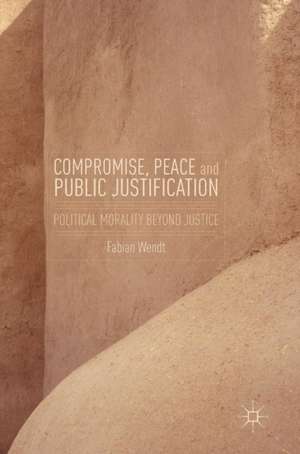
Compromise, Peace and Public Justification
Autor Fabian Wendten Limba Engleză Hardback – 21 iul 2016
Preț: 566.41 lei
Preț vechi: 666.37 lei
-15%
Puncte Express: 850
Carte tipărită la comandă
Livrare economică 08-22 iunie
Specificații
ISBN-13: 9783319288765
ISBN-10: 3319288768
Pagini: 296
Ilustrații: X, 286 p.
Dimensiuni: 153 x 216 x 21 mm
Greutate: 0.5 kg
Ediția:1st edition 2016
Editura: Springer
Locul publicării:Cham, Switzerland
ISBN-10: 3319288768
Pagini: 296
Ilustrații: X, 286 p.
Dimensiuni: 153 x 216 x 21 mm
Greutate: 0.5 kg
Ediția:1st edition 2016
Editura: Springer
Locul publicării:Cham, Switzerland
V-ar putea interesa
-
 The Idea of JusticeAmartya Sen-30%Preț: 72.80 lei103.32 lei
 -
 -14%Preț: 549.43 lei638.87 lei
 -
 -14%Preț: 92.96 lei108.55 lei
 -
 Motive and RightnessSteven Sverdlik-14%Preț: 505.21 lei587.45 lei
 -
 Human EnhancementJulian Savulescu-13%Preț: 289.89 lei334.78 lei
 -
 Well-Being and DeathBen BradleyPreț: 321.78 lei
 -
 Placing Blame: A Theory of the Criminal LawMichael S. Moore-21%Preț: 480.30 lei607.80 lei
 -
 -22%Preț: 369.72 lei476.30 lei
 -
 Killing in WarJeff McMahan-17%Preț: 151.67 lei183.25 lei
 -
 Objectivity: A Very Short IntroductionStephen Gaukroger-22%Preț: 52.71 lei67.33 lei
 -
 The Oxford Handbook of Philosophy of EmotionPeter Goldie-10%Preț: 336.79 lei374.49 lei
 -
 -7%Preț: 597.69 lei642.56 lei
 -
 Preț: 253.87 lei
 -
 The Structural Evolution of MoralityJ. McKenzie AlexanderPreț: 337.56 lei
 -
 Perpetual Euphoria – On the Duty to Be HappyPascal BrucknerPreț: 229.15 lei
 -
 Perspectives on Human Dignity: A ConversationJeff Malpas-15%Preț: 620.67 lei730.19 lei
 -
 Introduction to Evolutionary EthicsSM JamesPreț: 360.26 lei
 -
 Why Are You Free?: Neurobiology & Psychology of Voluntary ActionBoris Kotchoubey-30%Preț: 816.32 lei1169.67 lei
Public țintă
ResearchCuprins
Introduction.- 1. Compromise.- 1.1 What Compromises Are.- 1.2 Two Levels of Moral Evaluation.- 1.3 Consent.- 1.4 Types of Compromises.- 2. Peace.- 2.1 Peace and Modus Vivendi Arrangements.- 2.2 The Value of Peace.- 2.3 Peace and Justice.- 2.4 Peace and Non-Interference.- 3. Public Justification.- 3.1 Public Justification: The Basic Idea.- 3.2 Rawls, Stability and Public Justification.- 3.3 Respect and Public Justification.- 3.4 Community and Public Justification.- 4. Compromising for Peace and Public Justification.- 4.1 Peace and Public Justification as Second Level Values.- 4.2 The Deontic Morality of Compromising.- 4.3 Compromise and Liberal Institutions.- 4.4 Compromise and Legitimacy.- Conclusion.- Bibliography.- Index.
Notă biografică
Fabian Wendt is a Temporary Professor of Philosophy at Bielefeld University, Germany. He has previously been an Assistant Professor at the University of Hamburg, Germany, and a visiting scholar at the University of Arizona, USA.
Textul de pe ultima copertă
This book explores the morality of compromising. The author argues that peace and public justification are values that provide moral reasons to make compromises in politics, including compromises that establish unjust laws or institutions. He explains how it is possible to have moral reasons to agree to moral compromises and he debates our moral duties and obligations in making such compromises. The book also contains discussions of the sources of the value of public justification, the relation between peace and justice, the nature of modus vivendi arrangements and the connections between compromise, liberal institutions and legitimacy. In exploring the morality of compromising, the book thus provides some outlines for a map of political morality beyond justice.
Caracteristici
Offers a unique perspective on the nature of compromise, peace and public justification Documents a systematic theory applicable to politicians and philosophers Provides a clear, rigorous and well-documented analysis of political compromises