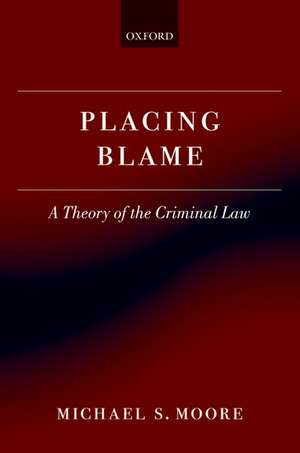
Placing Blame: A Theory of the Criminal Law
Autor Michael S. Mooreen Limba Engleză Paperback – 15 iul 2010
Preț: 537.18 lei
Preț vechi: 671.16 lei
-20%
Puncte Express: 806
Carte tipărită la comandă
Livrare economică 04-09 decembrie
Livrare prin curier în România Termenul estimat este afișat lângă disponibilitate.
Transport gratuit pentru acest produs Plată online sau ramburs, în funcție de opțiunile comenzii.
Retur gratuit în 14 zile Comandă securizată și suport în română.
Specificații
ISBN-13: 9780199599493
ISBN-10: 0199599491
Pagini: 872
Dimensiuni: 157 x 234 x 51 mm
Greutate: 1.29 kg
Ediția:Published in PB.
Editura: OUP OXFORD
Colecția OUP Oxford
Locul publicării:Oxford, United Kingdom
ISBN-10: 0199599491
Pagini: 872
Dimensiuni: 157 x 234 x 51 mm
Greutate: 1.29 kg
Ediția:Published in PB.
Editura: OUP OXFORD
Colecția OUP Oxford
Locul publicării:Oxford, United Kingdom
V-ar putea interesa
-
 Transitional JusticeRuti Teitel-21%Preț: 495.06 lei627.71 lei
 -
 Introduction to the Philosophy of Law: Readings and CasesJefferson White-27%Preț: 1124.43 lei1540.31 lei
 -
 -29%Preț: 470.51 lei658.50 lei
 -
 -13%Preț: 303.17 lei347.15 lei
 -
 -31%Preț: 545.19 lei789.41 lei
 -
 Retrospectivity and the Rule of LawCharles Sampford-33%Preț: 1122.73 lei1670.65 lei
 -
 Educating Oneself in Public: Critical Essays in JurisprudenceMichael S. Moore-33%Preț: 1315.27 lei1956.63 lei
 -
 Positive Law and Objective ValuesAndrei Marmor-31%Preț: 818.30 lei1191.31 lei
 -
 Justice and Punishment: The Rationale of CoercionMatt Matravers-30%Preț: 533.09 lei760.66 lei
 -
 -31%Preț: 743.60 lei1071.98 lei
 -
 -22%Preț: 402.61 lei517.86 lei
 -
 -20%Preț: 436.02 lei547.21 lei
 -
 Preț: 279.42 lei
 -
 Jacques Derrida: Law as Absolute HospitalityJacques de Ville-15%Preț: 461.72 lei543.20 lei
 -
 The Legal Theory of Carl SchmittMariano Croce-15%Preț: 457.63 lei538.39 lei
 -
 What Is This Babbler Trying to Say?Michael S. MoorePreț: 287.71 lei
 -
 The Balaam TraditionsMichael S. MoorePreț: 117.27 lei
 -
 A Textbook of International LawAlf Ross-19%Preț: 527.09 lei650.74 lei
 -
 Wealthwatch: A Study of Socioeconomic Conflict in the BibleMichael S. MoorePreț: 256.59 lei
 -
 Preț: 263.43 lei
 -
 Law and Social TheoryReza Banakar-14%Preț: 298.92 lei347.52 lei
 -
 Towards a European Legal CultureGenevieve Helleringer-33%Preț: 1628.23 lei2423.09 lei
 -
 History of Social Law in GermanyMichael Stolleis-23%Preț: 928.58 lei1205.95 lei
Recenzii
The high-point of Moore's exposition ... is a fine and psychologically penetrating defense of subjective moral institutions and emotions as 'heuristic indicators' of moral truths.
In an elegant and masterly introductory essay, laying out in order all the tasks of a theory of criminal law, he pleads that any 'deep theory' of the way law operates must take a moral point of view and be founded on moral institutions.
This book belongs on the shelves of every serious criminal law theorist and every research library in the world.
The book has four particular qualities which mark it out as a distinctive contribution to criminal law theory... its scope is remarkably broad. Furthermore, Moore brings an unusual combination of disciplinary perspectives to bear on the wide range of questions which he considers. Moore is also unusual in giving the emotions a central place in his theory of criminal law. One has to admire the originality of Moore's position. He is a trenchant anti-consequentialist in ethics who nonetheless provides a careful analysis of the proper role of consequential arguments in shaping criminal law.
... these are high-quality essays by a considerable figure, and should be read by anyone interested in criminal theory who has not done so already.
Much appreciation goes to Professor Moore for sharing his eloquent legal mind with us and our everlasting gratitude goes to the publisher, Oxford Univesrity Press, for bringing us this marvellous book in paperback....making this wonderful journey through the law accessible to students even.
In an elegant and masterly introductory essay, laying out in order all the tasks of a theory of criminal law, he pleads that any 'deep theory' of the way law operates must take a moral point of view and be founded on moral institutions.
This book belongs on the shelves of every serious criminal law theorist and every research library in the world.
The book has four particular qualities which mark it out as a distinctive contribution to criminal law theory... its scope is remarkably broad. Furthermore, Moore brings an unusual combination of disciplinary perspectives to bear on the wide range of questions which he considers. Moore is also unusual in giving the emotions a central place in his theory of criminal law. One has to admire the originality of Moore's position. He is a trenchant anti-consequentialist in ethics who nonetheless provides a careful analysis of the proper role of consequential arguments in shaping criminal law.
... these are high-quality essays by a considerable figure, and should be read by anyone interested in criminal theory who has not done so already.
Much appreciation goes to Professor Moore for sharing his eloquent legal mind with us and our everlasting gratitude goes to the publisher, Oxford Univesrity Press, for bringing us this marvellous book in paperback....making this wonderful journey through the law accessible to students even.
Notă biografică
Professor Michael Moore holds the Charles R. Walgreen, Jr. Chair at the Univerity of Illinois. He is jointly appointed as Professor of Law in the College of Law and as Professor of Philosophy in the College of Liberal Arts and Sciences. He also holds an appointment as a Professor with the Center for Advanced Studies. His major works include Causation and Responsibility (OUP, 2009), Act and Crime (OUP, 1993), and Law and Psychiatry (CUP, 1984).