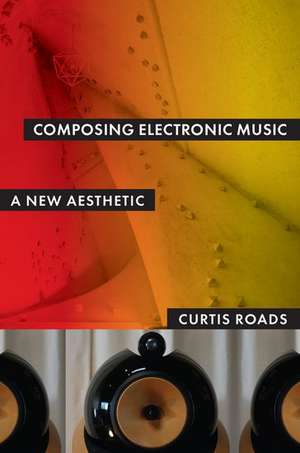
Composing Electronic Music: A New Aesthetic
Autor Curtis Roadsen Limba Engleză Paperback – 20 aug 2015
Preț: 408.11 lei
Preț vechi: 511.23 lei
-20%
Puncte Express: 612
Carte tipărită la comandă
Livrare economică 27 noiembrie-02 decembrie
Livrare express 21-27 octombrie pentru 106.72 lei
Livrare prin curier în România Termenul estimat este afișat lângă disponibilitate.
Transport gratuit pentru acest produs Plată online sau ramburs, în funcție de opțiunile comenzii.
Retur gratuit în 14 zile Comandă securizată și suport în română.
Specificații
ISBN-13: 9780195373240
ISBN-10: 0195373243
Pagini: 512
Ilustrații: 144 illus.
Dimensiuni: 155 x 231 x 28 mm
Greutate: 0.73 kg
Editura: Oxford University Press
Colecția OUP USA
Locul publicării:New York, United States
ISBN-10: 0195373243
Pagini: 512
Ilustrații: 144 illus.
Dimensiuni: 155 x 231 x 28 mm
Greutate: 0.73 kg
Editura: Oxford University Press
Colecția OUP USA
Locul publicării:New York, United States
V-ar putea interesa
-
 Electronic and Computer MusicPeter Manning-17%Preț: 440.51 lei528.35 lei
 -
 Live Audio: The Art of Mixing a ShowDave SwallowPreț: 333.56 lei
 -
 -19%Preț: 647.12 lei803.16 lei
 -
 Music TechnologyJulio D'EscrivanPreț: 214.32 lei
 -
 Preț: 229.09 lei
 -
 Techno RebelsDan SickoPreț: 160.67 lei
 -
 Love Saves the DayTim LawrencePreț: 200.03 lei
 -
 Keyboard Presents Synth GodsErnie Rideout-16%Preț: 109.57 lei130.56 lei
 -
 Studio One for Engineers and ProducersWilliam Edstrom Jr.-14%Preț: 124.85 lei144.82 lei
 -
 Kraftwerk: PublikationDavid Buckley-17%Preț: 103.61 lei124.76 lei
Recenzii
a worthwhile addition to electronic music literature.
What a pleasure to read a book which explains to us all the foundations of electronic music ... [which] has been opening a new full area on the history of music, and putting a clear separation between the area of "acoustic" music, and the area of "electronic" music.
Clearly formulated starting points engage the reader in more challenging concepts and interesting lines of enquiry, contextualising the many perspectives surrounding each topic. This well researched treasure chest of quotes, references, and examples illustrates an insightful text which the author, himself with decades of experience as a transcontinental practitioner, has enriched with personal reflections that in turn allow the reader to do the same.
Curtis Roads' book is a kind of prism that reevaluates the field of music composition in the light of the new technologies of the 21st century. He builds a thousand bridges between different approaches to attributes like pitch, rhythm, time scales, and even sonic narratives in order to help us to understand present music practices.
A rich and enjoyable survey for the computer musician, ranging from the objects of compositional manipulation to the performative aspects of the shaping of sensory experience. This book will be of interest not only to the electronic music composer, but also to the performing musician, and the general reader interested in the process and principles of musical design.
What a pleasure to read a book which explains to us all the foundations of electronic music ... [which] has been opening a new full area on the history of music, and putting a clear separation between the area of "acoustic" music, and the area of "electronic" music.
Clearly formulated starting points engage the reader in more challenging concepts and interesting lines of enquiry, contextualising the many perspectives surrounding each topic. This well researched treasure chest of quotes, references, and examples illustrates an insightful text which the author, himself with decades of experience as a transcontinental practitioner, has enriched with personal reflections that in turn allow the reader to do the same.
Curtis Roads' book is a kind of prism that reevaluates the field of music composition in the light of the new technologies of the 21st century. He builds a thousand bridges between different approaches to attributes like pitch, rhythm, time scales, and even sonic narratives in order to help us to understand present music practices.
A rich and enjoyable survey for the computer musician, ranging from the objects of compositional manipulation to the performative aspects of the shaping of sensory experience. This book will be of interest not only to the electronic music composer, but also to the performing musician, and the general reader interested in the process and principles of musical design.
Notă biografică
Curtis Roads is a composer and researcher who teaches electronic music composition at the University of California, Santa Barbara. He co-founded the International Computer Music Association and served as an editor/associate editor of Computer Music Journal for 23 years. The author of numerous books, his electronic music set POINT LINE CLOUD won the Award of Distinction at the 2002 Ars Electronica.
Cuprins
- 00 Preface
- 01 The electronic medium
- 02 Aesthetic foundations
- 03 The nature of sound
- 04 Creating sound materials
- 05 Sound transformation
- 06 Processes of rhythm
- 07 Pitch in electronic music
- 08 Articulating space
- 09 Multiscale organization
- 10 Sonic narrative
- 11 Generative strategies
- 12 The art of mixing
- 13 References
- Appendix A List of sound examples
- Index