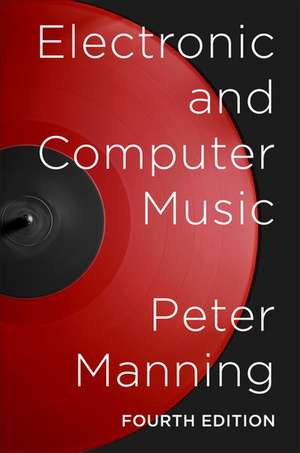
Electronic and Computer Music
Autor Peter Manningen Limba Engleză Paperback – 25 apr 2013
Preț: 440.51 lei
Preț vechi: 528.35 lei
-17%
Puncte Express: 661
Carte disponibilă
Livrare economică 13-18 noiembrie
Livrare prin curier în România Termenul estimat este afișat lângă disponibilitate.
Transport gratuit pentru acest produs Plată online sau ramburs, în funcție de opțiunile comenzii.
Retur gratuit în 14 zile Comandă securizată și suport în română.
Specificații
ISBN-13: 9780199746392
ISBN-10: 0199746397
Pagini: 576
Ilustrații: 20 halftones, 21 music examples, 24 line illus.
Dimensiuni: 155 x 231 x 28 mm
Greutate: 0.79 kg
Ediția:Fourth Edition
Editura: Oxford University Press
Colecția OUP USA
Locul publicării:New York, United States
ISBN-10: 0199746397
Pagini: 576
Ilustrații: 20 halftones, 21 music examples, 24 line illus.
Dimensiuni: 155 x 231 x 28 mm
Greutate: 0.79 kg
Ediția:Fourth Edition
Editura: Oxford University Press
Colecția OUP USA
Locul publicării:New York, United States
V-ar putea interesa
-
 Selected Poems of Lord George Gordon ByronLord George Gordon Byron-16%Preț: 105.56 lei125.82 lei
 -
 Schoenberg's Early CorrespondenceEthan Haimo-7%Preț: 337.50 lei362.34 lei
 -
 Love one anotherAlan BullardPreț: 27.86 lei
 -
 Praise the Lord, ye heavens adore himAlan BullardPreț: 27.86 lei
 -
 O Come, EmmanuelAlan BullardPreț: 88.69 lei
 -
 Writings on Music,: 1965-2000Steve Reich-13%Preț: 303.36 lei347.26 lei
 -
 -31%Preț: 596.13 lei863.76 lei
 -
 Letters of Ralph Vaughan Williams, 1895-1958Hugh Cobbe-22%Preț: 528.58 lei675.52 lei
 -
 Rethinking BrittenPhilip Rupprecht-21%Preț: 413.72 lei524.96 lei
 -
 Preț: 459.02 lei
 -
 Preț: 249.41 lei
 -
 The Ashgate Research Companion to Experimental MusicJames Saunders-9%Preț: 1335.73 lei1467.83 lei
 -
 -32%Preț: 397.87 lei585.01 lei
 -
 Nicolas Medtner: His Life and MusicBarrie Martyn-18%Preț: 1122.50 lei1368.90 lei
 -
 Preț: 74.63 lei
Recenzii
Manning ... presents an in-depth history of electronic and computer music by tracing the technological developments that gave birth to it and governed its evolution ... he provides a remarkable breadth of scientifically oriented information for advanced students and practitioners in the field who need to understand how the current technological landscape came about. This new edition, along with the earlier editions, belongs in academic music research libraries as well as relevant science collections.
Notă biografică
Peter Manning completed a doctorate in electronic and computer music at the University of Durham in 1977, and has been director of the Electronic Music Studio since 1980. In addition to writing books and articles on the history and development of the medium he has directed several research programs into new technologies for computer music and composed a number of electroacoustic works that have been widely performed in Europe, the Far East, and America.