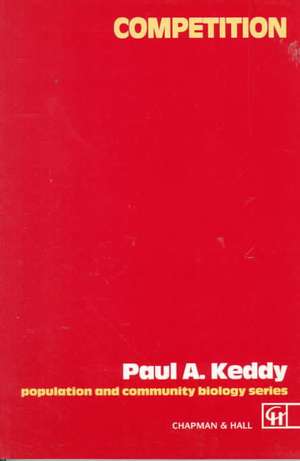
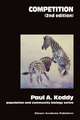
Competition: Population and Community Biology Series, cartea 6
Autor P.A. Keddyen Limba Engleză Paperback – 31 mai 1989
Din seria Population and Community Biology Series
- 15%
 Preț: 665.54 lei
 - 18%
 Preț: 1262.27 lei
 -
 Preț: 389.13 lei
 -
 Preț: 369.85 lei
 -
 Preț: 385.10 lei
 -
 Preț: 379.62 lei
 - 15%
 Preț: 614.41 lei
 -
 Preț: 370.91 lei
 - 5%
 Preț: 362.47 lei
 - 18%
 Preț: 1262.48 lei
 -
 Preț: 369.16 lei
 - 24%
 Preț: 1187.31 lei
 - 18%
 Preț: 1168.53 lei
 - 24%
 Preț: 1117.23 lei
 - 18%
 Preț: 1261.56 lei
 - 18%
 Preț: 1598.06 lei
 - 18%
 Preț: 1483.50 lei
 - 18%
 Preț: 966.92 lei
 - 18%
 Preț: 983.00 lei
 - 15%
 Preț: 611.27 lei
 - 18%
 Preț: 980.46 lei
 - 24%
 Preț: 831.70 lei
 - 15%
 Preț: 622.64 lei
 -
 Preț: 381.55 lei
 - 18%
 Preț: 1338.98 lei
 - 18%
 Preț: 1275.52 lei
 - 15%
 Preț: 631.79 lei
 -
 Preț: 371.73 lei
 -
 Preț: 385.84 lei
 - 15%
 Preț: 643.25 lei
Preț: 368.96 lei
Puncte Express: 553
Carte tipărită la comandă
Livrare economică 27 noiembrie-11 decembrie
Livrare prin curier în România Termenul estimat este afișat lângă disponibilitate.
Transport gratuit de la 400.00 lei Plată online sau ramburs, în funcție de opțiunile comenzii.
Retur gratuit în 14 zile Comandă securizată și suport în română.
Specificații
ISBN-13: 9780412313608
ISBN-10: 041231360X
Pagini: 224
Ilustrații: 224 p. 3 illus.
Dimensiuni: 155 x 235 x 12 mm
Greutate: 0.31 kg
Ediția:New.
Editura: SPRINGER NETHERLANDS
Colecția Springer
Seria Population and Community Biology Series
Locul publicării:Dordrecht, Netherlands
ISBN-10: 041231360X
Pagini: 224
Ilustrații: 224 p. 3 illus.
Dimensiuni: 155 x 235 x 12 mm
Greutate: 0.31 kg
Ediția:New.
Editura: SPRINGER NETHERLANDS
Colecția Springer
Seria Population and Community Biology Series
Locul publicării:Dordrecht, Netherlands
V-ar putea interesa
-
 On Natural SelectionCharles Darwin-20%Preț: 45.12 lei56.55 lei
 -
 Darwin: A Very Short IntroductionJonathan Howard-20%Preț: 56.97 lei71.00 lei
 -
 Origins of Life: From the Birth of Life to the Origin of LanguageJohn Maynard Smith-17%Preț: 162.40 lei195.86 lei
 -
 Frogs, Flies, and Dandelions: Speciation - The Evolution of New SpeciesMenno Schilthuizen-27%Preț: 352.84 lei484.02 lei
 -
 -32%Preț: 728.30 lei1078.94 lei
 -
 Origins of the Human BrainJean-Pierre Changeux-33%Preț: 759.48 lei1126.07 lei
 -
 The Origin and Early Evolution of LifeTom Fenchel-28%Preț: 377.94 lei528.22 lei
 -
 New Uses for New PhylogeniesPaul H. Harvey-30%Preț: 414.43 lei589.60 lei
 -
 -28%Preț: 421.40 lei582.39 lei
 -
 Genomics and Evolution of Microbial EukaryotesLaura A. Katz-28%Preț: 407.25 lei567.11 lei
 -
 Language EvolutionMorten H. Christiansen-28%Preț: 389.54 lei540.46 lei
 -
 Human Nature and the Limits of ScienceJohn Dupré-20%Preț: 364.38 lei453.29 lei
 -
 Mathematical Population Genetics 1Warren J. Ewens-18%Preț: 1161.93 lei1416.98 lei
 -
 Sex AllocationStuart West-19%Preț: 459.87 lei567.74 lei
 -
 -28%Preț: 84.33 lei116.62 lei
 -
 Charles Darwin: VoyagingJanet BrownePreț: 214.22 lei
 -
 Preț: 426.40 lei
Public țintă
ResearchCuprins
1 Studying competition.- 1.1 A definition of competition.- 1.2 Other views on the definition of competition.- 1.3 Kinds of resources.- 1.4 Kinds of competition.- 1.5 Competitive dominance.- 1.6 Back to basics.- 1.7 Questions for discussion.- 2 Competition in action.- 2.1 Competition and thermodynamics: basic principles.- 2.2 Case studies of intraspecific competition.- 2.3 Case studies of interspecific competition.- 2.4 Literature review of case studies.- 2.5 The current situation.- 2.6 Questions for discussion.- 3 Modelling of competition.- 3.1 Kinds of models.- 3.2 The Lotka-Volterra models.- 3.3 A resource competition model.- 3.4 Competition, behaviour and habitat use.- 3.5 Two graphical models for resource partitioning.- 3.6 Conclusion.- 3.7 Questions for discussion.- 4 Choosing the tools.- 4.1 Descriptive, comparative and experimental studies.- 4.2 Descriptive studies.- 4.3 Comparative studies.- 4.4 Experimental studies.- 4.5 Choosing a research path.- 4.6 Questions for discussion.- 5 Extending the generality of field experiments.- 5.1 Criticisms regarding lack of generality.- 5.2 Demonstrating generality of pattern.- 5.3 Using increased numbers of species.- 5.4 Providing a comparative context.- 5.5 Using general experimental factors.- 5.6 Arrangement along gradients.- 5.7 Conclusion.- 5.8 Questions for discussion.- 6 Community matrices and competitive hierarchies.- 6.1 Patterns in community matrices.- 6.2 Two examples of communities with competitive hierarchies.- 6.3 Future directions.- 6.4 Conclusion.- 6.5 Questions for discussion.- 7 Competition, empiricism and comparison.- 7.1 Constraints on competition in plant communities.- 7.2 Constraints on competition in animal communities.- 7.3 Comparison of insect and plant communities.- 7.4 Making theories operational for hypothesis testing.- 7.5 Resource partitioning revisited.- 7.6 Towards general principles.- 7.7 Questions for discussion.- 8 The path to competition theory.- 8.1 Goals for competition theory.- 8.2 Brains and their limitations.- 8.3 Choosing a question.- 8.4 Choosing appropriate model systems.- 8.5 Selecting a conceptual approach.- 8.6 Obstacles to communication.- 8.7 Conclusion.- 8.8 Questions for discussion.- References.
Recenzii
`... Competition is certainly a theory which has generated wide debate and Keddy's book does full justice to the diversity of ideas and the quality of the arguments that concern it. It is not a book which just sets out data so as to demonstrate either the reality or the extent of competition; rather it is a stimulating and challenging review of the range of ideas and types of studies which have been generated by the topic.'
British Ecological Society Bulletin
` ...I would recommend the book as a valuable reference for graduate students...there has been no convenient synthesis of competition theory and data. This book is a good step in the right direction.'
Acta Oecologica
British Ecological Society Bulletin
` ...I would recommend the book as a valuable reference for graduate students...there has been no convenient synthesis of competition theory and data. This book is a good step in the right direction.'
Acta Oecologica