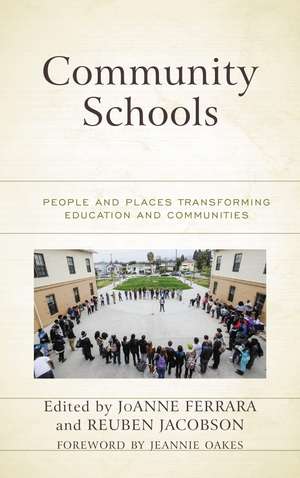
Community Schools: People and Places Transforming Education and Communities
Editat de JoAnne Ferrara, Reuben Jacobsonen Limba Engleză Hardback – 24 mai 2019
Preț: 393.89 lei
Preț vechi: 553.36 lei
-29%
Puncte Express: 591
Carte tipărită la comandă
Livrare economică 01-15 decembrie
Livrare prin curier în România Termenul estimat este afișat lângă disponibilitate.
Transport gratuit de la 400.00 lei Plată online sau ramburs, în funcție de opțiunile comenzii.
Retur gratuit în 14 zile Comandă securizată și suport în română.
Specificații
ISBN-13: 9781475831405
ISBN-10: 1475831404
Pagini: 170
Dimensiuni: 150 x 232 x 20 mm
Greutate: 0.49 kg
Editura: Bloomsbury Publishing
Colecția Rowman & Littlefield
Locul publicării:New York, United States
ISBN-10: 1475831404
Pagini: 170
Dimensiuni: 150 x 232 x 20 mm
Greutate: 0.49 kg
Editura: Bloomsbury Publishing
Colecția Rowman & Littlefield
Locul publicării:New York, United States
V-ar putea interesa
-
 -35%Preț: 408.44 lei627.73 lei
 -
 Globally Networked Teaching in the Humanities: Theories and PracticesAlexandra Schultheis MoorePreț: 424.32 lei
 -
 Preț: 465.18 lei
 -
 Preț: 450.95 lei
 -
 Beyond Native-Speakerism: Current Explorations and Future VisionsStephanie Ann Houghton-18%Preț: 1115.17 lei1359.96 lei
 -
 Preț: 386.05 lei
 -
 Becoming Critical Teacher Educators: Narratives of Disruption, Possibility, and PraxisJulie Ellison JusticePreț: 419.51 lei
 -
 -18%Preț: 1112.48 lei1356.68 lei
 -
 -18%Preț: 924.04 lei1126.88 lei
 -
 -18%Preț: 1245.04 lei1518.35 lei
 -
 -30%Preț: 421.87 lei598.80 lei
 -
 -23%Preț: 360.67 lei469.94 lei
 -
 -24%Preț: 252.84 lei334.54 lei
 -
 -26%Preț: 216.14 lei291.95 lei
 -
 -31%Preț: 348.45 lei507.05 lei
 -
 -25%Preț: 349.18 lei464.34 lei
 -
 Gifted or Just Plain Smart?: Teaching the 99th Percentile Made EasierAudrey M. Quinlan-25%Preț: 140.49 lei187.67 lei
 -
 -25%Preț: 218.85 lei291.90 lei
 -
 -26%Preț: 218.44 lei293.38 lei
 -
 Philosophy and Education as ActionYusef Waghid-19%Preț: 638.72 lei788.53 lei
 -
 -28%Preț: 397.20 lei555.50 lei
 -
 Teaching for Experiential Learning: Five Approaches That WorkScott D. Wurdinger-24%Preț: 279.78 lei369.61 lei
Cuprins
Dedication
Foreword: Dr. Jeannie Oakes, Presidential Professor of Education Equity Emeritus, UCLA, and Senior Fellow in Residence, Learning Policy Institute
Acknowledgements
Introduction
JoAnne Ferrara and Reuben Jacobson
The Community Schools Movement: Emergence and Growth Trends Reuben Jacobson
The Imagineers of Community School LeadershipLynda Tredway, Institute for Educational Leadership, Matthew Militello, East Carolina University
Community School Teacher Leaders Enhance LearningEllen Pais, Sarah Hurst, Deborah Lowe, Jessica Wadle, Jennifer Carey Rosenbaum, Los Angeles Education Partnership, HAAT
Re-imagining Teacher Preparation: The Role of Community Schools JoAnne Ferrara and Diane Gomez, Manhattanville College
The Community School Coordinator: Connecting Hearts and Mission Lissette Gomez, Children's Aid Society
Transformative Family Engagement in Community SchoolsMegan Hester, New York University Metro Center,
Natasha Capers, NYC Coalition for Educational Justice
The Voices for Equity: Youth Leadership in Oakland Community SchoolsKendra Fehrer and Aurora Lopez, Stanford University, Oakland Unified School District
Community School Partnerships and Continuous Improvement Adeline Ray and Carl Enger, Chicago Public Schools
The Role of the School District Alison McArthur, Tony Majors, and Kelly Noser, Metro Nashville Public Schools
Foreword: Dr. Jeannie Oakes, Presidential Professor of Education Equity Emeritus, UCLA, and Senior Fellow in Residence, Learning Policy Institute
Acknowledgements
Introduction
JoAnne Ferrara and Reuben Jacobson
The Community Schools Movement: Emergence and Growth Trends Reuben Jacobson
The Imagineers of Community School LeadershipLynda Tredway, Institute for Educational Leadership, Matthew Militello, East Carolina University
Community School Teacher Leaders Enhance LearningEllen Pais, Sarah Hurst, Deborah Lowe, Jessica Wadle, Jennifer Carey Rosenbaum, Los Angeles Education Partnership, HAAT
Re-imagining Teacher Preparation: The Role of Community Schools JoAnne Ferrara and Diane Gomez, Manhattanville College
The Community School Coordinator: Connecting Hearts and Mission Lissette Gomez, Children's Aid Society
Transformative Family Engagement in Community SchoolsMegan Hester, New York University Metro Center,
Natasha Capers, NYC Coalition for Educational Justice
The Voices for Equity: Youth Leadership in Oakland Community SchoolsKendra Fehrer and Aurora Lopez, Stanford University, Oakland Unified School District
Community School Partnerships and Continuous Improvement Adeline Ray and Carl Enger, Chicago Public Schools
The Role of the School District Alison McArthur, Tony Majors, and Kelly Noser, Metro Nashville Public Schools
Recenzii
With its attention to the people who make community schools possible, this book can be an important resource to many across the research, higher education, and PreK-12 sectors. Educational researchers in the field of com-munity schools, leadership studies, and school-community collaborations will all find utility in these chapters. In addition, this book offers help to teacher educators via a chapter by Ferrara and Gómez on the role of student teachers in community schools, and it also provides a text that their students-preservice teachers-can read to understand the multifaceted roles of schools in meeting not only student but also family needs. Finally, practitioners in community schools or leaders in districts hoping to adopt this model will find this book to be an invaluable resource to better understand the many parts of a successful community school. Overall, this volume reminds us of the essential work of not only teachers and school leaders, but also of coordinators, school boards, social services case workers, and families in the work of schools that create stu-dent success by attending to the whole child, not simply the child within the walls of the school
This timely book elevates the voices of practitioners and adds a missing dimension to the growing literature on full-service community schools.
For community schools advocates and practitioners alike, this book makes clear why community schools are so important. It is a must-read blue print for anyone who cares about helping at-risk and vulnerable children by strengthening neglected neighborhood schools and investing in public education.
In these challenging times, community schools have proven to be a powerful strategy to ensure that all children receive the full range of supports they need to be ready to learn: from health care and social services to before and after school experiences that reinforce classroom instruction to opportunities for families to become educationally engaged. This insightful book shows how a diverse set of leaders across a community can work together to improve schools. Its vivid examples inspire hope and pave a path to progress.
There is growing interest throughout the country in community schools that can respond holistically to the needs of children. This book describes how to make such schools work. The authors analyze the critical role of leadership and what they must do to coordinate the delivery of services to ensure success. For educators, policy makers and parents who seek to create schools that can serve as genuine assets to their communities, this book will be an excellent resource.
Carrying out an effective community schools initiative presumes new roles for all involved-- teachers, administrators, students, families and community partners. However, we know little about what this new way of "doing school" means for these stakeholders. Until Community Schools: People and Places Transforming Education and Communities, the field has had limited understanding of the many roles vital to a successful community school strategy, how they were developed, integrated and sustained. This book's up-close consideration of stakeholders' efforts to rethink their responsibilities and relationships provides an important community schools implementation perspective largely missing until now-one that features the people involved.
This timely book elevates the voices of practitioners and adds a missing dimension to the growing literature on full-service community schools.
For community schools advocates and practitioners alike, this book makes clear why community schools are so important. It is a must-read blue print for anyone who cares about helping at-risk and vulnerable children by strengthening neglected neighborhood schools and investing in public education.
In these challenging times, community schools have proven to be a powerful strategy to ensure that all children receive the full range of supports they need to be ready to learn: from health care and social services to before and after school experiences that reinforce classroom instruction to opportunities for families to become educationally engaged. This insightful book shows how a diverse set of leaders across a community can work together to improve schools. Its vivid examples inspire hope and pave a path to progress.
There is growing interest throughout the country in community schools that can respond holistically to the needs of children. This book describes how to make such schools work. The authors analyze the critical role of leadership and what they must do to coordinate the delivery of services to ensure success. For educators, policy makers and parents who seek to create schools that can serve as genuine assets to their communities, this book will be an excellent resource.
Carrying out an effective community schools initiative presumes new roles for all involved-- teachers, administrators, students, families and community partners. However, we know little about what this new way of "doing school" means for these stakeholders. Until Community Schools: People and Places Transforming Education and Communities, the field has had limited understanding of the many roles vital to a successful community school strategy, how they were developed, integrated and sustained. This book's up-close consideration of stakeholders' efforts to rethink their responsibilities and relationships provides an important community schools implementation perspective largely missing until now-one that features the people involved.