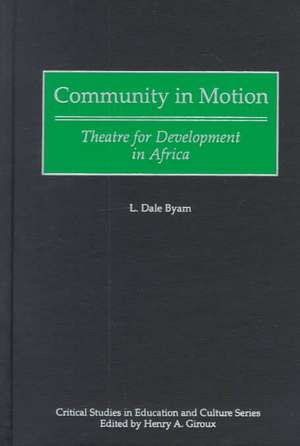
Community in Motion: Theatre for Development in Africa: Critical Studies in Education and Culture Series
Autor L. Dale Byamen Limba Engleză Hardback – 30 dec 1999
The author describes selected significant Theatre for Development programs in diverse parts of Africa and determines the extent that these programs find congruence with the teachings of Paulo Freire. Case studies of Botswana, Zambia, Nigeria, and Kenya explore in detail the ongoing work in Zimbabwe, specifically the Zimbabwe Association of Community Theatre (ZACT). ZACT's work is analyzed in the context of Freirian pedagogy in order to highlight the development of a community-based theatre operation that is national in its scope and international in its influences.
Din seria Critical Studies in Education and Culture Series
- 22%
 Preț: 245.43 lei
 - 37%
 Preț: 175.00 lei
 - 19%
 Preț: 246.73 lei
 - 22%
 Preț: 248.07 lei
 - 21%
 Preț: 181.50 lei
 - 26%
 Preț: 245.43 lei
 - 38%
 Preț: 477.54 lei
 - 24%
 Preț: 245.91 lei
 - 23%
 Preț: 244.24 lei
 - 26%
 Preț: 189.16 lei
 - 31%
 Preț: 354.92 lei
 - 26%
 Preț: 233.00 lei
 - 24%
 Preț: 183.34 lei
 - 31%
 Preț: 474.28 lei
 - 27%
 Preț: 170.15 lei
 - 37%
 Preț: 176.71 lei
 - 28%
 Preț: 475.91 lei
 - 22%
 Preț: 331.89 lei
 - 26%
 Preț: 233.00 lei
 - 31%
 Preț: 449.39 lei
 - 31%
 Preț: 450.05 lei
 - 22%
 Preț: 308.40 lei
 - 21%
 Preț: 184.30 lei
 - 31%
 Preț: 479.18 lei
 - 26%
 Preț: 245.43 lei
 - 26%
 Preț: 233.59 lei
 - 31%
 Preț: 472.80 lei
 - 23%
 Preț: 243.59 lei
 - 26%
 Preț: 242.16 lei
 - 28%
 Preț: 475.91 lei
 - 31%
 Preț: 450.46 lei
 - 32%
 Preț: 143.16 lei
 - 28%
 Preț: 174.41 lei
 - 31%
 Preț: 356.54 lei
 - 44%
 Preț: 675.89 lei
 - 41%
 Preț: 450.46 lei
 - 28%
 Preț: 473.73 lei
 - 23%
 Preț: 243.06 lei
 - 33%
 Preț: 247.20 lei
 - 41%
 Preț: 450.46 lei
Preț: 474.82 lei
Preț vechi: 658.56 lei
-28%
Puncte Express: 712
Preț estimativ în valută:
83.98€ • 99.58$ • 73.17£
83.98€ • 99.58$ • 73.17£
Carte tipărită la comandă
Livrare economică 25 martie-08 aprilie
Specificații
ISBN-13: 9780897895811
ISBN-10: 0897895819
Pagini: 240
Dimensiuni: 156 x 235 x 23 mm
Greutate: 0.48 kg
Ediția:New.
Editura: Bloomsbury Publishing
Colecția Praeger
Seria Critical Studies in Education and Culture Series
Locul publicării:New York, United States
ISBN-10: 0897895819
Pagini: 240
Dimensiuni: 156 x 235 x 23 mm
Greutate: 0.48 kg
Ediția:New.
Editura: Bloomsbury Publishing
Colecția Praeger
Seria Critical Studies in Education and Culture Series
Locul publicării:New York, United States
V-ar putea interesa
-
 -18%Preț: 445.96 lei542.47 lei
 -
 -19%Preț: 498.02 lei612.70 lei
 -
 India: Development and ParticipationJean Drèze-9%Preț: 397.46 lei437.11 lei
 -
 Development Policy of the European UnionMartin HollandPreț: 278.43 lei
 -
 Preț: 374.91 lei
 -
 Preț: 276.70 lei
 -
 Bangladesh: Politics, Economy and Civil SocietyDavid LewisPreț: 232.07 lei
 -
 Key Concepts in Development GeographyRob PotterPreț: 344.07 lei
 -
 -18%Preț: 164.64 lei199.86 lei
 -
 -22%Preț: 130.17 lei167.23 lei
 -
 -21%Preț: 163.25 lei207.24 lei
 -
 -22%Preț: 147.83 lei189.60 lei
 -
 The Participation ReaderAndrea Cornwall-16%Preț: 171.50 lei203.74 lei
 -
 Innovation in Seed Potato Systems in Eastern AfricaPeter Gildemacher-13%Preț: 175.85 lei201.59 lei
Cuprins
Series Foreword by Henry A. Giroux
Foreword by Ngugi wa Thiong'o
Preface
Post-Colonialism, Development, and a New African Theatre
The Growth of Theatre for Development Case Studies of Botswana, Nigeria, Zambia, and Kenya
The Zimbabwe Association of Community Theatre
Conscientization through ZACT
Conclusion
Appendices
Bibliography
Index
Foreword by Ngugi wa Thiong'o
Preface
Post-Colonialism, Development, and a New African Theatre
The Growth of Theatre for Development Case Studies of Botswana, Nigeria, Zambia, and Kenya
The Zimbabwe Association of Community Theatre
Conscientization through ZACT
Conclusion
Appendices
Bibliography
Index