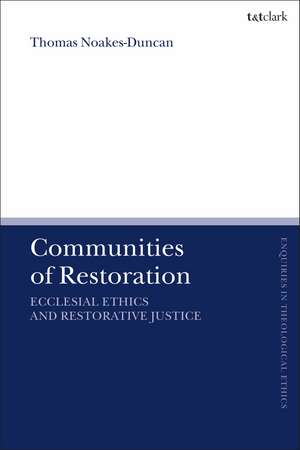
Communities of Restoration: Ecclesial Ethics and Restorative Justice: T&T Clark Enquiries in Theological Ethics
Autor Dr Thomas Noakes-Duncanen Limba Engleză Paperback – 18 apr 2019
"How does an ecclesial context shape the theological apprehension and praxis of justice?" This question orientates the book. In particular, it asks how, in view of its members having been admitted into God's restoring justice in Christ, the church might embody in the world this same justice of restoring right relationships. While Christian reflection on the nature of justice has tended to favour a judicial and retributive conception of justice, it will be argued that the biblical understanding of the justice of God is best understood as a saving, liberating, and restorative justice. It is this restorative conception that ought to guide the community that reads Scripture so that it might be embodied in life.
Din seria T&T Clark Enquiries in Theological Ethics
- nou
 Preț: 193.70 lei
 -
 Preț: 224.61 lei
 - 29%
 Preț: 197.36 lei
 - 25%
 Preț: 222.60 lei
 - 37%
 Preț: 559.73 lei
 - 31%
 Preț: 205.53 lei
 - 29%
 Preț: 197.50 lei
 - 17%
 Preț: 237.12 lei
 - 37%
 Preț: 525.51 lei
 - 27%
 Preț: 202.25 lei
 - 32%
 Preț: 482.18 lei
 - 26%
 Preț: 231.30 lei
 - 27%
 Preț: 199.07 lei
 - 34%
 Preț: 526.24 lei
 - 26%
 Preț: 229.51 lei
 - 37%
 Preț: 526.43 lei
 - 26%
 Preț: 237.12 lei
 - 14%
 Preț: 557.80 lei
 - 32%
 Preț: 203.52 lei
 - 28%
 Preț: 243.99 lei
 - 25%
 Preț: 224.42 lei
 - 29%
 Preț: 196.96 lei
 - 28%
 Preț: 238.36 lei
 - 27%
 Preț: 247.79 lei
 - 27%
 Preț: 197.79 lei
 - 34%
 Preț: 526.73 lei
 - 27%
 Preț: 203.06 lei
 - 27%
 Preț: 197.60 lei
 - 37%
 Preț: 525.33 lei
Preț: 238.74 lei
Preț vechi: 322.10 lei
-26%
Puncte Express: 358
Carte tipărită la comandă
Livrare economică 09-23 iunie
Specificații
ISBN-13: 9780567688002
ISBN-10: 0567688003
Pagini: 288
Dimensiuni: 156 x 234 x 23 mm
Greutate: 0.4 kg
Editura: Bloomsbury Publishing
Colecția T&T Clark
Seria T&T Clark Enquiries in Theological Ethics
Locul publicării:London, United Kingdom
ISBN-10: 0567688003
Pagini: 288
Dimensiuni: 156 x 234 x 23 mm
Greutate: 0.4 kg
Editura: Bloomsbury Publishing
Colecția T&T Clark
Seria T&T Clark Enquiries in Theological Ethics
Locul publicării:London, United Kingdom
V-ar putea interesa
-
 -9%Preț: 358.15 lei393.36 lei
 -
 BENEATH THE MASK OF HOLINESSMark ShawPreț: 202.39 lei
 -
 Living JesusJohn PritchardPreț: 82.12 lei
 -
 Seven: The Deadly Sins and the BeatitudesJeff V. CookPreț: 101.62 lei
 -
 Preț: 106.49 lei
 -
 The Routledge Companion to the Christian ChurchGerard Mannion-15%Preț: 474.55 lei558.29 lei
 -
 Sanctorum CommunioDietrich BonhoefferPreț: 238.13 lei
 -
 Desiring the Kingdom - Worship, Worldview, and Cultural FormationJames K. A. SmithPreț: 138.61 lei
 -
 For the Beauty of the EarthSteven Bouma-PredigerPreț: 196.47 lei
 -
 God Is Great, God Is GoodChad MeisterPreț: 180.12 lei
 -
 Forgotten GodFrancis ChanPreț: 92.30 lei
 -
 Letters from a SkepticGregory A. BoydPreț: 99.99 lei
 -
 Death and AfterlifeTerence NicholsPreț: 145.50 lei
Cuprins
Introduction
Chapter 1
Ecclesial Perspectives on Justice in Historical Perspective
Chapter 2
The Ecclesial Turn in Christian Ethics
Chapter 3
The Emergence of Restorative Justice in Ecclesial Practice
Chapter 4
The Theological Interpretation of Scripture and Biblical Justice
Chapter 5
A Parable of the Justice of God, Luke 15:11-32
Chapter 6
The Restorative Spirit in Christian Community, A Reading of First Corinthians
Chapter 7
Ecclesial Embodiments of Restorative Justice Practice
Conclusion
Bibliography
Index
Chapter 1
Ecclesial Perspectives on Justice in Historical Perspective
Chapter 2
The Ecclesial Turn in Christian Ethics
Chapter 3
The Emergence of Restorative Justice in Ecclesial Practice
Chapter 4
The Theological Interpretation of Scripture and Biblical Justice
Chapter 5
A Parable of the Justice of God, Luke 15:11-32
Chapter 6
The Restorative Spirit in Christian Community, A Reading of First Corinthians
Chapter 7
Ecclesial Embodiments of Restorative Justice Practice
Conclusion
Bibliography
Index
Recenzii
This is a book that needs to be thought about and discussed, and has a contribution to make to the ongoing discussion.
[Noakes-Duncan's] book is a plea that we think more deeply about the idea of justice as a relational concept - reconciliation - made explicit in God's revelation in Christ as we have it in Scripture.
Despite its origins in the peace church tradition, restorative justice has yet to receive the attention it deserves from theological scholarship as a brilliant framework for elucidating the character of God's justice in Scripture. It also has the potential, as Thomas Noakes-Duncan demonstrates in this original and far-reaching study, to cast fresh light on the meaning and mission of the church. After establishing that the justice of God disclosed in Christ is fundamentally a restorative rather than a retributive justice, Noakes-Duncan shows how the church is created to embody and perform that same justice in its own distinctive life, worship and witness. This is an excellent contribution to the field of ecclesial ethics. It also provides a template for contemporary congregations to use as they work out what it means to be caught up in God's great work of restoring the world to wholeness.
In this timely, acute and wise study, Thomas Noakes-Duncan rightly identifies justice as a power that heals, restores, and reconciles rather than hurts, punishes, and kills. He gives us an excellent work of ecclesial ethics, because he is never satisfied not only until the church performs Jesus' story, but also until that story both learns from and profoundly enriches the world's story. How justice and the church ever got separated in imagination or practice is a tragedy: for how they should be correctly practised as the same thing, Noakes-Duncan here offers an articulate, vigorous and compelling account.
[Noakes-Duncan's] book is a plea that we think more deeply about the idea of justice as a relational concept - reconciliation - made explicit in God's revelation in Christ as we have it in Scripture.
Despite its origins in the peace church tradition, restorative justice has yet to receive the attention it deserves from theological scholarship as a brilliant framework for elucidating the character of God's justice in Scripture. It also has the potential, as Thomas Noakes-Duncan demonstrates in this original and far-reaching study, to cast fresh light on the meaning and mission of the church. After establishing that the justice of God disclosed in Christ is fundamentally a restorative rather than a retributive justice, Noakes-Duncan shows how the church is created to embody and perform that same justice in its own distinctive life, worship and witness. This is an excellent contribution to the field of ecclesial ethics. It also provides a template for contemporary congregations to use as they work out what it means to be caught up in God's great work of restoring the world to wholeness.
In this timely, acute and wise study, Thomas Noakes-Duncan rightly identifies justice as a power that heals, restores, and reconciles rather than hurts, punishes, and kills. He gives us an excellent work of ecclesial ethics, because he is never satisfied not only until the church performs Jesus' story, but also until that story both learns from and profoundly enriches the world's story. How justice and the church ever got separated in imagination or practice is a tragedy: for how they should be correctly practised as the same thing, Noakes-Duncan here offers an articulate, vigorous and compelling account.