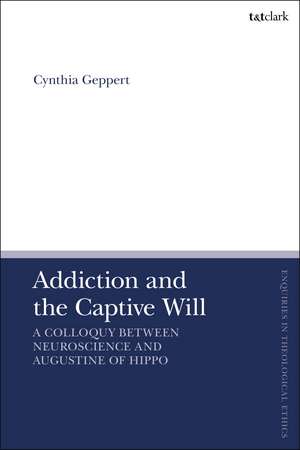
Addiction and the Captive Will: A Colloquy between Neuroscience and Augustine of Hippo: T&T Clark Enquiries in Theological Ethics
Autor Professor Cynthia Gepperten Limba Engleză Hardback – 27 iun 2024
and subsuming other moral priorities and human rewards. Scholars have investigated Aristotle's concept of akrasia as an ancient mirror of this understanding and there have been some preliminary discussions of Augustine's concept of the divided will as it bears on addiction.
No detailed and comprehensive exploration of the work of Augustine has yet been undertaken as it relates to three contemporary models of addiction: the choice, learning, and brain disease models. Augustine's psychological awareness, his mastery of ancient theological and philosophical thinking, and his enormous and enduring influence on both Catholic and Protestant theology, make him an ideal subject for such research. This incisive book argues that Augustine's doctrine of the captive will offers a theological parallel of each of these contemporary models of addiction.
Din seria T&T Clark Enquiries in Theological Ethics
- 28%
 Preț: 207.19 lei
 - 24%
 Preț: 233.22 lei
 -
 Preț: 239.64 lei
 - 36%
 Preț: 584.38 lei
 - 26%
 Preț: 215.78 lei
 - 30%
 Preț: 219.30 lei
 - 28%
 Preț: 207.35 lei
 - 16%
 Preț: 248.84 lei
 - 36%
 Preț: 551.45 lei
 - 31%
 Preț: 503.36 lei
 - 25%
 Preț: 246.79 lei
 - 25%
 Preț: 214.01 lei
 - 32%
 Preț: 552.23 lei
 - 26%
 Preț: 229.51 lei
 - 36%
 Preț: 552.40 lei
 - 25%
 Preț: 248.94 lei
 - 14%
 Preț: 557.80 lei
 - 30%
 Preț: 213.66 lei
 - 27%
 Preț: 260.33 lei
 - 23%
 Preț: 239.45 lei
 - 28%
 Preț: 211.72 lei
 - 26%
 Preț: 216.67 lei
 - 27%
 Preț: 250.23 lei
 - 26%
 Preț: 260.01 lei
 - 26%
 Preț: 211.03 lei
 - 32%
 Preț: 552.72 lei
 - 25%
 Preț: 250.53 lei
 - 25%
 Preț: 212.42 lei
Preț: 551.25 lei
Preț vechi: 863.76 lei
-36%
Puncte Express: 827
Carte tipărită la comandă
Livrare economică 27 noiembrie-11 decembrie
Livrare prin curier în România Termenul estimat este afișat lângă disponibilitate.
Transport gratuit pentru acest produs Plată online sau ramburs, în funcție de opțiunile comenzii.
Retur gratuit în 14 zile Comandă securizată și suport în română.
Specificații
ISBN-13: 9780567713520
ISBN-10: 0567713520
Pagini: 288
Dimensiuni: 155 x 234 x 20 mm
Greutate: 0.5 kg
Editura: Bloomsbury Publishing
Colecția T&T Clark
Seria T&T Clark Enquiries in Theological Ethics
Locul publicării:London, United Kingdom
ISBN-10: 0567713520
Pagini: 288
Dimensiuni: 155 x 234 x 20 mm
Greutate: 0.5 kg
Editura: Bloomsbury Publishing
Colecția T&T Clark
Seria T&T Clark Enquiries in Theological Ethics
Locul publicării:London, United Kingdom
Cuprins
Chapter 1
Eternal Questions
Part I: The Historical and Philosophical Review of the Models of Addiction
Chapter 2
Models and Methods in Addictionology
Chapter 3
The Moral Model of Addiction
Chapter 4
The Disease Model of Addiction
Chapter 5
The Brain Disease Model of Addiction
Chapter 6
The Backlash Against the Brain Disease Model and the Rise of Alternative Models
Part II: Phenomenology of the Confessions
Chapter 7
Books I through IV: Augustine the Lost Seeker
Chapter 8
Books V through VII: Augustine's Intellectual Conversion
Chapter 9
The Conversion of the Will: Books VIII through IX
Chapter 10
The Conversions of Memory: Books X through XIII
Part III: Theological Analysis
Chapter 11
The Captivity of the Will
Chapter 12
Augustine, Sin, and the Models of Addiction
Chapter 13
Grace and the Models of Addiction
Chapter 14
The Colloguium between Augustine and Addiction
Bibliography
Index
Eternal Questions
Part I: The Historical and Philosophical Review of the Models of Addiction
Chapter 2
Models and Methods in Addictionology
Chapter 3
The Moral Model of Addiction
Chapter 4
The Disease Model of Addiction
Chapter 5
The Brain Disease Model of Addiction
Chapter 6
The Backlash Against the Brain Disease Model and the Rise of Alternative Models
Part II: Phenomenology of the Confessions
Chapter 7
Books I through IV: Augustine the Lost Seeker
Chapter 8
Books V through VII: Augustine's Intellectual Conversion
Chapter 9
The Conversion of the Will: Books VIII through IX
Chapter 10
The Conversions of Memory: Books X through XIII
Part III: Theological Analysis
Chapter 11
The Captivity of the Will
Chapter 12
Augustine, Sin, and the Models of Addiction
Chapter 13
Grace and the Models of Addiction
Chapter 14
The Colloguium between Augustine and Addiction
Bibliography
Index
Recenzii
Seeking to imagine a conversation between neuroscience and Augustine is thus ambitious. In doing so, this book engages with some fundamental human concerns.
Addiction mystifies all who experience or observe it. Anyone new to this field encounters a maelstrom of studies, models, and competing claims for what drives addiction, and for what its sufferers might need. Dr Geppert's extensive expertise in ethics, medicine, and theology guides us through this terrain by conversing modern theories of addiction with Augustine's theological anthropology. The result is highly readable, nuanced, and integrative. Her work interleaves the latest literature in the neuroscience and psychology of addiction, with a profound apprehension of the bottomless grace of God. She points sufferers and their helpers toward a new, yet also a very ancient, kind of hope.
Drawing on her professional experience in addiction medicine, Cynthia Geppert sets up an intensive and well-resourced dialogue between the neuroscience of addiction, Augustine's theological anthropology, and recent theological accounts of addiction. The result is a sophisticated and important contribution that advances the theological understanding of addiction, offers critical and constructive insights for scientists and clinicians, and suggests lessons for the churches' pastoral practice. Anyone wishing to understand and respond well to the human predicament of addiction should read this book.
Augustine's sensitive portrayal of the nature and limits of his own agency in his Confessions makes him an illuminating dialogue partner in our own attempts to respond to addiction-especially when he is read in light of recent scholarship on his ideas about freedom. As she wrestles with the dilemma of how to hold addicts accountable without shaming them, Geppert's training in both psychology and theology are put to good use. This is the most scientifically well-informed theological discussion of addiction and human agency published in recent years, and a helpful introduction to key aspects of Augustine's thought.
Addiction mystifies all who experience or observe it. Anyone new to this field encounters a maelstrom of studies, models, and competing claims for what drives addiction, and for what its sufferers might need. Dr Geppert's extensive expertise in ethics, medicine, and theology guides us through this terrain by conversing modern theories of addiction with Augustine's theological anthropology. The result is highly readable, nuanced, and integrative. Her work interleaves the latest literature in the neuroscience and psychology of addiction, with a profound apprehension of the bottomless grace of God. She points sufferers and their helpers toward a new, yet also a very ancient, kind of hope.
Drawing on her professional experience in addiction medicine, Cynthia Geppert sets up an intensive and well-resourced dialogue between the neuroscience of addiction, Augustine's theological anthropology, and recent theological accounts of addiction. The result is a sophisticated and important contribution that advances the theological understanding of addiction, offers critical and constructive insights for scientists and clinicians, and suggests lessons for the churches' pastoral practice. Anyone wishing to understand and respond well to the human predicament of addiction should read this book.
Augustine's sensitive portrayal of the nature and limits of his own agency in his Confessions makes him an illuminating dialogue partner in our own attempts to respond to addiction-especially when he is read in light of recent scholarship on his ideas about freedom. As she wrestles with the dilemma of how to hold addicts accountable without shaming them, Geppert's training in both psychology and theology are put to good use. This is the most scientifically well-informed theological discussion of addiction and human agency published in recent years, and a helpful introduction to key aspects of Augustine's thought.