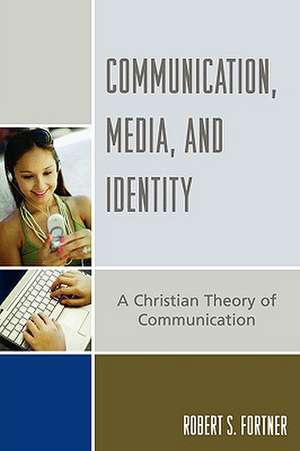
Communication, Media, and Identity: A Christian Theory of Communication: Communication, Culture, and Religion
Autor Robert S. Fortneren Limba Engleză Paperback – 27 noi 2006
As the newest book in the Communication, Culture, and Religion Series, Robert Fortner's work illuminates the theological aspects of communication.
Preț: 350.75 lei
Preț vechi: 448.20 lei
-22%
Puncte Express: 526
Carte tipărită la comandă
Livrare economică 08-22 iunie
Specificații
ISBN-13: 9780742551954
ISBN-10: 0742551954
Pagini: 281
Dimensiuni: 155 x 233 x 14 mm
Greutate: 0.44 kg
Editura: Bloomsbury Publishing
Colecția Rowman & Littlefield
Seria Communication, Culture, and Religion
Locul publicării:New York, United States
ISBN-10: 0742551954
Pagini: 281
Dimensiuni: 155 x 233 x 14 mm
Greutate: 0.44 kg
Editura: Bloomsbury Publishing
Colecția Rowman & Littlefield
Seria Communication, Culture, and Religion
Locul publicării:New York, United States
V-ar putea interesa
-
 -31%Preț: 475.91 lei690.76 lei
 -
 Faith and Liberty: The Economic Thought of the Late ScholasticsAlejandro A. Chafuen-23%Preț: 291.00 lei375.97 lei
 -
 Christian College, Christian CallingSteve Wilkens-26%Preț: 209.25 lei283.33 lei
 -
 Preț: 62.00 lei
 -
 Preț: 103.06 lei
 -
 Job Unlocked - A RevelationMR Randy WintersPreț: 66.81 lei
 -
 Preț: 86.35 lei
 -
 Coming Out of BondageFolake HassanPreț: 105.68 lei
 -
 God Is GoodFolake HassanPreț: 71.31 lei
 -
 Be EncouragedFolake HassanPreț: 83.64 lei
 -
 We All Have Reasons to Praise GodFolake HassanPreț: 70.85 lei
 -
 Preț: 95.38 lei
 -
 Preț: 80.93 lei
 -
 Preț: 46.51 lei
 -
 Preț: 42.56 lei
 -
 Church Administration and ManagementDag Heward-MillsPreț: 248.31 lei
 -
 Thoughts and GleaningsRalph BeallPreț: 351.47 lei
 -
 GearedCarolyn Alexander BrownPreț: 87.90 lei
 -
 Por Que Creo En Lo Que Creo?Reynaldo ParejaPreț: 121.50 lei
 -
 World War 3 Coming Soon!Meyer StahlPreț: 65.70 lei
 -
 A Manual for Men Mentoring MenJerome StevensonPreț: 119.47 lei
 -
 Espiritus Que Atacan a la IglesiaRev Manuel a. CarrascoPreț: 64.92 lei
 -
 Liderazgo En La Iglesia LocalDenis LumbiPreț: 60.08 lei
Cuprins
Chapter 1 Preface
Chapter 2 Figures
Chapter 3 Chapter 1: What is Communication?
Chapter 4 Chapter 2: Communication: Theology and Theory
Chapter 5 Chapter 3: Communication as a Relational Activity
Chapter 6 Chapter 4: Communication through Technology
Chapter 7 Chapter 5: Communication as if People Mattered
Chapter 8 Chapter 6: Communication as Art
Chapter 9 Chapter 7: Communication and Culture
Chapter 10 Chapter 8: Communication, Information, and Knowledge
Chapter 11 Chapter 9: Christian Intimacy and the Self in a Digital World
Chapter 12 Chapter 10: Communicating in Cybernetic Culture
Chapter 13 Chapter 11: Implications
Chapter 14 References
Chapter 15 Index
Chapter 2 Figures
Chapter 3 Chapter 1: What is Communication?
Chapter 4 Chapter 2: Communication: Theology and Theory
Chapter 5 Chapter 3: Communication as a Relational Activity
Chapter 6 Chapter 4: Communication through Technology
Chapter 7 Chapter 5: Communication as if People Mattered
Chapter 8 Chapter 6: Communication as Art
Chapter 9 Chapter 7: Communication and Culture
Chapter 10 Chapter 8: Communication, Information, and Knowledge
Chapter 11 Chapter 9: Christian Intimacy and the Self in a Digital World
Chapter 12 Chapter 10: Communicating in Cybernetic Culture
Chapter 13 Chapter 11: Implications
Chapter 14 References
Chapter 15 Index
Recenzii
A needed and detailed synthesis of Christian ontology/epistemology and contemporary communication theory. Will be a great help to the young scholar.
In Communication, Media, and Identity, Robert Fortner takes us on a pilgrimage through Christian thought and social theory to a place where we can see the possibilities of communion and community in communication. This book achieves a rare synthesis of scholarship and evangelical Christian faith.
A brilliant book, written with the intelligence and beauty of a humanities craftsman. It's erudite, but smart: readable as ever, illustrations that sing, and wisdom with theory. It will speak to what the author calls his 'interpretive community' with the same phosphoresence as John Dewey's The Public and Its Problems did for his. Robert Fortner's definition of communication is the best I've ever seen, and organizing the book around it is a splendid idea. This is imperative reading for the field as a whole.
In Communication, Media, and Identity, Robert Fortner takes us on a pilgrimage through Christian thought and social theory to a place where we can see the possibilities of communion and community in communication. This book achieves a rare synthesis of scholarship and evangelical Christian faith.
A brilliant book, written with the intelligence and beauty of a humanities craftsman. It's erudite, but smart: readable as ever, illustrations that sing, and wisdom with theory. It will speak to what the author calls his 'interpretive community' with the same phosphoresence as John Dewey's The Public and Its Problems did for his. Robert Fortner's definition of communication is the best I've ever seen, and organizing the book around it is a splendid idea. This is imperative reading for the field as a whole.