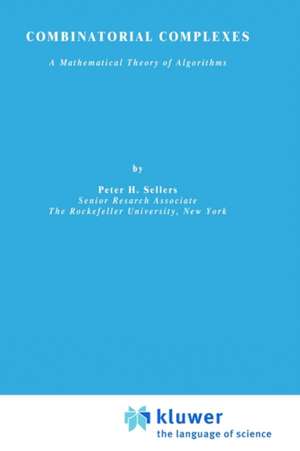
Combinatorial Complexes: Mathematics and Its Applications, cartea 2
Autor P. H. Sellersen Limba Engleză Hardback – 30 sep 1979
Din seria Mathematics and Its Applications
-
 Preț: 412.68 lei
 - 18%
 Preț: 1048.25 lei
 - 15%
 Preț: 672.96 lei
 -
 Preț: 404.05 lei
 - 15%
 Preț: 662.05 lei
 - 15%
 Preț: 723.46 lei
 - 15%
 Preț: 667.29 lei
 - 15%
 Preț: 668.15 lei
 -
 Preț: 405.32 lei
 - 20%
 Preț: 615.89 lei
 -
 Preț: 399.19 lei
 -
 Preț: 404.56 lei
 - 18%
 Preț: 1037.84 lei
 - 15%
 Preț: 668.41 lei
 - 15%
 Preț: 676.76 lei
 - 15%
 Preț: 677.98 lei
 - 15%
 Preț: 624.77 lei
 - 15%
 Preț: 616.45 lei
 -
 Preț: 401.99 lei
 -
 Preț: 439.09 lei
 -
 Preț: 408.44 lei
 -
 Preț: 399.31 lei
 - 15%
 Preț: 670.10 lei
 - 15%
 Preț: 618.99 lei
 - 18%
 Preț: 975.31 lei
 - 20%
 Preț: 684.97 lei
 - 20%
 Preț: 662.39 lei
 -
 Preț: 411.74 lei
 -
 Preț: 436.79 lei
 -
 Preț: 368.23 lei
 - 15%
 Preț: 668.41 lei
 -
 Preț: 402.52 lei
 -
 Preț: 374.91 lei
 - 15%
 Preț: 679.50 lei
 - 15%
 Preț: 677.73 lei
 - 20%
 Preț: 645.35 lei
 -
 Preț: 414.61 lei
 -
 Preț: 399.93 lei
 - 18%
 Preț: 985.19 lei
 -
 Preț: 405.84 lei
 - 15%
 Preț: 676.33 lei
 - 15%
 Preț: 668.83 lei
 -
 Preț: 403.53 lei
Preț: 400.98 lei
Puncte Express: 601
Carte tipărită la comandă
Livrare economică 28 noiembrie-12 decembrie
Livrare prin curier în România Termenul estimat este afișat lângă disponibilitate.
Transport gratuit pentru acest produs Plată online sau ramburs, în funcție de opțiunile comenzii.
Retur gratuit în 14 zile Comandă securizată și suport în română.
Specificații
ISBN-13: 9789027710000
ISBN-10: 9027710007
Pagini: 204
Ilustrații: XVI, 184 p.
Dimensiuni: 160 x 241 x 16 mm
Greutate: 0.43 kg
Ediția:1979
Editura: Springer
Colecția Mathematics and its Applications
Seria Mathematics and Its Applications
Locul publicării:Dordrecht, Netherlands
ISBN-10: 9027710007
Pagini: 204
Ilustrații: XVI, 184 p.
Dimensiuni: 160 x 241 x 16 mm
Greutate: 0.43 kg
Ediția:1979
Editura: Springer
Colecția Mathematics and its Applications
Seria Mathematics and Its Applications
Locul publicării:Dordrecht, Netherlands
V-ar putea interesa
-
 Cybersecurity and Applied MathematicsLeigh Metcalf-29%Preț: 340.35 lei479.85 lei
 -
 Constraint Handling RulesThom Frühwirth-20%Preț: 395.12 lei493.89 lei
 -
 Quantum Computing for Computer ScientistsNoson S. Yanofsky-8%Preț: 590.98 lei642.37 lei
 -
 Guaranteed Accuracy in Numerical Linear AlgebraS. K. Godunov-15%Preț: 680.30 lei800.34 lei
 -
 Adjoint Equations and Analysis of Complex SystemsGuri I. Marchuk-15%Preț: 702.01 lei825.90 lei
 -
 Numerical Integration of Stochastic Differential EquationsG. N. Milstein-18%Preț: 917.74 lei1119.19 lei
 -
 -23%Preț: 487.76 lei633.45 lei
 -
 -20%Preț: 645.35 lei806.69 lei
 -
 Preț: 419.59 lei
 -
 Statistical & Soft Computing Approaches in Insurance ProblemsSancho Salcedo-Sanz-20%Preț: 617.39 lei771.74 lei
 -
 Introduction to Mathematica® with ApplicationsMarian Mure¿an-20%Preț: 788.85 lei986.07 lei
 -
 Arithmetic of Finite FieldsSylvain Duquesne-20%Preț: 321.74 lei402.18 lei
 -
 Preț: 389.02 lei
 -
 Theory and Applications of Models of ComputationT. V. Gopal-20%Preț: 343.86 lei429.81 lei
 -
 Relational and Algebraic Methods in Computer SciencePeter Höfner-20%Preț: 337.17 lei421.47 lei
 -
 -20%Preț: 319.92 lei399.90 lei
 -
 Numerical Solutions of the N-Body ProblemA. MarciniakPreț: 403.61 lei
 -
 Computational ComplexityG. Wechsung-15%Preț: 680.40 lei800.47 lei
 -
 -18%Preț: 901.63 lei1099.55 lei
 -
 The Application of Mathematics in IndustryR. S. AnderssenPreț: 371.73 lei
Public țintă
ResearchCuprins
0. Introduction.- 0.1. Finding Algorithms.- 0.2. Programs Represent Algorithms.- 0.3. Programming Languages.- 0.4. List-making Algorithms.- 0.5. The Theory in a Nutshell.- I. Programming.- I.1. To Make a List.- I.2. Elementary Programming Languages.- I.3. To Specify a Program Inductively.- I.4. Graphical Programming Languages.- I.5. Chain Complexes.- I.6. Programming Complexes.- I.7. Complexes which are Not Free.- I.8. Language Isomorphisms.- I.9. To Find an Algorithm.- II. Monomials.- II.1. The Language.- II.2. The Interpretation ?.- II.3. The Interpretation ?.- II.4. The Interpretation ?.- II.5. Language Isomorphisms.- II.6. A Program for Monomials.- II.7. Sample Programs.- III. Factorizations.- III.1. The Language.- III.2. The Interpretation ?.- III.3. The Interpretation ?.- III.4. The Interpretation ?.- III.5. Language Isomorphisms.- III.6. A Program for Factorizations.- III.7. Sample Programs.- IV. Transpositions.- IV.1. The Language.- IV.2. The Interpretation ?.- IV.3. The Interpretation ?.- IV.4. The Interpretation ?.- IV.5. Language Isomorphisms.- IV.6. A Program for Sequences.- IV.7. Sample Programs.- V. Bracketings.- V.1. The Language.- V.2. The Interpretation ?.- V.3. The Interpretation ?.- V.4. The Interpretation ?.- V.5. Language Isomorphisms.- V.6. A Program for Bracketings.- V.7. Sample Programs.- VI. Clustering.- VI.1.The Language.- VI.2. The Interpretation ?.- VI.3. The Interpretation ?.- VI.4. The Interpretation ?.- VI.5. Language Isomorphisms.- VI.6. A Program of Clusterings.- VI.7. Sample Program.- Appendix. Flowcharts.- Flowchart 1. Elementary Languages.- Flowchart 2. Languages in General.- References.