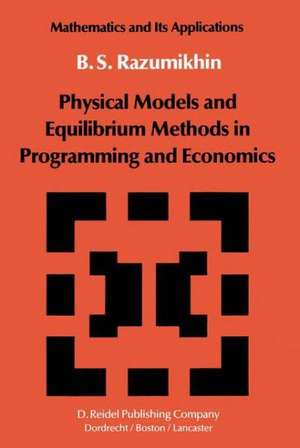
Physical Models and Equilibrium Methods in Programming and Economics: Mathematics and Its Applications, cartea 2
Autor B. S. Razumikhinen Limba Engleză Hardback – 31 oct 1984
Din seria Mathematics and Its Applications
-
 Preț: 412.68 lei
 - 18%
 Preț: 1048.25 lei
 - 15%
 Preț: 672.96 lei
 -
 Preț: 404.05 lei
 - 15%
 Preț: 662.05 lei
 - 15%
 Preț: 723.46 lei
 - 15%
 Preț: 667.29 lei
 - 15%
 Preț: 668.15 lei
 -
 Preț: 405.32 lei
 - 20%
 Preț: 615.89 lei
 -
 Preț: 399.19 lei
 -
 Preț: 404.56 lei
 - 18%
 Preț: 1037.84 lei
 - 15%
 Preț: 668.41 lei
 - 15%
 Preț: 676.76 lei
 - 15%
 Preț: 677.98 lei
 - 15%
 Preț: 624.77 lei
 - 15%
 Preț: 616.45 lei
 -
 Preț: 401.99 lei
 -
 Preț: 439.09 lei
 -
 Preț: 408.44 lei
 -
 Preț: 399.31 lei
 - 15%
 Preț: 670.10 lei
 - 15%
 Preț: 618.99 lei
 - 18%
 Preț: 975.31 lei
 - 20%
 Preț: 684.97 lei
 - 20%
 Preț: 662.39 lei
 -
 Preț: 400.98 lei
 -
 Preț: 436.79 lei
 -
 Preț: 368.23 lei
 - 15%
 Preț: 668.41 lei
 -
 Preț: 402.52 lei
 -
 Preț: 374.91 lei
 - 15%
 Preț: 679.50 lei
 - 15%
 Preț: 677.73 lei
 - 20%
 Preț: 645.35 lei
 -
 Preț: 414.61 lei
 -
 Preț: 399.93 lei
 - 18%
 Preț: 985.19 lei
 -
 Preț: 405.84 lei
 - 15%
 Preț: 676.33 lei
 - 15%
 Preț: 668.83 lei
 -
 Preț: 403.53 lei
Preț: 411.74 lei
Puncte Express: 618
Carte tipărită la comandă
Livrare economică 07-21 decembrie
Livrare prin curier în România Termenul estimat este afișat lângă disponibilitate.
Transport gratuit pentru acest produs Plată online sau ramburs, în funcție de opțiunile comenzii.
Retur gratuit în 14 zile Comandă securizată și suport în română.
Specificații
ISBN-13: 9789027716446
ISBN-10: 9027716447
Pagini: 372
Ilustrații: XV, 351 p.
Dimensiuni: 160 x 241 x 25 mm
Greutate: 0.67 kg
Ediția:1984
Editura: Springer
Colecția Mathematics and its Applications
Seria Mathematics and Its Applications
Locul publicării:Dordrecht, Netherlands
ISBN-10: 9027716447
Pagini: 372
Ilustrații: XV, 351 p.
Dimensiuni: 160 x 241 x 25 mm
Greutate: 0.67 kg
Ediția:1984
Editura: Springer
Colecția Mathematics and its Applications
Seria Mathematics and Its Applications
Locul publicării:Dordrecht, Netherlands
V-ar putea interesa
-
 Hurricane Climatology: A Modern Statistical Guide Using RJames B. Elsner-30%Preț: 820.09 lei1169.33 lei
 -
 -18%Preț: 1370.46 lei1671.29 lei
 -
 Handbook in Monte Carlo SimulationPaolo Brandimarte-9%Preț: 993.76 lei1092.04 lei
 -
 -9%Preț: 715.91 lei786.71 lei
 -
 -14%Preț: 702.53 lei816.89 lei
 -
 -27%Preț: 833.31 lei1141.52 lei
 -
 Growth Curve ModelingMichael J Panik-9%Preț: 904.81 lei994.29 lei
 -
 Mathematical and Computational ModelingRoderick Melnik-8%Preț: 659.58 lei716.94 lei
 -
 Milling SimulationWeihong Zhang-9%Preț: 1019.61 lei1120.46 lei
 -
 Nonlinear Physical SystemsOleg N Kirillov-23%Preț: 1192.96 lei1549.29 lei
 -
 Mathematics for Modeling and Scientific ComputingThierry Goudon-9%Preț: 1031.51 lei1133.53 lei
 -
 Systems Dependability AssessmentJean-Francois Aubry-9%Preț: 1020.35 lei1121.26 lei
 -
 METHODS & APPL OF WHITE NOISE ANALY IN INTERDISCIPLIN SCIBernido Christopher C-15%Preț: 577.78 lei679.74 lei
Public țintă
ResearchCuprins
I: Equilibrium of mechanical systems with linear constraints and linear programming problems.- 1.1. Introduction.- 1.2. Linear equations and inequalities.- 1.3. Systems of linear equations and inequalities.- 1.4. Linear programming problems. Duality theorems.- II: Equilibrium of physical systems and linear programming problems.- 2.1. Introduction.- 2.2. Some concepts from thermodynamics.- 2.3. Physical models of dual pairs of systems of linear equations and inequalities. Alternative theorems.- 2.4. A physical model for linear programming problems. Equilibrium conditions.- 2.5. Penalty methods.- 2.6. Some properties of approximate solutions of dual problems of linear programming problems.- 2.7. Models for transport type problems.- III: The method of redundant constraints and iterative algorithms.- 3.1. Introduction.- 3.2. The method of redundant constraints.- 3.3. The first iterative algorithm for solving linear programming problems and for solving systems of linear equations and inequalities.- 3.4. The second algorithm.- 3.5. Reduction of the general linear programming problem to a sequence of inconsistent systems. The third algorithm.- IV: The principle of removing constraints.- 4.1. Introduction.- 4.2. The method of generalized coordinates.- 4.3. The method of multipliers.- 4.4. Elastic constraints. Penalty function methods.- 4.5. Discussion.- V: The hodograph method.- 5.1. Introduction.- 5.2. The hodograph method for linear programming problems.- 5.3. Solution of the dual problem.- 5.4. Results of numerical experiments.- VI: The method of displacement of elastic constraints.- 6.1. Introduction.- 6.2. The first algorithm.- 6.3 The second algorithm.- 6.4. Combining the algorithms.- VII: Decomposition methods for linear programming problems.- 7.1. Introduction.- 7.2. Decomposition algorithms.- 7.3. Allocation of resources problems.- VIII: Nonlinear programming.- 8.1. Introduction.- 8.2. The principle of virtual displacements and the Kuhn-Tucker theorem.- 8.3. Numerical methods for solving nonlinear programming problems.- IX: The tangent method.- 9.1. Introduction.- 9.2. Constrained minimization problems.- 9.3. Linear programming.- 9.4. Dynamic problems of optimal control.- X: Models for economic equilibrium.- 10.1. Introduction.- 10.2. Equilibrium problems for linear exchange models.- 10.3. An algorithm for solving numerically equilibrium problems for linear exchange economies.- 10.4. Discussion. The Boltzmann principle.- 10.5. Equilibrium of linear economic models.- 10.6 Physical models for economic equilibrium. The equilibrium theorem.- 10.7. An algorithm for solving equilibrium problems for linear economic models.- 10.8. A generalization of the economic equilibrium problem.- XI: Dynamic economic models.- 11.1. Introduction.- 11.2. The Von Neumann-Gale model. Growth rates and interest rates.- 11.3. A method for solving the problem of maximum growth rates.- 11.4. Duality and problems of growth rates and interest rates.- 11.5. The minimal time problem.- 11.6. A time optimal control problem economic growth.- 11.7. A physical model for solving optimal control problems.- 11.8. Decomposition for time optimal control problems.- 11.9. Optimal balanced growth problems.- XII: Optimal control problems.