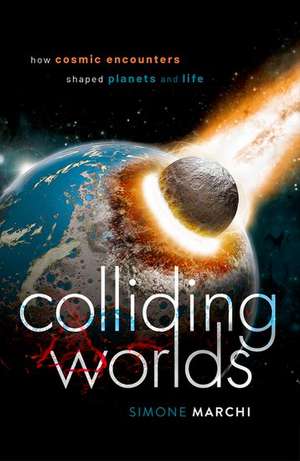
Colliding Worlds: How Cosmic Encounters Shaped Planets and Life
Autor Simone Marchien Limba Engleză Hardback – 24 iun 2021
Preț: 145.91 lei
Preț vechi: 191.57 lei
-24%
Puncte Express: 219
Carte disponibilă
Livrare economică 13-18 noiembrie
Livrare express 28 octombrie-03 noiembrie pentru 79.43 lei
Livrare prin curier în România Termenul estimat este afișat lângă disponibilitate.
Transport gratuit de la 400.00 lei Plată online sau ramburs, în funcție de opțiunile comenzii.
Retur gratuit în 14 zile Comandă securizată și suport în română.
Specificații
ISBN-13: 9780198845409
ISBN-10: 0198845405
Pagini: 224
Ilustrații: 30 black and white images and a 4 page colour plate section
Dimensiuni: 161 x 242 x 23 mm
Greutate: 0.48 kg
Editura: OUP OXFORD
Colecția OUP Oxford
Locul publicării:Oxford, United Kingdom
ISBN-10: 0198845405
Pagini: 224
Ilustrații: 30 black and white images and a 4 page colour plate section
Dimensiuni: 161 x 242 x 23 mm
Greutate: 0.48 kg
Editura: OUP OXFORD
Colecția OUP Oxford
Locul publicării:Oxford, United Kingdom
V-ar putea interesa
-
 Preț: 240.94 lei
 -
 The Universe WithinNeil ShubinPreț: 92.60 lei
 -
 -14%Preț: 129.50 lei151.25 lei
 -
 Earth and Life: A History of Four Billion YearsAnne Nédélec-12%Preț: 275.15 lei311.54 lei
 -
 Ocean Worlds: The story of seas on Earth and other planetsJan Zalasiewicz-20%Preț: 84.23 lei105.83 lei
 -
 Preț: 147.33 lei
 -
 A Little History of the EarthJamie WoodwardPreț: 151.60 lei
 -
 -25%Preț: 70.44 lei94.37 lei
 -
 Ends of the EarthNeil ShubinPreț: 158.97 lei
 -
 -5%Preț: 75.34 lei79.65 leiRecomandat
 -
 Our StoryColin Butfield-21%Preț: 133.36 lei168.13 lei
 -
 -37%Preț: 137.47 lei219.35 lei
 -
 -35%Preț: 53.93 lei82.95 lei
 -
 -27%Preț: 64.97 lei89.47 lei
 -
 Preț: 60.75 lei
 -
 Planetary GeologyClaudio Vita-FinziPreț: 546.97 lei
 -
 Eight Improbable PossibilitiesJohn GribbinPreț: 70.14 lei
 -
 -18%Preț: 64.80 lei79.39 lei
 -
 Solar SystemGail HarlandPreț: 201.21 lei
Recenzii
In Colliding Worlds, Simone Marchi explores the key role that collisions in space have played in the formation and evolution of our solarsystem, the development of planets, and possibly even the origin of life on Earth. Analyzing our latest understanding of the surfaces of Mars and Venus, gleaned from recent space missions, Marchi presents the dramatic story of cosmic collisions and their legacies.
Although collisions form the main thread running through the book, it's actually wider in scope than that, covering both the history of the Solar System, and the history of our understanding of it. That includes our understanding of our own planet, and one of the eye-opening facts is how long it took the academic world to recognise the role played by collisions in geological history. Basically, the topic got lost for decades in the gap between the geology and astronomy departments. [...] Marchi's first-hand accounts of work he was personally involved in - such as NASAs Dawn mission to the asteroid belt - make especially fascinating reading. For anyone wanting an up-to-date account of the Solar System and the processes that shape it, this is the perfect place to start.
Colliding Worlds is a fascinating and fresh look at the history of our solar system through the lens of the cataclysmic events that have profoundly shaped it. Marchi's engaging and clearly written book helps us understand the nature and significance of impacts for Earth's geologic history and the emergence of life, as well as their implications for our sibling terrestrial planets and exoplanetary systems.
A fascinating story of how our Solar System was formed, and how we have arrived at the current understanding of it, from the unique perspective of cosmic collisions. Information from a few hundred years of planetary and astronomical research to the latest space exploration is marvellously weaved together. The very success of being able to connect diverse subjects in such a coherent and engaging manner attests to the fundamental importance of cosmic collisions, or "creative destruction" as the author puts it, in our search for the grand theory of planetary formation in the coming years.
Although collisions form the main thread running through the book, it's actually wider in scope than that, covering both the history of the Solar System, and the history of our understanding of it. That includes our understanding of our own planet, and one of the eye-opening facts is how long it took the academic world to recognise the role played by collisions in geological history. Basically, the topic got lost for decades in the gap between the geology and astronomy departments. [...] Marchi's first-hand accounts of work he was personally involved in - such as NASAs Dawn mission to the asteroid belt - make especially fascinating reading. For anyone wanting an up-to-date account of the Solar System and the processes that shape it, this is the perfect place to start.
Colliding Worlds is a fascinating and fresh look at the history of our solar system through the lens of the cataclysmic events that have profoundly shaped it. Marchi's engaging and clearly written book helps us understand the nature and significance of impacts for Earth's geologic history and the emergence of life, as well as their implications for our sibling terrestrial planets and exoplanetary systems.
A fascinating story of how our Solar System was formed, and how we have arrived at the current understanding of it, from the unique perspective of cosmic collisions. Information from a few hundred years of planetary and astronomical research to the latest space exploration is marvellously weaved together. The very success of being able to connect diverse subjects in such a coherent and engaging manner attests to the fundamental importance of cosmic collisions, or "creative destruction" as the author puts it, in our search for the grand theory of planetary formation in the coming years.
Notă biografică
Dr. Simone Marchi is a Principal Scientist at Southwest Research in Boulder, Colorado. His interests cover the formation and geology of the terrestrial planets, the Moon, and asteroids. He is Deputy Project scientist for the NASA Lucy mission, and Co-Investigator of the NASA Psyche mission, NASA Dawn mission, and ESA BepiColombo. He is a member of the science teams of the ESA JUICE and Rosetta missions. Marchi won the international Farinella Prize and NASA's Susan Mahan Neibur Early Career Award for his studies of the impact histories of terrestrial planets and asteroids and early evolution of the Solar System. He is also the recipient of several NASA and ESA mission group achievement awards, and has an asteroid named after him by the International Astronomical Union: Asteroid 72543 Simonemarchi. His work is regularly featured on the news.
Cuprins
- 1: Born out of Fire and Chaos
- 2: A Clash of Giants
- 3: Wandering Among the Planets
- 4: Earth's Wild Years
- 5: A Watery Mars
- 6: Creative Destruction
- Endnotes