
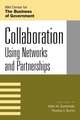
Collaboration: Using Networks and Partnerships: IBM Center for the Business of Government
Editat de John M. Kamensky, Thomas J. Burlin Contribuţii de Mark A. Abramson, Robert Agranoff, Xavier de Souza Briggs, Samuel M. DeMarie, Elaine C. Kamarck, Robert Klitgaard, John W. Scanlon, William M. Snyder, Gregory F. Treverton, William L. Waugh Jr.en Limba Engleză Hardback – 19 mar 2004
Din seria IBM Center for the Business of Government
- 27%
 Preț: 357.45 lei
 - 31%
 Preț: 351.16 lei
 - 22%
 Preț: 352.79 lei
 - 24%
 Preț: 353.87 lei
 - 26%
 Preț: 175.18 lei
 - 24%
 Preț: 253.93 lei
 - 23%
 Preț: 271.02 lei
 - 25%
 Preț: 181.42 lei
 - 23%
 Preț: 270.43 lei
 - 23%
 Preț: 270.03 lei
 - 19%
 Preț: 318.61 lei
 - 24%
 Preț: 353.46 lei
 - 24%
 Preț: 357.20 lei
 - 28%
 Preț: 400.92 lei
 - 21%
 Preț: 369.30 lei
 - 21%
 Preț: 363.20 lei
 - 22%
 Preț: 306.87 lei
Preț: 796.19 lei
Preț vechi: 1188.26 lei
-33%
Puncte Express: 1194
Carte tipărită la comandă
Livrare economică 01-15 decembrie
Livrare prin curier în România Termenul estimat este afișat lângă disponibilitate.
Transport gratuit pentru acest produs Plată online sau ramburs, în funcție de opțiunile comenzii.
Retur gratuit în 14 zile Comandă securizată și suport în română.
Specificații
ISBN-13: 9780742535138
ISBN-10: 0742535134
Pagini: 392
Dimensiuni: 162 x 226 x 30 mm
Greutate: 0.76 kg
Editura: Bloomsbury Publishing
Colecția Rowman & Littlefield
Seria IBM Center for the Business of Government
Locul publicării:New York, United States
ISBN-10: 0742535134
Pagini: 392
Dimensiuni: 162 x 226 x 30 mm
Greutate: 0.76 kg
Editura: Bloomsbury Publishing
Colecția Rowman & Littlefield
Seria IBM Center for the Business of Government
Locul publicării:New York, United States
V-ar putea interesa
-
 Building the New American EconomyJeffrey D. SachsPreț: 128.18 lei
 -
 Us Environmental HistoryJohn Wills-18%Preț: 598.48 lei729.85 lei
 -
 Churchill's FollyAnthony RogersPreț: 141.30 lei
 -
 Too Much Stuff: Capitalism in CrisisKozo YamamuraPreț: 163.15 lei
 -
 Preț: 139.48 lei
 -
 Preț: 233.04 lei
 -
 Preț: 190.84 lei
 -
 ThorGeoff Goodchild-11%Preț: 129.40 lei144.79 lei
 -
 Ford, M: Weapon of ChoiceMatthew Ford-22%Preț: 235.11 lei301.08 lei
Cuprins
Part 1 I Understanding Networks and Partnerships
Chapter 2 Networks and Partnerships: Collaborating to Achieve Results No One Can Achieve Alone
Chapter 3 Assessing Partnerships: New Forms of Collaboration
Chapter 4 Leveraging Networks: A Guide for Public Managers Working across Organizations
Chapter 5 Applying 21st-Century Government to the Challenge of Homeland Security
Part 6 II Networks and Partnerships in Action
Chapter 7 Using Virtual Teams to Manage Complex Projects: A Case Study of the Radioactive Waste Management Project
Chapter 8 Communities of Practice: A New Tool for Government Managers
Chapter 9 Leveraging Networks to Meet National Goals: FEMA and the Safe Construction Networks
Chapter 10 Extraordinary Results on National Goals: Networks and Partnerships in the Bureau of Primary Health Care's 100%/0 Campaign
Chapter 2 Networks and Partnerships: Collaborating to Achieve Results No One Can Achieve Alone
Chapter 3 Assessing Partnerships: New Forms of Collaboration
Chapter 4 Leveraging Networks: A Guide for Public Managers Working across Organizations
Chapter 5 Applying 21st-Century Government to the Challenge of Homeland Security
Part 6 II Networks and Partnerships in Action
Chapter 7 Using Virtual Teams to Manage Complex Projects: A Case Study of the Radioactive Waste Management Project
Chapter 8 Communities of Practice: A New Tool for Government Managers
Chapter 9 Leveraging Networks to Meet National Goals: FEMA and the Safe Construction Networks
Chapter 10 Extraordinary Results on National Goals: Networks and Partnerships in the Bureau of Primary Health Care's 100%/0 Campaign
Recenzii
Those working at the local level will recognise Klitgaard and Treverton's assertion that we are entering an era of 'hybrid governance' where the lines between the public, private, and voluntary sectors are fast eroding. This volume is a timely addition to our toolkit for managing that acceleration.