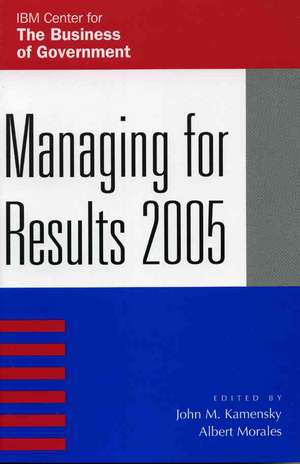
Managing for Results 2005: IBM Center for the Business of Government
Editat de John M. Kamensky, Albert Morales Contribuţii de Mark A. Abramson, Joe Adams, Harry P. Hatry, Carolyn J. Heinrich, Lenneal J. Henderson, Mark T. Imperial, Philip G. Joyce, Mordecai Lee, Shelley H. Metzenbaum, Elaine Morley, Shelli B. Rossman, Joseph S. Wholey, Chris Wyeen Limba Engleză Paperback – 10 dec 2004
Part I increases our understanding about the potential use of performance information in government. It starts with a chapter on how government leaders can overcome obstacles to using performance information. Another chapter presents a comprehensive framework for tying performance to the budget process. The book provides specific examples of how performance information has been used to dramatically improve program outcomes.
Part II presents case studies on the use of performance information to improve results in a range of federal agencies, in Texas state government, and in the City of Baltimore. As pioneering efforts, these examples do not all present success stories; nevertheless, the lessons learned will be instructive to public managers as the "managing for results" movement advances toward maturity.
Din seria IBM Center for the Business of Government
- 27%
 Preț: 357.45 lei
 - 31%
 Preț: 351.16 lei
 - 22%
 Preț: 352.79 lei
 - 24%
 Preț: 353.87 lei
 - 26%
 Preț: 175.18 lei
 - 24%
 Preț: 253.93 lei
 - 23%
 Preț: 271.02 lei
 - 25%
 Preț: 181.42 lei
 - 23%
 Preț: 270.43 lei
 - 23%
 Preț: 270.03 lei
 - 19%
 Preț: 318.61 lei
 - 24%
 Preț: 353.46 lei
 - 24%
 Preț: 357.20 lei
 - 21%
 Preț: 369.30 lei
 - 21%
 Preț: 363.20 lei
 - 22%
 Preț: 306.87 lei
Preț: 400.92 lei
Preț vechi: 556.98 lei
-28%
Puncte Express: 601
Carte tipărită la comandă
Livrare economică 30 noiembrie-14 decembrie
Livrare prin curier în România Termenul estimat este afișat lângă disponibilitate.
Transport gratuit pentru acest produs Plată online sau ramburs, în funcție de opțiunile comenzii.
Retur gratuit în 14 zile Comandă securizată și suport în română.
Specificații
ISBN-13: 9780742545441
ISBN-10: 074254544X
Pagini: 528
Ilustrații: illustrations
Dimensiuni: 140 x 228 x 28 mm
Greutate: 0.69 kg
Ediția:New.
Editura: Bloomsbury Publishing
Colecția Rowman & Littlefield
Seria IBM Center for the Business of Government
Locul publicării:New York, United States
ISBN-10: 074254544X
Pagini: 528
Ilustrații: illustrations
Dimensiuni: 140 x 228 x 28 mm
Greutate: 0.69 kg
Ediția:New.
Editura: Bloomsbury Publishing
Colecția Rowman & Littlefield
Seria IBM Center for the Business of Government
Locul publicării:New York, United States
Cuprins
Chapter 1 Chapter One: From "Useful Measures" to "Measures Used"
Part 2 Part I: Understanding the Potential of Using Performance Information
Chapter 3 Chapter Two: Performance Management for Career Executives: A "Start Where You Are, Use What You Have" Guide
Chapter 4 Chapter Three: Linking Performance and Budgeting: Opportunities in the Federal Budget Process
Chapter 5 Chapter Four: E-Reporting: Using Managing-for-Results Data to Strengthen Democratic Accountability
Chapter 6 Chapter Five: How Federal Programs Use Outcome Information: Opportunities for Federal Managers
Part 7 Part II: Lessons in the Use of Performance Information
Chapter 8 Chapter Six: Strategies for Using State Information: Measuring and Improving Program Performance
Chapter 9 Chapter Seven: Setting Performance Targets: Lessons from the Workforce Investment Act System
Chapter 10 Chapter Eight: Collaboration and Performance Management in Network Settings: Lessons from Three Watershed Governance Efforts
Chapter 11 Chapter Nine: Using a Performance Budgeting System: Lessons from the Texas Experience
Chapter 12 Chapter Ten: The Baltimore CitiStat Program: Performance and Accountability
Part 2 Part I: Understanding the Potential of Using Performance Information
Chapter 3 Chapter Two: Performance Management for Career Executives: A "Start Where You Are, Use What You Have" Guide
Chapter 4 Chapter Three: Linking Performance and Budgeting: Opportunities in the Federal Budget Process
Chapter 5 Chapter Four: E-Reporting: Using Managing-for-Results Data to Strengthen Democratic Accountability
Chapter 6 Chapter Five: How Federal Programs Use Outcome Information: Opportunities for Federal Managers
Part 7 Part II: Lessons in the Use of Performance Information
Chapter 8 Chapter Six: Strategies for Using State Information: Measuring and Improving Program Performance
Chapter 9 Chapter Seven: Setting Performance Targets: Lessons from the Workforce Investment Act System
Chapter 10 Chapter Eight: Collaboration and Performance Management in Network Settings: Lessons from Three Watershed Governance Efforts
Chapter 11 Chapter Nine: Using a Performance Budgeting System: Lessons from the Texas Experience
Chapter 12 Chapter Ten: The Baltimore CitiStat Program: Performance and Accountability
Recenzii
This book, sponsored by the IBM Center for the Business of Government, is a collection of nine reports on managing for results. The contributors-who include Carolyn J. Heinrich, Philip Joyce, Elaine Morley, Joseph S. Wholey, and Chris Wye-offer guiding principles for linking performance management to performance information and detailed case studies.
Analyses and case studies describe the progress being made in federal, state, and local governments in managing for results - a movement that began in the early 1990s and uses the information gleaned from performance-measuring systems to make data-driven decisions. Chapters describe how the cultures of government agencies are changing to reflect results-oriented planning in their day-to-day operations. The contributors are academics and consultants in public policy and public administration.
Analyses and case studies describe the progress being made in federal, state, and local governments in managing for results - a movement that began in the early 1990s and uses the information gleaned from performance-measuring systems to make data-driven decisions. Chapters describe how the cultures of government agencies are changing to reflect results-oriented planning in their day-to-day operations. The contributors are academics and consultants in public policy and public administration.