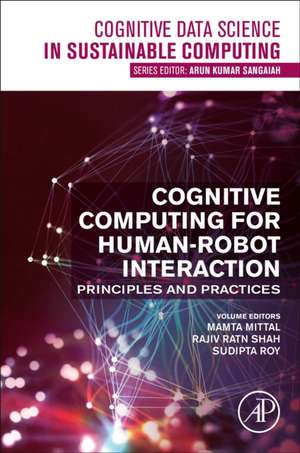
Cognitive Computing for Human-Robot Interaction: Principles and Practices: Cognitive Data Science in Sustainable Computing
Editat de Mamta Mittal, Rajiv Ratn Shah, Sudipta Royen Limba Engleză Paperback – 18 aug 2021
Adresat cercetătorilor, studenților postuniversitari și arhitecților de sisteme din domeniul inteligenței artificiale, acest volum colectiv oferă o perspectivă riguroasă asupra intersecției dintre calculul cognitiv și robotica sustenabilă. Notăm cu interes modul în care lucrarea depășește bariera teoretică, propunând implementări de lucru și arhitecturi deliberative coerente care vizează o interacțiune om-robot mai naturală. Reținem că pilonul central al cărții este utilizarea semanticii de nivel uman pentru a îmbunătăți sistemele de decizie ale roboților.
Structura este organizată progresiv: începe cu bazele calculului cognitiv și evoluează spre aplicații critice în sectoare precum sănătatea (recunoașterea activităților) și transportul inteligent (vehicule autonome). Capitolele dedicate semnalelor EEG și predicției stărilor cognitive prin deep learning subliniază o abordare tehnică avansată a interfețelor creier-calculator. Merită menționat că editorii Mamta Mittal, Rajiv Ratn Shah și Sudipta Roy au integrat aproximativ 150 de ilustrații care susțin rezultatele experimentale prezentate.
Cititorul care a aplicat ideile din Cognitive Computing Using Green Technologies de Asis Kumar Tripathy va găsi aici o extindere necesară către managementul cunoștințelor explicite în sistemele autonome, trecând de la procesele de auto-învățare la arhitecturi complexe de control. În contextul operei editorilor, acest titlu completează direcțiile explorate în Smart Technologies for Energy and Environmental Sustainability, mutând focusul de la monitorizarea mediului către sustenabilitatea socială prin intermediul roboților „umanizați”. Față de Intelligent Systems for Neurocognition and Human-Robot-Computer Interaction, volumul de față este mai ancorat în aspectele de middleware și cinematică aplicată, oferind soluții specifice pentru provocările actuale ale roboticii sustenabile.



Preț: 602.81 lei
Preț vechi: 990.99 lei
-39%
Carte tipărită la comandă
Livrare economică 20 noiembrie-04 decembrie
Specificații
ISBN-10: 0323857698
Pagini: 418
Ilustrații: Approx. 150 illustrations
Dimensiuni: 152 x 229 x 25 mm
Greutate: 0.56 kg
Editura: ELSEVIER SCIENCE
Seria Cognitive Data Science in Sustainable Computing
V-ar putea interesa
-
 Using Artificial Intelligence Absolute Beginner's GuideMichael Miller-20%Preț: 201.24 lei251.56 lei
 -
 In Robots We TrustSamuele Vinanzi-16%Preț: 147.25 lei175.17 lei
 -
 -20%Preț: 1437.53 lei1796.91 lei
 -
 Driving Intelligence: The Green Book: Routes to AutonomyJ. Mark Bishop-20%Preț: 297.95 lei372.44 lei
 -
 -20%Preț: 1371.39 lei1714.24 lei
 -
 Cognitive Computing and Big Data AnalyticsJudith Hurwitz-20%Preț: 302.05 lei377.57 lei
 -
 Agentic AI For DummiesPam Baker-20%Preț: 145.95 lei182.44 lei
 -
 The Essential Book of AIAnne Rooney-20%Preț: 76.61 lei95.77 lei
 -
 Advances in AI for Cloud, Edge, and Mobile Computing ApplicationsShrikaant Kulkarni-20%Preț: 1296.62 lei1620.78 lei
 -
 The Atomic HumanNeil D. LawrencePreț: 94.41 lei
 -
 Modern Approaches in Machine Learning and Cognitive Science: A WalkthroughVinit Kumar Gunjan-20%Preț: 1018.38 lei1272.98 lei
 -
 -20%Preț: 1238.99 lei1548.74 lei
 -
 -18%Preț: 1366.29 lei1666.21 lei
 -
 Raising Robots to be GoodRebecca RaperPreț: 194.01 lei
 -
 -20%Preț: 458.54 lei573.18 lei
 -
 -20%Preț: 676.33 lei845.42 lei
 -
 Recent Advances in Artificial Intelligence and Smart ApplicationsJyotsna K. Mandal-18%Preț: 1017.19 lei1240.48 lei
 -
 Human Motion Awareness and Robot TeleoperationHonghao Lyu-18%Preț: 1111.98 lei1356.06 lei
De ce să citești această carte
Pentru specialiștii în AI și robotică, acest volum reprezintă un ghid tehnic esențial pentru implementarea sistemelor cognitive. Cititorul câștigă o înțelegere profundă a modului în care semantica umană și datele biometrice pot fi integrate în controlul robotic. Este o resursă valoroasă datorită studiilor de caz pe vehicule autonome și asistență medicală, oferind instrumente concrete pentru a construi roboți capabili de interacțiuni complexe și etice în societatea modernă.
Cuprins
- Introduction to cognitive computing and its various applications
- Recent trends towards cognitive science: from robots to humanized robots
- Cognitive compyuting in human activity recognition by healthcare robots
- Deep learning-based cognitive state prediction analysis using brain wave signals
- EEG-based cognitive performance evaluations for mental arithmetic tasks
- Trust or no trust in chat-bots: a millennial dilemma
- Cognitive computing in autonomous vehicles
- Optimized navigation using deep learning techniques for automatic guided vehicles
- Vehicular middleware and heuristic approaches for ITS systems of smart cities
- Error traceability and error prediction using machine learning techniques to improve the quality of vehicle modeling in computer-aided engineering
- All about human-robot interaction
- Teleportation of human body kinematicss for a tangible humanoid robot control
- Recognition of trivial humanoid group events using clustering and higher order local auto-correlation techniques
- Understanding the hand gesture command to visual attention model for mobile robot navigation: service robots in the domestic environment
- Mobile robots for air quality monitoring of landfill sites using the Internet of Things
- Artificial intelligence and Internet of Things readiness: the inclination for hotels to support a sustainable envoronment
- Design and fabrication of a new multi-function smart trash bin based on the Internet of Things
Descriere
Cognitive Computing for Human-Robot Interaction: Principles and Practices explores the efforts that should ultimately enable society to take advantage of the often-heralded potential of robots to provide economical and sustainable computing applications.
This book discusses each of these applications, presents working implementations, and combines coherent and original deliberative architecture for human–robot interactions (HRI). Supported by experimental results, it shows how explicit knowledge management promises to be instrumental in building richer and more natural HRI, by pushing for pervasive, human-level semantics within the robot's deliberative system for sustainable computing applications.
This book will be of special interest to academics, postgraduate students, and researchers working in the area of artificial intelligence and machine learning.
Key features:
- Introduces several new contributions to the representation and management of humans in autonomous robotic systems;
- Explores the potential of cognitive computing, robots, and HRI to generate a deeper understanding and to provide a better contribution from robots to society;
- Engages with the potential repercussions of cognitive computing and HRI in the real world.
- Introduces several new contributions to the representation and management of humans in an autonomous robotic system
- Explores cognitive computing, robots and HRI, presenting a more in-depth understanding to make robots better for society
- Gives a challenging approach to those several repercussions of cognitive computing and HRI in the actual global scenario