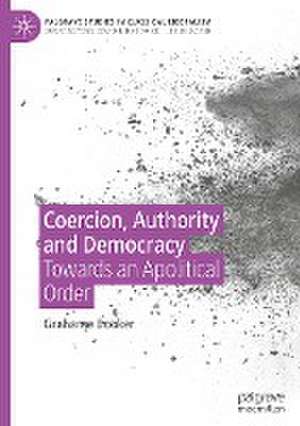
Coercion, Authority and Democracy: Towards an Apolitical Order: Palgrave Studies in Classical Liberalism
Autor Grahame Bookeren Limba Engleză Hardback – noi 2022
| Toate formatele și edițiile | Preț | Express |
|---|---|---|
| Paperback (1) | 750.58 lei 6-8 săpt. | |
| Springer International Publishing – 2 noi 2023 | 750.58 lei 6-8 săpt. | |
| Hardback (1) | 754.40 lei 6-8 săpt. | |
| Springer International Publishing – noi 2022 | 754.40 lei 6-8 săpt. |
Din seria Palgrave Studies in Classical Liberalism
- 15%
 Preț: 670.38 lei
 -
 Preț: 433.54 lei
 - 15%
 Preț: 560.36 lei
 - 15%
 Preț: 671.31 lei
 - 18%
 Preț: 701.14 lei
 - 15%
 Preț: 668.48 lei
 - 15%
 Preț: 669.59 lei
 - 15%
 Preț: 615.52 lei
 - 15%
 Preț: 670.38 lei
 - 15%
 Preț: 675.40 lei
 - 15%
 Preț: 668.61 lei
 - 15%
 Preț: 616.15 lei
 - 15%
 Preț: 676.35 lei
 - 15%
 Preț: 388.29 lei
 - 18%
 Preț: 695.27 lei
 - 18%
 Preț: 860.24 lei
 - 15%
 Preț: 507.06 lei
 - 15%
 Preț: 615.52 lei
 - 15%
 Preț: 614.11 lei
 - 15%
 Preț: 450.29 lei
 - 15%
 Preț: 460.21 lei
 - 15%
 Preț: 669.13 lei
 - 15%
 Preț: 673.53 lei
 -
 Preț: 371.37 lei
 - 18%
 Preț: 699.93 lei
 - 15%
 Preț: 618.83 lei
 - 15%
 Preț: 673.53 lei
 -
 Preț: 469.31 lei
 - 15%
 Preț: 665.50 lei
 - 18%
 Preț: 862.04 lei
 - 18%
 Preț: 962.30 lei
 -
 Preț: 379.15 lei
 -
 Preț: 242.85 lei
 - 15%
 Preț: 618.34 lei
Preț: 754.40 lei
Preț vechi: 920.00 lei
-18%
Puncte Express: 1132
Preț estimativ în valută:
133.35€ • 157.34$ • 116.46£
133.35€ • 157.34$ • 116.46£
Carte tipărită la comandă
Livrare economică 08-22 aprilie
Specificații
ISBN-13: 9783031168826
ISBN-10: 3031168828
Pagini: 300
Ilustrații: IX, 300 p. 1 illus.
Dimensiuni: 148 x 210 mm
Greutate: 0.52 kg
Ediția:1st ed. 2022
Editura: Springer International Publishing
Colecția Palgrave Macmillan
Seria Palgrave Studies in Classical Liberalism
Locul publicării:Cham, Switzerland
ISBN-10: 3031168828
Pagini: 300
Ilustrații: IX, 300 p. 1 illus.
Dimensiuni: 148 x 210 mm
Greutate: 0.52 kg
Ediția:1st ed. 2022
Editura: Springer International Publishing
Colecția Palgrave Macmillan
Seria Palgrave Studies in Classical Liberalism
Locul publicării:Cham, Switzerland
V-ar putea interesa
-
 -27%Preț: 904.00 lei1238.35 lei
 -
 HOW TO LEARN AGILE STEP BY STEPLoueh G. SonembergPreț: 310.63 lei
 -
 LEARN THE ART OF DROPSHIPPINGAmelia VandercorptPreț: 329.63 lei
 -
 -18%Preț: 1068.61 lei1303.18 lei
 -
 -18%Preț: 1077.53 lei1314.06 lei
 -
 5 CutsStephanie OurslerPreț: 144.53 lei
 -
 Verhandlungen in der AutomobilindustrieHanno GoffinPreț: 217.24 lei
 -
 Adam Smith and Yan Fu: Western Economics in Chinese PerspectiveCheng-chung LaiPreț: 239.67 lei
 -
 MUSINGS ON LEADERSHIPWilliam J. SingletonPreț: 100.44 lei
Cuprins
1. Introduction.- 2. Coercion.- 3. Authority.- 4. Democracy.- 5. The non-fallacy of anarchism.- 6. Conclusion.
Notă biografică
Grahame Booker is an independent researcher. He completed his PhD at the University of Waterloo, Canada and was Adjunct Assistant Professor in Political Philosophy. He has published in the International Journal of Prices and Markets and been a reviewer for the Canadian Journal of Philosophy and the Journal of Libertarian Studies.
Textul de pe ultima copertă
Classical liberalism has typically sought to maintain as much room as possible for the exercise of personal initiative in the face of the encroachment of states. This book explores these questions of coercion and authority in the context of the size and scope of the state and argues that the state and its agents should be held to the same moral rules as are the individuals it rules over. The book considers how a distinct feature of the state is its police or coercive power, about which one may ask how the state acquires it and what if anything would justify its use. It considers the implication that there is nothing inherent about state agents that entitles one to behave in ways that we would not accept from a private actor, and how once that argument is made, the state’s claim to authority is weakened. The author also discusses the extent to which democracy has been thought to provide any sort of justification for coercion or authority. This book will be of interest to academics and students of political philosophy, especially classical liberalism, and legal philosophy.
Grahame Booker is an independent researcher. He completed his PhD at the University of Waterloo, Canada and was Adjunct Assistant Professor in Political Philosophy. He has published in the International Journal of Prices and Markets and been a reviewer for the Canadian Journal of Philosophy and the Journal of Libertarian Studies.
Grahame Booker is an independent researcher. He completed his PhD at the University of Waterloo, Canada and was Adjunct Assistant Professor in Political Philosophy. He has published in the International Journal of Prices and Markets and been a reviewer for the Canadian Journal of Philosophy and the Journal of Libertarian Studies.
Caracteristici
Studies how a distinct feature of the state is its police or coercive power Considers how democracy has been thought to provide justification for coercion or authority Is of interest to academics and students of political philosophy